fat men

The Fat Detective and the Rogue Cowboy: Die Hard (1988, dir John McTiernan); Die Hard 2: Die Harder (1990, dir Renny Harlan)

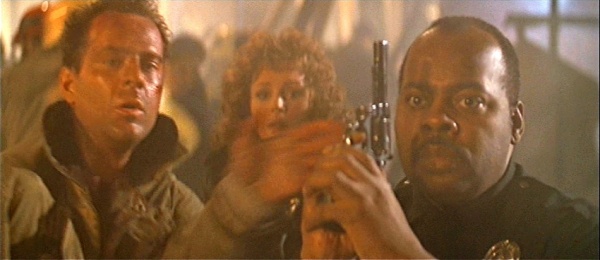
My last few posts have focused on male/masculine fat best friends.  Thus far I haven’t sought out films specifically for their portrayals of fat people– or, to be more accurate, I’ve been heard to whine “But I don’t wanna rewatch Bridesmaids”– so it’s not surprising that most of the films default to having male protagonists with another man, somehow coded as less heroic, in a support role.  I decided to lean into the trend and revisit the first two Die Hard films.  I first saw Die Hard and Die Hard 2:  Die Harder a few years ago; while I wasn’t actively looking at the role that body size plays in the character dynamics, I found the developing bromance between John McClane (Bruce Willis) and Al Powell (Reginald VelJohnson) to be one of the more intriguing parts of the film.

As we’ve seen in previous films, McClane and Powell form a contrasting duo; the differences between them go beyond body type and race.  Both are archetypal cop characters, but from opposite ends of that spectrum.  McClane is a fiercely independent male power fantasy.  Explicitly identified with cowboys, he’s the rogue agent who breaks all the rules because his ideas are invariably more effective than the protocols set by those in power.  Even his personal life finds him bristling against cooperation: he has become estranged from his family because of his reluctance to leave New York after his wife Holly (Bonnie Bedelia) lands a great job in Los Angeles.  There were several reasons that I prefer the original movie to the sequel, which isn’t surprising in and of itself, but the most unexpected reason was that I don’t find McClane nearly as interesting when he’s put in a situation that requires teamwork.  It’s somewhat surprising that he outranks Powell by the second film. 

McClane is defined by his profession, but specifically by being part of the NYPD.  New York City as part of McClane’s identity is an expression of regionalism, but it also seems to be an inherent part of his stubbled, streetwise masculinity.  He is out of place at the Nakatomi Christmas party, especially when another man greets him with a kiss on the cheek, and is practically a different species than Ellis (Hart Bochner), Holly’s smarmy, coke-snorting coworker.  The film portrays association with LA as a symptom of a character being phony and weak:  after moving to LA, Holly goes by her maiden name; McClane has a much harder time gaining respect with his LAPD badge in Die Hard 2.   Even the local news team turns into a minor antagonist, as reporter Richard Thornburg (William Atherton) forces himself into the McClane home for the sake of his scoop.

McClane’s likability and authenticity comes not only from Bruce Willis’ charisma, but from his alliances with average joes, especially black men.  McClane is initially characterized as an unpretentious populist by making friends with his limo driver Argyle (De’voreaux White)– naturally, he sits shotgun and puts his kids’ giant teddybear in the back seat where the LA phonies ride.  In the sequel, McClane forms an alliance with nerdy director of communications Leslie Barnes (Art Evans).  However, he is more brusque with other average joe characters: possibly due to the stress of having so many people standing between him and the bad guys, or a change in director and writing team, but it may be that LA is rubbing off on McClane.  However, the role of Grounding Black Friend is fulfilled most strongly by Sgt. Powell, both in terms of the depth of their relationship and by balancing out the milieu of upper class white LA.

Powell is a by-the-book cop, representing the everyman who supports and roots for McClane.  He isn’t as phony as the other LA-based characters, but he is an emasculated figure.  His lack of power is visually manifested through fat stereotypes; in both Die Hard and Die Hard 2, he is introduced by an armful of Twinkies.  In the first film, he tells a convenience store cashier that the Twinkies are for his pregnant wife, which is met with skepticism.  McClane is also introduced while fulfilling a paternal role– wrangling a giant teddy bear for his children– but flirts with a pretty flight attendant in the process.  Powell doesn’t have the skilled action hero control of McClane:  he doesn’t realize that the Nakatomi Tower is overrun by bad guys until McClane throws one of them onto the hood of his cop car.

 reginald veljohnson, die hard, al powell, powell, sgt powell, twinkies

Powell is sensitive and emasculated when compared with McClane, but his sensitivity also serves as a strength, in line with the fat detective trope.  Not only does Powell form a correct hunch that McClane is a cop, but he does so after one brief conversation. Deputy Chief of Police Dwayne T. Robinson (Paul Gleason), Powell’s superior, arrives just as this conversation ends.  His approach to the as-yet-unnamed McClane is cautious, but the audience is more attuned to the need for immediate action:  his blowhard skepticism reads like a waste of precious time.  Powell also proves himself to be a step ahead of Robinson when he correctly surmises that the terrorists are shooting at the cops’ floodlights, which Robinson loudly repeats as his own revelation once the lights are starting to shatter.  However, Powell is a team player.  While he directly disagrees with Robinson, he ultimately lacks McClane’s ability to undermine authority.  At one point, Robinson interrupts Powell and McClane’s conversation, snatching the radio from Powell’s hand.  Powell grimaces at the affront, but says nothing.  McClane, on the other hand, responds to Robinson’s demand that the LAPD take over by calling him a “jerkoff” and demands that he give the radio back to Powell.

Powell’s fat detective sensitivity also facilitates the growth of his relationship with McClane.  The initial conversation where Powell establishes that McClane is a cop is also enough for them to decide not only to trust each other, but to form an alliance; by their first sign-off, they are calling each other “partner.” The two partners provide each other with necessary information, but Powell also provides the moral support McClane needs, including making McClane laugh by reciting the ingredients of a Twinkie and telling him “I love you, and so do a lot of the other guys down here.”

It’s worth noting that the majority of Powell and McClane’s relationship takes place via radio; they are essentially two voices connecting with each other.  In the context of a mainstream action film, McClane is white and athletic, aspects of a default representation of legitimacy.  Not so for Powell, who is marginalized as a fat person and as a black person.  However, on the radio, Powell is separated from the aspects of his corporeality that could otherwise detract from McClane viewing him as legitimate.  We see the different ways McClane and Robinson treat Powell; we could chalk it up to McClane being a heroic everyman and Robinson being a blowhard boss, but it’s worth considering the fact that McClane is separated from the preconceived notions that are inexorably tied to Powell’s body.

The most obvious marker of Powell’s lack of (masculine) power is that he’s been put on desk duty because he has lost his ability to shoot his gun, following an incident where he accidentally shot and killed a kid.  He triumphantly regains the ability to fill a human body with bullets at the end of the film, when it means defending McClane from the final bad guy. Even if the scene is a black cop killing a homicidal Aryan, in light of the recent publicized lack of accountability from police departments for police brutality, it’s very uncomfortable to consider that regaining the ability to kill is considered a happy resolution to Powell’s character arc.
reginald veljohnson, mcclane, bruce willis, powell, al powell, john mcclane, die hard

Despite having his masculinity redeemed through his friendship with McClane at the end of Die Hard, Powell fills the same role of less masculine, more cooperative foil in his brief appearance in Die Hard 2.  He faxes a criminal background check to McClane as he chews on a Twinkie, gently laughing at his friend’s refusal to “wake up and smell the 90s” and learn how to use the technology that has become a basic tool of his profession, untameable cowboy that he is.  And again, Powell is more of a friend to McClane than the other law enforcement in the film, notably Captain Lorenzo (Dennis Franz), the head of airport police who impedes McClane’s process every step of the way, along with his brother Sgt. Lorenzo (Robert Costanzo).  Both of the Lorenzos are fat; McClane calls Captain Lorenzo a “fat ass” during their unending tennis match of insults.  All three fat characters are shown as ineffectual cops when compared to McClane; the Lorenzos’ ineffectiveness comes from complacency and arrogance, treating McClane rudely while failing to see the big picture.  Captain Lorenzo initially describes himself as a “big fish” in a “little pond,” but towards the end of the film, he is dismissed as a “bureaucrat.”  He is unable to see reality; namely, that John McClane, Supercop is in his airport trying to foil an unfolding terrorist plot.  Powell, on the other hand, realizes what’s going on, but isn’t able to garner the respect needed to convey it to those around him.

dennis franz, die hard 2

Captain Lorenzo and Powell are both fat men who are socially inappropriate.  They have character arcs where the begin their film with problematic relationships to their profession that are ultimately corrected through their association with McClane.  Powell is initially deferential and emasculated (relative to the world of male power fantasy), but finds the strength to argue with his superior in order to advocate for McClane, and then the ability to shoot his gun in order to defend McClane.  Lorenzo, on the other hand, is rigid and arrogant, but is eventually humbled when McClane proves the worth of his disorderly methods.  I see race as the more component of the difference in these fat characters’ trajectories.  McClane spends Die Hard and Die Hard 2 clashing with power-hungry white men (whether military-trained terrorists or jagoff yuppies) and building alliances with salt-of-the-earth black men.  We know that he will never become the former because of how he treats the latter, and the latter ultimately exist to accessorize McClane’s quests.  The politics of fat in Die Hard cannot be separated from similar questions about the politics of race.

Fatness and Class in Planes, Trains & Automobiles (1987, dir. John Hughes)

I watched Planes, Trains & Automobiles for the first time ever this weekend; not only did it make me feel more confident in my decision to forego the trip from Chicago to New York and back for the holiday weekend, but it gave me a chance to take in one of the best beloved performances from fat character legend John Candy.  PT&A is a simple premise that spins wildly out of control: Neal Page (Steve Martin) is a marketing executive who is trying to get back home to Chicago from NYC on the Tuesday before Thanksgiving.  He’s going to make a 6 pm flight, until things Go Awry, due in equal parts to bad luck and Del Griffith (John Candy), a bumbling shower curtain ring salesman.

Del embodies so many facets of an archetypal fat guy, watching this film made me wish I had a Bingo card with size-based stereotypes in the squares (coming soon from Panda Bear Shape Industries™).  He’s uncouth, messy, clumsy, and sponges off Neal.  He is frequently snacking and overburdened by materiality, specifically his massive trunk.  His wardrobe isn’t too loud on its own (except those pajamas), but he does tend to look unstylish and frumpy next to his traveling companion’s tailored grey business attire.

planes trains and automobiles, steve martin, neal page, john candy, del griffith

Despite these shortcomings, Del is also optimistic, friendly, and a savvy traveler.  The combination of wanting to help and having specialized knowledge ultimately make him indispensable to Neal, and thus does our thin, straight-laced protagonist gain a loose cannon fat best friend.

Both Neal and Del are straight white dudes, not uncommon for two main characters in a film from the US, but some of the tension between them lies in class (reflected in their differing body sizes).  Neal starts the film in an executive boardroom in midtown Manhattan, whereas Del is a travelling salesman.  Both men are shown to have strengths and faults due to their social standing.  Whereas Neal is shown to have a happy, stable home life and has the literal capital to fund most of their adventure, he is also judgmental and rude, angering people who would otherwise be able to help him.  Del is crude and graceless, but also charismatic, seemingly having friends all over the travel industry and getting an entire bus of strangers to participate in a sing-along.

I hope PT&A would be a very different movie if it were made today (and not made by John Hughes), in that I hope it would not be almost exclusively from Neal’s point of view.  It seems like a specifically 80s choice to assume that the audience would be able to identify an uptight, entitled yuppie whose blonde nuclear family is so pristine they might as well be shrink wrapped.  The story can easily be seen from Del’s point of view, as the film readily concedes in one of the best-acted, pivotal scenes in the film.

Having reached a breaking point, Neal rants at Del about his shortcomings, especially his tendency to tell boring stories.  Leading up to his speech, Del tells Neal that he’s “intolerant” and a “tight-ass.”  There are several closeups of Del’s reaction, a truly heartrending mix of indignance and hurt.  It’s unsurprising that this performance is often considered Candy’s best.  His simple, dignified response is the kind of thing I’d want in needlepoint over my front door: “…You think what you want about me, I’m not changing. I like me.”   Del even gets a stirring backup of Heartfelt Speech Synth Music, whereas Neal’s opening attack was strictly solo.  The camerawork, on the other hand, suggests that the audience identify more closely with Neal.  Their exchange is a series of angle and reverse-angle shots.  During the bulk of Neal’s monologue, the camera shows both men in medium close-up shots; eventually, the shots of Del are slightly closer, bringing into focus the pain and vulnerability in his eyes.  Having spoken his piece, Neal breaks this static stance and turns away from Del (and the camera), but Del remains in slightly zoomed in close-up when he begins his response.  During his speech, the camera repeats the pattern, but starts with a comparable close-up to Neal before progressing much more quickly to an extreme close-up of his face, full of shame and regret.  Del’s parting line allows him to move away from the camera into a full body shot, and back into bed, but Neal remains in closeup for another few shots, as he wordlessly shows his remorse and acceptance of Del by deciding to stay in their shared room for the rest of the night.  Visually, the scene is focused on Neal developing empathy for Del, even though Del’s self-defense and assertion of his dignity could have been just as compelling a focus for the scene.  But Neal has been designated as the character through whom the audience vicariously experiences the film, and Hughes has deemed in necessary for both Neal and the audience to be explicitly reminded by through a powerful speech that Del is a human being who deserves respect and compassion.  It’s truly an effective scene, but as a viewer who readily identifies with fat schlub characters, it’s unnerving to think about the necessity of the scene’s function.  Maybe I should keep a little speech like that in my wallet.

Ultimately, the film is about Neal’s emotional journey, both in travelling from his professional life to his family life (a few lines about neglecting his family in favor of work are shoehorned in here and there) and in coming to accept Del, despite his crass ways.  The movie climaxes with Neal’s return home, significantly, with Del in tow.  By the end of the film, Del has become singularly focused on getting Neal home in time for Thanksgiving dinner; after they arrive to Chicago, it is revealed that Del literally has nowhere to go, and sitting at the same L stop where Neal leaves him.  Neal’s newfound empathy clues him into this, and it is Neal’s choice to include him in a relationship with actual significance; otherwise, having helped Neal achieve his initial goal, Del’s function as a character in the story is complete.  For all we know, he would have sat at Van Buren and LaSalle indefinitely until another rich person in minor peril came along.  Even Del’s admission to Neal that he is a homeless widower doesn’t have the same build of energy as Neal’s reunion with his wife, who is barely a character; the hook of the song that’s playing is “Everytime you go away you take a piece of me with you,” seemingly the sentiment that Neal’s wife feels for him.  The last shot is of Del, smiling as he witnesses the reunion he has helped to bring about.

This is a film that gives us a fat character who is sweet, clever, and keenly aware of his self-worth, but ultimately less complete and presumably less relatable than the thinner, wealthier protagonist.  As is often the case with best friend characters, especially ones from marginalized groups, a character who is otherwise interesting and likable on their own is ultimately dependent on their usefulness to the main character.

Fat Guys Trying to Survive Horror Films: Abbott & Costello Meet Frankenstein (1948, dir. Charles T. Barton); Tucker & Dale vs. Evil (2010, dir. Eli Craig)

“I shoulda known if a guy like me talked to a girl like you, somebody’d end up dead.”  –Dale, Tucker & Dale vs. Evil

“It’s a little past sunset. And if Dracula’s here, he’s gonna want breakfast. And I’m fatter than you, and it ain’t gonna be me.”  –Wilbur, Abbott & Costello Meet Frankenstein

The comic duo composed of a fat and thin character is a common trope in Western cinema, and has been for a long time.  The thin character is usually smart and quick-tempered; the fat character tends to be meek and simple-minded (either unintelligent, naive, or both), but also tends to be the source of humor, whether through a savant sense for one-liners, propensity for pratfalls, or outlandish eccentricities.  One of the most famous and most illustrative pairs of this kind is Abbott and Costello, who started out as a Vaudeville act and went on to star in more than 30 films together.  Several of their films are horror-comedy, the first of which is Abbott & Costello Meet Frankenstein, putting the hapless duo in a story filled with supernatural threats.  Most of the fun comes from seeing them in way over their heads, coming to the realization that something is up and trying to figure out what’s going on.  62 years later, the same basic dynamic of two disparately-sized Joe Six Packs inadvertently stumbling into a horror film scenario plays out in Tucker & Dale Versus Evil.  Although both horror and comedy have changed enough in the intervening years to make some significant differences in the dynamic between the characters, there’s also a lot that hasn’t changed for respective fat guys Wilbur Gray (Lou Costello) and Dale Dobson (Tyler Labine).

Dale and Wilbur are both the sole fat characters in their respective films.  Wilbur is directly labeled as the fat guy: his size is directly mentioned in several jokes (e.g. Wilbur says he’s “floating in love,” Chick responds by calling him a “blimp”).  Dale’s size is not directly referenced, but is part of a few typical fat-person sight gags (e.g. inappropriately-timed nudity, falling on his friend) and is arguably a part of his insecurities.  Chad, his main college kid nemesis, has an athletic physique.  Tucker tells his friend to have more confidence, but Dale responds that he’s always had an easier time with the ladies.  (It’s never stated directly that Dale is referencing Tucker’s physique, but they did cast Alan Tudyk…)

The dynamic between the two friends at the center of each movie is very similar. Chick Young (Bud Abbott) and Tucker– the thin friends– are both more practical and strong-willed than Wilbur or Dale, and often take the role of leader.  Both Dale and Wilbur are more passive, but the films interpret that in different ways.  Dale’s lack of assertiveness is due to an “inferiority complex,” as Tucker describes it:  if Dale gains confidence, then he will be able to stand up for himself and flirt with women.  Tucker acts like an older brother to Dale, giving him advice and emotional support when he feels bad about himself, such as his initial failure to talk to beautiful college student Allison (Katrina Bowden).  Dale privileges Tucker over his own interests, such as pretending to like fishing because it allows him to spend time with his friend.

Wilbur’s weakness, on the other hand, is an immutable personality flaw, something that is practically part of his biology.  Dracula (Bela Lugosi) is plotting to put a fresh brain in Frankenstein’s Monster (Glenn Strange) in order to make him a compliant servant; Wilbur is being targeted as the donor because he has an “obedient” brain with “no will of his own, no fiendish intellect to oppose his master.”  Chick acts more like a boss, ordering Wilbur around and trying to rein in his unruly behavior.  Wilbur relies on Chick for physical protection, wailing his friend’s name whenever he’s frightened (of course, this results in the monsters removing themselves from the scene by the time Chick arrives).

Dale’s and Wilbur’s love interests are essential to the plots of both films, and both involve them mooning over women who are intelligent and conventionally beautiful, but again we see the similarities end there.  At the beginning of Tucker & Dale vs. Evil, the differences between Allison and Dale are highlighted.  College students like Allison “grew up with vacation homes and guys like me fixing their toilets,” Dale argues early in movie, explaining why he won’t approach her.  But just as Allison is convinced by her friends that Tucker and Dale are evil sadists because they look like villains from movies like Deliverance, Dale’s first impression of her is also a stereotype, and he discovers that she is a tomboy who grew up on a farm and likes bowling. Both Dale and Allison are the moral centers of their respective groups; Allison encourages her friends not to judge the locals of the rural area they’re camping in, while Tucker complains that Dale led them into a fiasco by being “a good Samaritan.”  The growth of their relationship, as much as the string of mishaps and misconceptions that make the titular characters look like serial killers, are the film’s evidence against judging a book by its cover.

tyler labine, tucker and dale vs evil

Wilbur’s love life is the inverse.  In the beginning of the film, Wilbur is dating the beautiful Sandra (Lenore Aubert).  The audience soon discovers that her affection is too good to be true: Sandra is working with Dracula to revive the Monster, and wants to use Wilbur in their experiment.  Later in the film, another beautiful woman, Joan (Jane Randolph), also professes love for Wilbur.  Without pausing to question her motives, Wilbur blithely tries to juggle relationships with both women, even bringing them to the same costume ball.  Joan, however, is also using Wilbur in an attempt to discover Dracula and the Monster’s whereabouts. While revisiting these films to write this piece, I imagined a young Dale watching Abbott & Costello Meet Frankenstein and internalizing that it is foolish for a fat person like himself to consider a viable relationship with someone “out of their league.”

lou costello, abbott and costello meet frankenstein

The differing dynamics between friends is also reflected in how the thin friend reacts to their fat friend’s romantic inclinations.  Chick repeatedly expresses skepticism that women like Joan and Sandra could be attracted to a guy like Wilbur, and tries to talk Wilbur into “sharing,” despite the fact that both women are disinterested in him. Tucker is occasionally frustrated that his friend chooses to woo Allison instead of help with renovations to their cabin, but ultimately he supports and encourages his friend.

Chick and Wilbur find themselves the victims of an objective threat– Dracula, Frankenstein, and the Wolfman (Lon Chaney Jr.) are all very real in their world– while Tucker and Dale are largely threatened due to subjective interpretation: the college kids see a scenario they and the audience associate with horror films and map their ghoulish expectations onto it, fueled by Chad’s prejudice against hillbillies and forceful positioning of himself as an anti-hero.  For much of Abbott & Costello Meet Frankenstein, Wilbur sees the monsters in their supernatural form and tries to convince skeptical Chick that they are real.  Lawrence Talbot (aka the Wolfman) warns Chick and Wilbur of the oncoming supernatural threat, but Wilbur is the one who sees him first in his werewolf form.  Wilbur also resists becoming part of Team Dracula, as he twice averts his gaze from a hypnotizing vampiric gaze and narrowly misses becoming part of the Monster when he is saved by Chick and Talbot.  Dale, on the other hand, tries for much of the film to be seen as benign when he is misjudged as a threat, even going so far as to sit down for a mediated discussion over tea with Chad to hash out their differences.  Eventually, though, he must conform to the college kids’ perception of him as a “psycho hillbilly” in order to save his friends and defeat Chad, who is the real source of danger to the other characters.

Seen in conversation with each other, Abbott & Costello Meet Frankenstein and Tucker & Dale vs. Evil show a progression of attitudes with regards to their fat protagonists.  Wilbur is static, as foolish at the end of the movie as he is in the beginning.  His body is a marker of his personality traits, marking him as objectively unattractive and inherently less dignified than the other characters.  At the beginning of Dale’s story, he perceives himself as the audience perceives Wilbur.  However, Dale lives in a world where perception can be changed and corrected.  His body and appearance never change, but he is able to change his persona through how he presents himself and how others see him, going from diffident fat friend to “killer hillbilly” warrior to romantic hero.

Fat at a Movie Marathon

[CW: discussions of violence and sexual assault]

There are a fair amount of spoilers in this post; if that’s a concern, click on the provided link to see what films I’ll be talking about.

This weekend I attended [most of] the 10th annual Music Box of Horrors, a 24-hour marathon of horror films from across the world and history of film.  It’s only my second time attending, and it’s been great fun both times.  Instead of doing a separate post for each movie– which would take a long time and I am so very, very tired– I’m opting to give a brief rundown of fat representation in this year’s lineup, to document my experience as a fat audience member.  For extra fun, I’ll include my favorite moments of misandry, as I was pleased to note that a good number of the movies in this year’s lineup had interesting and kickass female characters.

The Phantom Carriage (1921, dir. Victor Sjöström): no fat characters.

The Man They Could Not Hang (1939, dir. Nick Grinde): we skipped all but the last 15 minutes in the interest of getting lunch, but no fat people in the part I did see.

Cat People (1942, dir. Jacques Tourneur) no fat characters.
Misandry Moment: slimy psychiatrist refuses to stay friendzoned by his patient (ick), she turns into a panther and mauls the crap out of him.

The Curse of the Werewolf (1961, dir. Terence Fischer) Leon, the main character, has a fat best friend.  Jose is his cheerful, hedonistic coworker; he suggests that the two of them spend their wages at a brothel.  Unfortunately, Leon turns into a werewolf and mauls the crap out of him.

The Borrower (1991, dir. John McNaughton) in a group of potentially victimizable young people:  a heavy metal (I guess) band is shown filming a music video of a song about how they want to kill their parents.  The fat lead singer is an egomaniacal bully; when they hear the neighbor’s dog barking, he goes out to the backyard and sprays it down with the garden hose, laughing all the while.  However, the neighbor’s dog is actually the titular serial killer alien, who kills the fat lead singer.  (This was a weird one.)  His bandmates survive unharmed, while…
Misandry Moment: …the young person who has their shit together enough to load a gun and blast a hole in the baddie is the band’s camerawoman.  Also at least three scenes of a female cop shooting and beating up a rapist.

Nosferatu the Vampyre (1979, dir. Werner Herzog) no fat people.
Misandry Moment: this film follows the classic Dracula story, except that Lucy is the one who is solely responsible for killing the vampire, while Dr. Van Helsing is a skeptical milquetoast.

Dead Snow 2: Red vs. Dead (2014, dir. Tommy Wirkola) no fat people.
Misandry Moment: a professional zombie killing team that is two-thirds women, raising the film’s undead Nazi body count with shovels, shears, and homemade fertilizer bombs.

I went home for a few hours’s sleep, but stalwart Patrick stayed the whole night.  His not-entirely-awake testimony is as follows:

Nightmare, aka Nightmares in a Damaged Brain (1981, dir. Romano Scavolini) no fat people.

Shakma (1990, dir. Tom Logan) no fat people.

Don’t Look in the Basement (1973, dir. S.F. Brownrigg) Takes place in a psychiatric hospital; some of the patients are fat.

The marathon also plays shorter pieces in between the features; a short at one point overnight there was a screening of “Space Werewolf”, which features a fat protagonist.

I returned for the last two features:

Just Before Dawn (1981, dir. Jeff Lieberman)  My cup runneth over.  The bad guys are fat psycho hillbilly twins, terrorizing and murdering a group of sexy young campers.  The sexy young campers are given harbingers in the form of a large-bodied park ranger (George Kennedy) who eventually comes to their rescue, and a hillbilly family comprised of a friendly but shy waif daughter, a hostile old dad, and a fat mom in an ill-fitting dress who isn’t given much to do except remind the audience that hillbillies are grotesque, I guess?  The first killer twin to die is shot by Ranger Kennedy and falls on top of the Final Girl who he is attacking, leading some of the audience to vocalize disgust.  It’s pretty gross to have a bloody corpse fall on you, but I feel like the disgust factor was heightened by the fact that the corpse in question is a fat man who looks like he hasn’t bathed in a while.
Misandry Moment: the Final Girl rams her fist down the second killer twin’s throat and chokes him to death while her traumatized boyfriend cowers in the background.  One of the campers is murdered after he mansplains a rope bridge in the forest to the girl who lives in the forest and has presumably had her entire life to figure out the rope bridge.

Audition (1999, dir. Takashi Miike)  no fat people.
Misandry Moment: it’s Audition.

There weren’t any surprises as far as representation of fat people goes.  While nothing was grossly fatphobic, most of the films didn’t incorporate fat characters, and the fat characters that did appear were pretty typical, and in small supporting roles.  Hopefully I’ll end up seeing a horror film with a meatier (ha) role for a fat person that I can write about before Halloween; if I have to resort to writing about Tucker and Dale vs. Evil, one of my favorite horror films, so be it.

Fat Fuck: Nymphomaniac (2014, dir. Lars von Trier) and Concussion (2013, dir. Stacie Passon)

[CW diet talk, discussion of consensual sex]

Two recent films, Nymphomaniac and Concussion, spend ample time exploring the marginalized sexualities of their (thin) female protagonists. Joe (Charlotte Gainsboug/Stacy Martin), the titular character of von Trier’s epic, labels herself as a nymphomaniac and constructs her life around her insatiable libido; Abby (Robin Weigert), the heroine of Passon’s directorial debut, is a lesbian who subverts her life as a mainstream upper middle-class homemaker by involving herself in sex work. Both women have fat sex partners over the course of their respective stories, neither of whom function as a source of comedy or disgust.

A common observation of fat characters is that they possess an inappropriate sexuality relative to thin characters in the same film, either lacking in sexual desire or experience (based on the assumption that nobody wants to have sex with fat people) or being too assertive or indulgent with regards to their sexuality (based on the assumption that fat people desire more and control themselves less than thin people). Fat people in movies are often treated as de facto repugnant or pathetic, but even more so when they are seen as sexual beings. A portrayal of fat people experiencing lust the same as thin people, even being accepted as a thin person’s lover, is enough to make these movies stand out as unusually fair-minded with regards to body diversity. However, both F and Woman #1 are portrayed as less exciting than their thin counterparts, and evoke a sense of family and domesticity, elements which the protagonists of both films are trying to avoid or escape.

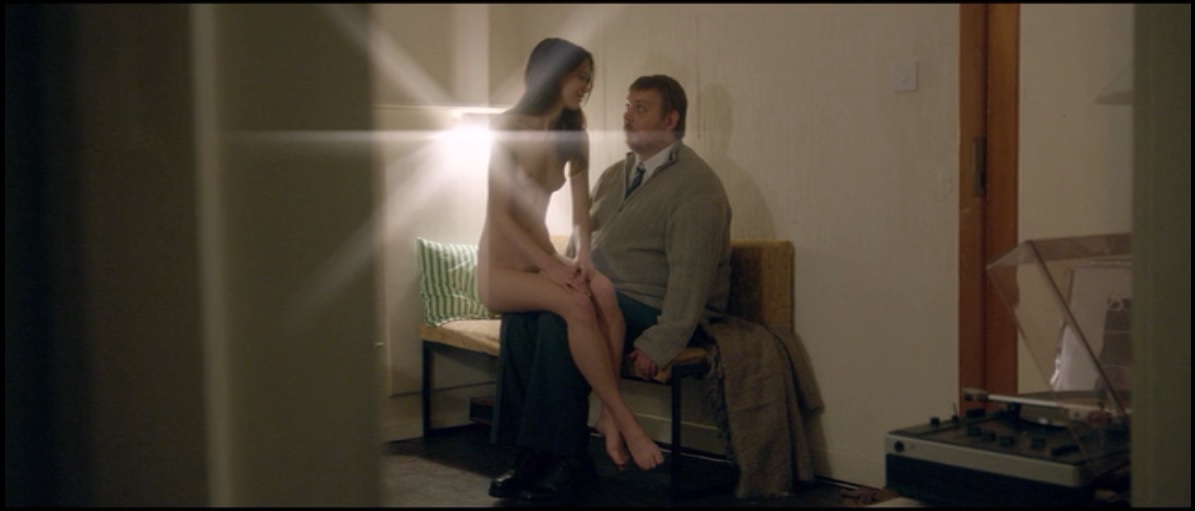
Nymphomaniac presents a series of flashbacks, where Joe relates her story Seligman (Stellan Skaarsgard), an asexual bookworm who compares the details of her life to his various intellectual pursuits. As the title suggests, a large portion of these flashbacks deal with Joe’s sex life. Nearing the end of Volume 1, almost 2 hours in, I found myself getting bored with scene after scene of Joe having rather vanilla sex with male partners, mostly young and thin. F’s arrival was perfectly timed. Joe describes a time when her sex life was a perfect balance of harmonizing elements, like a polyphonic organ piece, with F (Nicolas Bro) as the bass voice. If memory serves, this is the first time we see someone go down on Joe, shown in extreme closeup. F focuses on Joe and her satisfaction. “Without words, he knew exactly what I wanted, where he should touch me and what he should do. The most sacred goal for F was my orgasm.” Because he is so trustworthy and stable, Joe privileges him with activities she does not her other sexual partners. While she explains this in voice over, we see him gently washing her in a bathtub.

nicolas bro, nymphomaniac, stacy martin

The entire time we see Joe and F together, he is clothed and she is naked, heightening the contrast between their ages and body sizes. F is not Joe’s only extragenerational partner, but he is certainly the most paternal. Immediately after seeing them have sex, we cut to an image of Joe sitting on F’s lap, giggling as he tells her a fairytale. F’s arrival in Joe’s story immediately follows the death of her father (Christian Slater); perhaps it is not coincidental that she would so fondly remember a lover who would be “reassuring” and a “foundation,” while so strongly feeling the absence in her life of her dad, who provided her with a sense of security and consistency. F also contrasts with H, a previous lover of Joe’s who leaves his wife and children– his role as a father– to be with her. We have no information of who F is outside of his relationship with Joe, but if he is a father (or some other form of caregiver), he manages to merge the elements of that identity with being Joe’s lover.

F is accepting of Joe’s multiple partners and is actively in deference to her lifestyle, as he often arrives early and patiently waits for her in his car (which was bought used, she points out) with a bouquet of flowers, or in Joe’s living room while she has sex with someone else in the bedroom. F’s patience an example of one of Nymphomaniac‘s strong points: the refreshingly personal and straightforward portrayal of deviations (so to speak) from normative sexuality: monogamous, possessive, not extractable from idealized romantic love. However, F seems emasculated and powerless when Joe compares him to the other members of Joe’s sexual polyphony– and this comparison is explicitly illustrated, in split screen. G (Christian Gade Bjerrum), designated the second voice, is “the only one [Joe] had to and wanted to wait for.” Instead of arriving early, G stands on her threshold when she invites him in, entering as he pleases. Joe finds this exciting because it takes away her control of the situation; she compares G to a predatory wild cat. The sex that she has with G is rough and feral, polarized from F’s “predictable” lovemaking. The two create a spectrum of sexual experience that is beyond limited descriptions of a binary of straight/gay (sometimes expanding to dominant/submissive). As we see an image of a leopard killing a deer, representing G, we also see F waiting in his car for Joe to see him. In between these two is the cantus firmus, Jerome, the closest character to a typical One True Love a viewer might expect to see in a film that focuses on a woman’s love life. These series of images also show Joe’s face while she has sex with them. With G she is wantonly excited; with Jerome she seems transported by the intimacy and soulfulness of their lovemaking; but with F she appears placid and peaceful.

nymphomaniac, lars von trier, stacy martin, shia la boeuf, nicolas bro

Joe describes F as essential to her happiness, but ultimately unsatisfying on his own; Jerome, however, she entreats to “fill all [her] holes,” to complete her, and the fate of the film brings them back together again and again. Even if F displays generosity beyond her other lovers and is seemingly supernatural in his ability to anticipate her desires, what he offers is ultimately incomplete on its own.

Concussion‘s opening sequence is composed of voice overs of women talking about maintaining their aging bodies and images of a gym, showing a spin class of fit women in slow motion, sneaking competitive glances at each other. The film is about a lot of things– queer assimilation, aging– but the body is a prominent and recurring theme. Abby’s dissatisfaction with her life as a stay-at-home is brought to a head by a concussion she suffers accidentally at the hands of her son; there is an early scene of her running on a treadmill until she vomits. She deals with the dissatisfaction by going back to work in New York City, then patronizing sex workers, then finally becoming a sex worker herself, seeing women clients at the condo she is renovating. Like her protagonist, director Stacie Passon is a lesbian, and Concussion does step away from the normative male gaze in some significant ways, including showing sex between women who do not have all the characteristics required to be a woman with a sex life by most films. Some of the women Abby has sex with are older, some have extensive tattoos, one client has a mastectomy scar, and– in case you haven’t guessed where I’m going with this– another is fat.

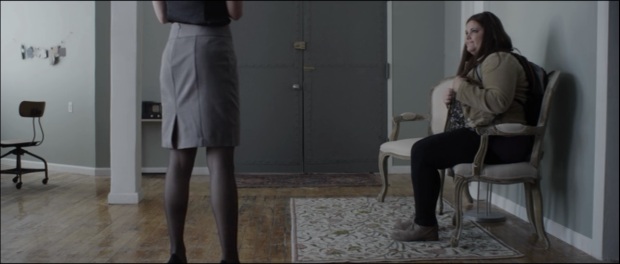
Abby’s fat client (Daria Rae Feneis) is only known as Woman #1, all clients of Abby’s only being referred to by numbers. It would be easy to see someone patronizing a sex worker as a sign of their inability to attract a partner without the exchange of money, and that sex workers will do anything (or anyone) as long as they’re paid. However, the film makes clear that Abby wants to have sex with Woman #1. Abby is very particular about her clients: she is not willing to go to their homes, and she insists on having coffee with them first, even though The Girl (Emily Kinney), her manager, screens them. Abby even rejects her first potential client for doing homework while she waits for their rendezvous. Abby wants to have sex with Woman #1 as an individual, not solely because she wants (or needs) the money.

daria feneis, concussion

Woman #1 embodies some characteristics often seen in fat film characters. She initiates the conversation awkwardly, talking about a Women’s Studies class she is taking where she has to draw her vulva and talk about her drawing in every class. She even brings a folder of these drawings to show Abby, who politely declines, recreating a common dynamic in films where a fat person’s social inappropriateness is highlighted or regulated by a thinner person. (Slight tangent: as someone who has taken over a dozen Women’s and Gender Studies courses– none at NYU, granted– this class exercise strikes me as absurd.) Women #1 describes drawing her vulva as having a force field around it, because she is 23 and has never had sex or even been kissed. The character comes across as shy and awkward (although she is very pretty), and her lack of experience is never explicitly linked to her weight, but given the setting and sexual/relational experience of the other characters, her late-bloomer status sticks out like a sore thumb. Women #1’s appointment with Abby– a first time for both of them– is quietly drawn out with tension and tenderness. Abby reassures her that she doesn’t have to do anything, can stop at any time, and Abby will do things that she wants to do. Woman #1 is still awkward, however; she neglects to take off her backpack, and after their kiss, she remarks that Abby “smells like oranges.”

During a subsequent visit, Abby finds the ingredients for a Master Cleanse in Woman #1’s bag, which her mother has given her to “start [her] off.” Abby assumes a maternal role in this scene, overriding Woman #1’s mother’s influence by giving her three books to read: Simone de Beauvoir’s feminist classic The Second Sex (“the Bible”), a book on vegetarianism, and a collection of Gandhi’s writings, which Abby describes as “an excellent book for weight loss.” (Another slight tangent. Overall I liked this movie, but the script rubbed me the wrong way at times, this line possibly being the worst example. I trust, reader, that I don’t have to go in-depth as to why it’s hugely problematic for rich white Americans to appropriate aspects of anti-colonial resistance to support their own assimilation into a beauty standard. I confess I’ve never read Gandhi’s writings, what about them makes them excellent for weight loss? Is Woman #1 supposed to fast? Because that slows your metabolism down. Is she supposed to use white guilt as an inspiration to be self-denying in her food choices? Does Gandhi talk about tips for cutting carbs at some point?) She then encourages Woman #1 to throw away her cleanse materials, “because that shit will kill you.” Woman #1 glows as she looks at Abby, who is treating her as a human being whose health needs to be prioritized, not a fatty problem to be eradicated using any means possible. I’m guessing that she experiences the latter attitude from the other people in her life more frequently than the former. We never find out if she herself wants to lose weight, though.

The third and final session we see between Abby and Woman #1 shows a progress in both of their explorations of sexuality. Their attitude with each other is relaxed and intimate; the camera is closer to them than ever. Woman #1 says that she read the books Abby loaned her, but didn’t lose any weight. This scene subverts the expected story beats that Woman #1 would have lost weight, or that a dramatic moment would occur between them (Abby giving some inspirational speech, Woman #1 revealing a dark secret), as the two laugh over this fact and move on with their conversation, as Abby strokes her hair affectionately. Woman #1 also says that she wants to move on from their arrangement and “try something new, like, maybe a guy.” The other woman who Abby loses to a man is Sam (Maggie Siff), another mom from her social group who shares a passionate liason with Abby, and understands her dissatisfaction, but ultimately decides to stay with her husband. Sam, like Woman #1, ties Abby to her inescapable role as a mother.

daria feneis, concussion

Losing her client is paralleled with scenes of Abby’s children waiting for her to pick them up at school, her failing to be a mother. As Abby has chosen to be unfaithful by having sex with women other than her wife, Kate (Julie Fain Lawrence), she is also unfaithful to her role in her family in that she is mothering someone who is not one of her children, neglecting them in the process.

As so much of the energy and rhetoric of the needs of LGBT folks is channeled into marriage equality, and the “we’re just like you” message, there is a dearth of questioning the merits of a white picket house in the suburbs as a desirable goal. Marriage equality and liberal social values allow Abby and Kate to have their American dream in an affluent suburb, but it shouldn’t come as a surprise that Abby would find that dream ultimately as hollow as Lester does in American Beauty. (Considering this film is about college-educated white folks, the attainability of that goal unfortunately doesn’t figure in to its critique.) Concussion‘s main story raises some radical questions about values and stories that we take for granted. This spirit is extended to Woman #1 to an extent– Abby finds her desirable, she isn’t punished for not losing weight– but some toxic presumptions remains intact: the inherent awkwardness of fat people; the inherent struggle to not be fat, even when failing to meet that goal comes as no surprise.

Concussion is a bit unrefined and Nymphomaniac a bit arduous, but ultimately it was a pleasure to watch both them. Even in their failings, it’s always refreshing to consider a film’s drawbacks through a feminist lens that called for more consideration and nuance than “hey, this film doesn’t pass the Bechdel test.” Both have interesting things to say about women’s sexuality, and what it means for a woman to search for happiness and fulfillment. The combination of these ideas puts both protagonists at odds with domesticity. However, even in searching for personal evolution through sex, the characters find themselves in dynamics that parallel their roles as members of their respective families, both with fat lovers. Despite the radical portrayal of fat people as desirable, the films ultimately don’t go far enough, and saddle these characters with drawbacks that can neither offer liberation or stand up when compared with more normatively attractive partners.

Link: The Howling Fat Men of the Coen Brothers

(CW: violence, profanity, spoilers for Blood SimpleBarton Fink, and Miller’s Crossing)

Behold: Ian Larsen’s supercut of shouting, bellowing, and howling fat men from early Coen Brothers films, from Blood Simple up through O Brother, Where Art Thou.  It probably will not surprise Coen Brothers fans that most of the video is John Goodman, but hey, I’m not complaining.

Fat Girl’s Shoes: The Wolf of Wall Street (2013, dir. Martin Scorcese)

[CW: sexist language, description of sex scene]

I resisted watching The Wolf of Wall Street when it was in theaters; I didn’t see it until a few weeks ago, when it hit Redbox and Patrick wanted to rewatch it.  The production of this film is admirable, but in the same way that some people can’t stomach slasher movies, I have trouble finding entertainment in stories about predatory capitalists.  I’m not keen on writing anything that would necessitate a rewatch of the full three hours, but a few thoughts sprang to mind.

The world that Wolf portrays constructs a binary of winners and losers, the divide only quantified by one’s bank account.  Characters do not gain or lose weight as part of the story to inform us that they have crossed the divide from one category to the other, as in Death Becomes Her or Dodgeball: a True Underdog Story.  The type of characters who those films are about– the women of Beverly Hills and gym-goers– have statuses that are tied into their ability to maintain the ideal body type, which both films comment on.  Compare this to the main characters in The Wolf of Wall Street:  the stockbrokers statuses are directly wealth-based, and they make this wealth from manipulating the people they associate with, their clients and employees.  Thus it is appropriate to Wolf‘s logic that associating with fat people, over one’s own body being fat, is one of the ways in which the film signifies loserdom, synonymous with being anything but upper class.

The Wolf of Wall Street is conspicuously absent of fat women, the possible exception being Jordan’s (Leonardo diCaprio) housekeeper (Johnnie Mae), who, tellingly, is also the only black person in the film.  The reason I say this is a conspicuous absence, unlike other movies that lack fat female characters, is that hypothetical fat women are symbolically attached to male characters to mark them as losers.  In a passionate speech to his sales team, Jordan spurs them to success by presenting two futures:  driving a new Porsche with a beautiful, large-breasted wife in the passenger seat (and if Jordan’s own wife is any example, the winner’s wife is thin), or driving a beat-up Pinto with “some disgusting wildebeest with three days of razor stubble in a sleeveless muumuu, crammed in next to you”– an image that evokes laughter from his team, his “room of winners.”  Anyone who doesn’t see Jordan as a role model is instructed to “work at McDonalds,” low-paying jobs and low-quality food being the shameful realm of losers.  Stratton Oakmont has some female stockbrokers as well; even if they are not seeking trophy wives for themselves, they still distance themselves from fat women to prove they are winners.  In one scene, shoe designer Steve Madden presents his company to the Stratton Oakmont team but lacks Jordan’s charisma: the pack quickly turns on him.  “They’re fat girl’s shoes!” one of the female brokers shouts out derisively, as her coworkers throw things at him.

The winners constantly surround themselves with thin, beautiful, sexually available women.  However, even these women are broken into categories of winner and loser.  Jordan describes three types of sex worker whom Stratton Oakmont hires, describing them in terminology he uses for the product he sells.  The “blue chip” women who charge the most are “model material,” the example being a beatifically lit, model-thin woman who floats towards the viewer from among a small group of stockbrokers, laughing and holding a flute of champagne.  The “NASDAQs” are the mid-tier sex workers: a curvier woman who jiggles her body suggestively at the larger group of office workers around her; she is drifting like the “blue chip” woman, but moving across the screen as though she were on a conveyor belt at a grocery store checkout.  Finally, the “pink sheets” are the “skanks” who charge the least, represented by a larger woman still who is bored and stationary, braced against a desk while her flesh bounces from the force of the stockbroker who is fucking her, a horde of his coworkers packed in the office, waiting for their turn.  None of these women could rightly be called fat, but this is a context where the range of body size considered beautiful is as slender as those who fall within it; the trimmer the body, the more monetary worth assigned, the more exclusive her company.

But what of the gentlemen?  A few of the guys in Jordan’s “pack” are chubby, and ostensibly winners, but they are only winners through their connection to Jordan.  The pack are initially presented as losers, all of whom are weed-dealing hometown buddies of Jordan’s who are slow to understand his business philosophy.  Jordan has to groom them into aggressive salesman through giving them a literal script.  They live through him vicariously to an extent, egging him on to seduce Naomi (Margot Robbie) while they watch from a balcony; this is the dynamic that Jordan’s success thrives on.  “I know they’re knuckleheads,” he tells his dad (Rob Reiner) in order to explain why sex workers’ services are billed as business expenses, “I need them to want to live like me.”  Jordan embodies the winner, inspiring his employees to be more ambitious and aggressive.  Not only is Jordan the man with the Porsche and the $40,000 watch he can throw away without batting an eye, he is the provider of thin, beautiful women.  Moreover, Jordan has learned the secrets to hyper-success in his field from Mark (Matthew McConaughey), one of the slenderest male characters in the film.

Donnie (Jonah Hill), Jordan’s right hand man, is the prime example of the fat man who can’t quite be a winner on his own.  He is desperate for Jordan’s approval from the start, offering to work for him minutes after introducing himself.  He does things that are socially awkward and downright taboo, such as marrying his first cousin and masturbating in the middle of a crowded room.  Jordan and the others make fun of him when he’s more inebriated than they are.  He may be sexually attracted to men, not a trait that is looked upon favorably in the movie’s world.  He mirrors Jordan’s ruthlessness, but in a way that is less inspiring than Jordan’s speeches.  During a crucial trading day, Donnie shames a stockbroker who has taken a few minutes to clean his fishbowl by swallowing his goldfish in front of the whole office.  Donnie asserts dominance over his employee, but the self-imposed frat house dare that he utilizes is model behavior for a goofy fat sidekick.  Even after he becomes wealthy, Donnie stays married to his cousin, suggesting his inability to leave behind either his boorish personality or his middle-class beginnings.  Jordan, on the other hand, becomes more charismatic and assertive as he gains wealth, divorcing his first wife who he married before making it big in favor of gorgeous, blonde Naomi.

There are several factors and turns of events that bring about Jordan’s downfall, but Donnie is a factor in a few of them.  He calls their banker on a tapped phone under the influence of quaaludes (before choking on a piece of ham).  Through his awkward way of socializing, he provokes another pack member into a fight in public, which gets the police involved.  Donnie’s poor decision making is not the only harbinger of doom for Jordan:  Jordan alerts Donnie that he is wearing a wire, which incriminates Jordan in tampering with an investigation.  Jordan’s friendship with a fat person, making a decision to protect that friend in contrast to his materialistic winner persona, has contributed to his departure from the “winner” category.  In a final stroke of fate, Jordan’s high class position unravels for good due to a bourgeois restaurant chain.

Despite imagery in media such as political cartoons that cling to using fat as a symbol of privileged wealth, the reverse has been true in USian culture for generations.  A slender body is the ultimate sign of wealth that people of every class are mandated to strive for, a body that has the time and resources to be sculpted by plastic surgery, personal trainers, fad diets, and cocaine, a body that symbolizes the willpower and drive required to survive in the bootstrap narrative we tell ourselves.  Fat bodies are seen as lower class, associated with overindulgence, lack of social ability, and poor decisions, qualities that contribute to failure.  Despite the characters in The Wolf of Wall Street adhering to this mentality, we see that Jordan, despite his straight-sized body and financial success, can’t separate himself from “fat” behaviors and characters, showing us how fleeting and unstable the conditions for winning are.

The Grotesque: Shock Corridor (1962, dir. Samuel Fuller)

Go on stage, while I’m nearly delirious?
I don’t know what I’m saying or what I’m doing!

— “Vesti la giubba,” Pagliacci, Ruggero Leoncavallo

[CW: mental illness, ableism]

An Icarus myth for the post-Freudian era, Shock Corridor follows Johnny (Peter Breck), a ruthless journalist who goes undercover at a psych ward to solve a murder and write a Pulitzer-winning article, but suffers damage to his own mind in the process.  The murder mystery plays out with all the complexity of a videogame fetch quest, but the the film has cult status due to its evocative exploration of the protagonist’s downfall.  Exploitation excitement is applied liberally, including how the plot kicks off:  Johnny gains admittance to the mental hospital by pretending that he has an overwhelming sexual attraction to his sister– played by his exotic dancer girlfriend Carol (Constance Towers)– which manifests in part as a fetish for long hair.

Once inside, he meets a number of astonishing characters among his fellow patients, who can be roughly separated into two categories.  The first category is patient-characters, those with a tragic backstory steeped in social conflict that causes delusions of a false identity; of note is Trent (Hari Rhodes, whose performance blazes), a young black man whose sanity crumpled under the racist backlash of being the first black student at a segregated college, and now believes himself to be a white supremacist and founder of the KKK.  The second is patient-caricatures, bit players who crudely cater to the conflation of mental illness with freakishness, such as the predacious pack of nymphomaniacs who assault Johnny, or the catatonic schizophrenics furnishing the ward hallway where much of the action takes place.

shock corridor, samuel fuller, peter breck

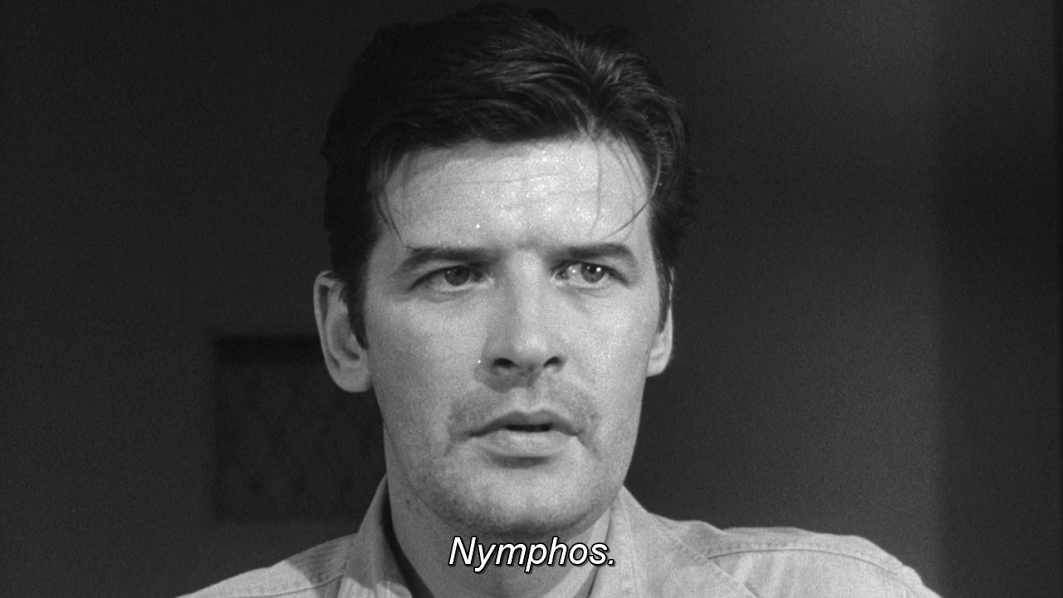
Among the inmates of the hospital that Johnny meets is Pagliacci (Larry Tucker), a fat man who is mentally immersed in opera.  Pagliacci occupies a space in between these two kinds of inmate.  He isn’t a patient-caricature: he has a name, a personality, an ongoing relationship with Johnny.  He is more like the patient-characters, those patients whom the audience are shown to be something apart from their mental illness.  The veracity of these personal details are open to question, however; Johnny’s voiceover, serving as an objective narrator, gives us information about the patient-characters’ lives before they talk about themselves.  Pagliacci is not afforded this confirmation.  Similarly, the three patient-characters have lucid moments where they monologue about their personal histories, explicitly detailing how contemporary issues intersected with their personal struggles (a signature of Samuel Fuller films), whereas Pagliacci is never given a monologue that connects him to a macro-level conflict.

The entire film can be read as grotesque, but its most vivid embodiment is Pagliacci.  I use this term not as an aesthetic or value judgment on his body, but in reference to the grotesque as an artistic concept, “a hesitation between horror and comedy… often rooted heavily in the physical…the inside becomes the outside, and the outside becomes the inside.”  He manifests the grotesque through a presence that speaks to the threat of potential disorder, through his defiance of easy categorization, and through his subversion of expectations set up by the other characters.

Pagliacci delivers the chaos and abnormality that the audience expects from a film set in an asylum.  When the audience is still being introduced to the hospital as the movie’s main setting, he starts a melee in the cafeteria.  This facet of the character is arguably the one most blatantly symbolized the most by actor Larry Tucker’s body.  Pagliacci is not husky or chubby: he is markedly fatter than most film characters, even most people than the “typical” audience member would know in real life.  His body differentiates him from the other characters, and likely alienates him from viewers, making him more of a spectacle than a sympathetic character.  The patient-characters all have some external display of their psychological conflict– Stuart wears a Civil War-era hat, Trent obsessively makes Klan hoods out of pillowcases, Boden sits on the floor like a child and draws with his crayons– but Pagliacci’s difference is intrinsic to his body, a body unlike any other on the screen.  He also has longer hair than any of the other male patients and is the only one with a beard, adding to the physical manifestation of his abnormality.  However, his mental state and personal history is hidden behind a veil of music, the external event that brought him to the hospital forever a mystery– the Samuel Fuller School of Psychology teaches us that mental illness is triggered by stressful life events– unlike the other patient-characters, whose histories are richly communicated to the audience.

shock corridor, samuel fuller, peter breck, larry tucker

The fat body is often used as a warning to straight-sized people: this could be you, if you fail to regulate your own body according to social norms.  Pagliacci is a portent of Johnny’s loss of control, and the last scene shows a catatonic Johnny who has indeed lost control of his body. But Shock Corridor’s horror is fueled by losing control over one’s brain.  Johnny has dangerously neglected to regulate his mind by entering into the world of the mental hospital, and the film tracks the downfall that is due to that choice.  Pagliacci also provides foreshadowing for Johnny’s fate through the script: “When we’re asleep, no one can tell a sane man from an insane man.”  Late in the film, Johnny’s breakdown begins when he hallucinates an indoor rainstorm.  “I like the rain,” Pagliacci comments peacefully, validating his friend’s psychosis. Now that Johnny is also insane, Pagliacci has shifted from the childish kookiness he displays at the beginning of the film to placidity. Johnny screams in fear and agony, causing Pagliacci to chuckle.  “That was such a sour note, John.  You were way off key.”

Pagliacci conducts himself socially in a way that is markedly different from the other patients.  He is the first patient Johnny interacts with, and is the only one to initiate interaction (except for the nymphomaniacs).  After Johnny has been shown his room, Pagliacci welcomes him, grabbing his hair and putting his arm around Johnny’s shoulders.  He rouses him from sleep several times.  His transgression of social boundaries, coupled with his annoying habits and erratic behaviors, fulfill the audience’s expectations of him based on both his size and his insanity.  Fat movie characters often act in socially inappropriate ways, tied closely to the idea that fat people are stupid and lack control, while at the same time providing comic relief or plot-driving villainy.  This overlaps with how mentally ill people are often portrayed, acting in outlandish ways to signify their lack of control and provide a spectacle for the audience, usually making us fear for the protagonist’s safety.  And between comic and horrific lies the grotesque.

Like the patient-characters and Johnny, we are given insight into Pagliacci’s mind.  However, unlike the memories of life on the outside shared by the patient-characters or Johnny’s increasingly frantic scheming, Pagliacci’s thoughts are music, specifically “Largo al Factotum” from Giacomo Rossinni’s opera The Barber of Seville (aka “Figaro Figaro Figaro”).  This is the song that Pagliacci sings constantly, creating a repetitive, off-key soundtrack that quickly becomes annoying.  What is most likely is that the opera references in Shock Corridor are chosen for their recognizability.  However, intentional or not, they create an interesting paradox: a character whose mind is apparently looping an aria from a comedy about a clever jack-of-all-trades who helps two people fall in love, but whose namesake is a tragedy about an actor who murders his unfaithful wife.  After singing “Largo al Factotum” while he mimes stabbing Johnny, paralleling how Canio stabs his wife and her lover at Pagliacci’s climax, he recites its final line “La commedia è finita!”  (Pagliacci is Italian for “clowns,” referring to the main characters’ travelling commedia dell’arte troupe. Canio is the protagonist’s name, the character on whom the image of the sad operatic clown is based.)  Once again, Pagliacci is situated between categories.

Pagliacci subverts Johnny’s expectations of his fellow patients.  Johnny’s motivation in going undercover at the mental hospital is to solve a murder, and his motivation for solving the murder is to win the Pulitzer Prize as a reward for his stunt.  Even in solving the murder, he has no interest in raising concerns about the safety and fair treatment of the hospital patients (in contrast to Nellie Bly’s investigative journalism, presumably a historical inspiration for the film).  Johnny treats his fellow patients as means to an end, treating the murder witnesses with empathy and understanding until they have lucid moments of reality.  When this seeming miracle occurs, they want to talk about their lives and their trauma, but Johnny only wants to ask them about Sloane’s murder.  Even when speaking to the final witness, who reveals that the murderer is an orderly who rapes patients, Johnny can only focus on getting the final piece of information needed to solve the murder.  In a sense, the way Johnny treats the patient-characters is a microcosm of the way Fuller treats them, avoiding the temptation to create well-rounded characters who are living with mental illness in favor of human megaphones for his opinions on controversial issues and puzzles for his protagonist to solve.  Pagliacci, however, is not a passive font of information waiting for Johnny to open him up.  He does confirm that Sloane was killed in the kitchen with a knife, and demonstrates to Johnny that the hospital patients are capable of lucidity (what a revelation).  But he reveals these things to Johnny on his own initiative.  He pushes himself on Johnny.  This serves to both protect the protagonist, such as encouraging him to chew gum to help him fall asleep, and to terrorize him, reminding the audience of the potential danger Johnny is in.

Pagliacci tells Johnny that he “died of a heart attack caused by overweight [sic],” and claims that many people came to his funeral because “they wanted to make sure [he] was dead.”  In claiming a fatal heart attack and funeral as part of his history, Pagliacci presents himself as a living dead man, another paradox.  This is a small but curious moment in the film, one that unsurprisingly lingered in my mind.  Pagliacci subverts the pathologization of his body, a “morbidly obese” body that is prescriptively assigned an early heart attack and death, a fate that he claims but obviously has not come to pass.  Perhaps he shares more in common with the other patient-characters than at first glance.  Perhaps, in accordance with Shock Corridor’s logic, Pagliacci’s mental illness stems from being told so often that his heart would give out that his mind finally accepted the role of a dead man as the only acceptable way to exist in a culture that assigns fat people an early death, similarly to how Trent’s mind assumed the role of a white supremacist to exist in a culture that maintains racism as the status quo.  This moment speaks to a mind uncontrolled by psychiatry, materialized in a physique uncontrolled by medicine.

He then tells Johnny that he killed his wife: “I despite butchery!  I didn’t want my wife to die like Sloane, so I gently sang her to sleep.”  Obviously Pagliacci is alive, so this statement throws a shadow of doubt over the rest of his words.  Is Johnny sleeping next to a murderer?  Or is Pagliacci conflating his own history with his namesake’s plot?  Disorienting the truth of Shock Corridor also undermines what the audience expects from Pagliacci.  Is he the dangerous person we expect from a mentally ill character?  Or is he guilty of the crime of passion we expect from the climax of a dramatic opera?  Is he the degenerate we expect fat men to be?

The grotesque unsettles us, presents us with something outside our ordinary experience that provokes simultaneous, divergent reactions.  The paradoxes in Pagliacci’s identity put us as audience members at this crossroads.  Is he the dead man to be pitied, the zany buffoon to be laughed at, or the unstable murderer to be feared?  We don’t have one simple reaction to Pagliacci, but all three options are common ways the audience is led to react to fat characters, and none of the possibilities lead to empathy.

The Fat Person as Community Member: True Stories (1986, dir. David Byrne)

True Stories is a visit to Virgil, a small town in Texas where characters and situations are based on tabloid stories David Byrne collected while on tour and interwoven with songs like “Wild Wild Life” and “Puzzlin’ Evidence.”  This movie features John Goodman in one of his earliest roles, playing country bachelor Louis Fyne with a finely tuned balance of vulnerability and amiability.

Louis makes his size part of his identity, through the lens of bearishness.  At the night club, he refers to himself as “Louis the Dancing Bear;” this self-appointed nickname is reflected on his date with the Cute Woman (Alix Elias).  He describes his body, in a phrase you may have heard before, as “a very consistent, panda bear shape.”  There isn’t shame or self-hatred in this label; rather, Louis seems to use it to describe his size in relation to masculinity and vigor (as evidenced in the nightclub scene).  There isn’t an overt connection to the bear identity used in gay male subculture, but the sentiment is not dissimilar.

Similar to Maurice from Secrets and Lies, Louis is largely defined by emotions and creativity.  He is a snappy dresser, a singer/songwriter, and “just [wants] to be loved.”  He is preoccupied with finding a wife and settling down; we see him on dates with several mismatches throughout the movie.  We don’t see his size as a detraction from his potential as a husband; these connections don’t last due to personality or lifestyle differences.  There is one scene that depicts Louis’ relationship with a yogini, but since the movie was filmed in the 80s before yoga had become normalized the way it is today, I’m assuming that the humor in the scene is more based on his girlfriend being a hippy weirdo than on his inability to do yoga (likewise I assume that someone struggling with a yoga position was still a fresh joke at the time).  His quest for a bride goes to extremes: he makes a television commercial advertising himself as an eligible bachelor and enlists the spiritual help of a Vodou practicioner (Pops Staples) to help him find love.

(Quick sidenote about the aforementioned scene:  There are certainly many more insensitive and inaccurate portrayals of Vodou in American cinema, but its inclusion feels shoehorned in to make use of the song “Papa Legba.”  I don’t know enough about Vodou to talk about how authentic the ritual scene is, but considering that Papa Legba is associated with crossroads, travel, and communication, I’m skeptical.  To its merit, it does, along with the “Puzzlin’ Evidence” preacher, undermine assumptions about the homogeneity of religion in small town America that viewers would likely otherwise make about the film’s setting.)

Louis is a character of excess, but instead of making him an outlier or moral lesson, this trait fits him in perfectly with the other characters in the movie.  Swoozie Kurtz plays a woman who is so lazy she elects to spend her life in bed watching tv.  In one scene, the Narrator (David Byrne) has dinner with the Culvers, a well-to-do married couple who have not spoken directly to each other in years.  Slothfulness and social maladjustment are usually attributes of fat characters, turning them into buffoons and isolating them from the thin characters around them, but none of these characters are fat.  Virgil is a community that is united in its paradoxically banal weirdness.

This unity is further evidenced in the group lip-sync that is kicked off by an energetic fat woman in a fierce yellow jumpsuit, and the fashion show that seamlessly includes fat people who model everything from business suits to powder blue formal wear to vegetation.  These scenes also incorporate age and racial diversity in a low-key way; this just happens to be a small town where different people come together to share their love of modeling grass suits and pretending to sing.

True Stories is about a community, but if one had to choose a protagonist, Louis is the most likely candidate.  The Narrator joins the audience in outsider status, learning about Virgil’s inhabitants through the course of the movie, but the detached quality of Byrne’s performance and details such as the self-aware fakeness of his driving scenes render him as an abstraction, a lens through which we can gaze at the town.  Louis, on the other end of the spectrum, is more human than the other characters.  In a movie that embraces performance and artifice, the most grounded moment comes at the end of Louis’ date with the Cute Woman, where they put aside their small-town geniality and admit that they aren’t making a love connection:

Goodman’s performance and Louis’ character relative to the other citizens of Virgil make True Stories stand in contrast to many films where fat people are depicted with the intent of rendering them as less relatable or sympathetic to the audience than their thin counterparts.

A few things I’m still pondering:  to what extent is Louis an embodiment of Virgil?  Is his size connected with perceptions of Virgil as a cookie-cutter small town USA, the ugly American stereotype that often comes packaged in a big body?

Link: The School of Rock Wails Against the Man– For Fat Acceptance

 But Dewey’s gradual transformation into a better, more self-aware version of himself is wholly divorced from his fat, which remains on his person, as permanent as his love of Black Sabbath. Fat can’t be a sign of sloth and self-indulgence if it remains when those characteristics disappear. More importantly, Dewey’s successful performance at the Battle of the Bands, where he careens and showboats all over the stage, proves that rock need not be attached to a scrawny, screeching rock-monkey aesthetic but can come in any size.

Inkoo Kang’s 2013 article for Badass Digest looks at fat tropes, specifically with regards to its chubby protagonist rocker Finn (Jack Black), in Richard Linklater’s 2003 comedy School of Rock.  It’s a short piece; one of the reasons I wanted to start this blog is because, after reading it, I very much wanted the conversation to continue.