Footage of the original voiceover work and matching storyboards for Shrek, with Chris Farley as the title character, was recently leaked. This coincides with the premiere of biographical documentary I Am Chris Farley, which will be available on VOD on Tuesday. Word from the limited theatrical release is that I Am Chris Farley is a touching tribute to a sweet, insecure, funny guy who died way too young.
Author: Tessa Racked
The Heart of a Champion: Chubby (2015, dir. Bruno Deville)
(CN: Eating disorders, suicide)
Fatness exists on a spectrum that is important to look at (but difficult to do in a way that isn’t objectifying or disrespectful). Chubby’s protagonist, Kevin (David Thielemans), is on different place on this spectrum than many fat characters we’re used to seeing in film, especially fat children. Gerry from Heavyweights is fat, but not to the same degree that Kevin is. Both characters, roughly the same age, are weighed in their respective films; Kevin has 100 lbs on Gerry. But it’s more than a number: after an opening shot of his doctor (Stefan Liberski) measuring him with a caliper and making a noise of disgust, the title card puts the word CHUBBY in bold letters over a closeup of his torso. The outline of his nipples and bellybutton can frequently be seen through the fabric of his shirts. A few scenes of him on a bicycle feature the sound of his heavy breathing. Watching as someone from the United States, Kevin appears to have stepped out of a newsmagazine piece worrying over The Health of Our Children. Kevin’s body is depicted in a confrontational manner.
A significant portion of the film is spent on the medical panic over Kevin’s body. The opening scene of his physical exam culminates with his doctor telling him that his heart is like a vespa engine trying to power a truck, accompanied by the sound effect of a struggling motor over a closeup of Kevin’s chest. This threat of cardiac trouble hangs over Kevin for the rest of the film and is fueled by other characters, like when his sister Océane (Themis Pauwels) says that he’s “committing suicide with creme brulee.” His aquafit instructor (Francoise Bolliat) parallels his doctor, lecturing her class of overweight kids on the potential for overweight children to suffer heart attacks. She also introduces an assistant instructor (Mehdi Douib), an amputee who is meant to “inspire” the children to lose weight by being athletic despite his disability.
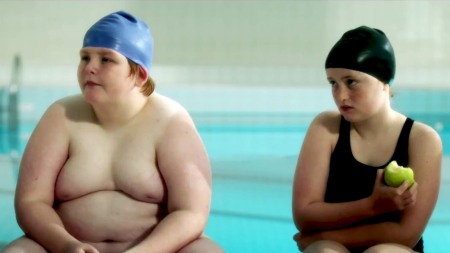
Kevin doesn’t respond directly to these barbs; rather, we see their effect more dramatically on his aquafit classmate, Alice (Lisa Harder). Although not as fat as Kevin, she seems to have absorbed more of the devaluing messages levied at her. She shows Kevin how to self-induce vomiting after their class, revealing that her mother taught her how. She also brings Kevin up to the top of a tall building and tries to convince him to jump off with her. Kevin is resistant to both the purging and suicide, which Alice sees as ways to solve her problems. She tells him that she wants to kill herself because she believes that the afterlife has to be an improvement over her life. Alice wants out of her body. Indeed, she disappears for a significant portion of the film, only to reappear late in the third act with bandages on her wrists, which she wordlessly displays for Kevin’s benefit. Her self-destructive behavior does seem like an attempt to get a response from him, but given how her body has been culturally framed both as something that is destroying her and should be destroyed for her own benefit, it’s not surprising that she would use self-harm to broadcast her presence, to try to inspire feelings of care in others. Although Kevin does not attempt to harm himself, he does absorb the view of his body as in danger of being destroyed, when he assumes that an episode of hyperventilation during a stressful event is a heart attack.
Kevin’s personal development over the course of Chubby occurs at the intersection of fatness and masculinity, at turns both liberatory and problematic. Kevin’s size is initially shown both as emasculating– his aquafit class shows him surrounded by girls, two bullies make comments about his breasts– and as a symptom of emasculation. His father is absent, he lives with his two sisters and mother (Julie Ferrier), who is characterized as overbearing, if well-meaning. (Moms are the worst, aren’t they? In, like, every film, book, and tv show ever?) She calls him “my little chick” and– in one creepy moment that I sincerely hope is just an innocent cultural norm that didn’t translate well– gropes his breast while cuddling him. His doctor straight up tells his mother than Kevin needs a male role model in his life.
Kevin finds this role model in Patrick (Swann Arlaud), a gruff security guard and military commando. Patrick is humorless and intense, reminiscent of Dwight Schrute from the Office, and rigidly conforms to a hyper-masculine ideal. His trained attack dog is named for porn star Rocco Siffredi, and his life revolves around living up to his military ideal. Kevin reveres him, following him around and becoming similarly obsessed with the commando lifestyle. He exercises more vigorously under Patrick’s training than in his doctor-mandated aquafit class (and, to the delight of his doctor, loses 4 kilos) and finds the confidence to stand up to his bullies. Patrick introduces Kevin to the Chief (Francois Hadji-Lazaro), an older fat man who owns the security company Patrick works for. Chief coaches Kevin on how to take pride in his fat body, telling him that fat men inspire a sense of comfort in other people and that he should never let anyone make fun of his breasts. He tells Kevin to eat salmon, as the omega 3 will protect his heart. He also shows Kevin some fighting tactics that rely on having a fat body. It always makes me happy when a fat film character shows a competence or skill unique to the experience of having a fat body, but this feeling was subverted to a degree by the cartoonish nature of Chief’s moves, specifically when he sits on Patrick’s face and farts.

Although their example gives Kevin an identity to try on besides fat kid, neither Patrick nor Chief are well suited to being role models. Kevin starts drinking beer and joins his two heroes in some petty burglary. Late in the film, Chief shatters Kevin’s perception of Patrick by revealing that he was never in the military, citing his slight build and uneven legs as the reason why. Indeed, Patrick visibly reacts whenever Chief makes a comment about his slight build. Like Kevin, Patrick has been deemed inappropriate by a social institution because of his body. He deals with that designation by clinging to military life and culture, and also by trying to assert his control over subjects more vulnerable to domination than himself. Patrick doesn’t seem to like Kevin as much as he likes how Kevin idolizes him, and even seems jealous of the connection that Kevin and Chief share over being fat. He tries to seduce Jennifer (Amelie Peterli), Kevin’s older sister, in an overly assertive manner, publicly giving her the third place medal that he and Rocco win in an obedience competition and asking her to “do the bitch.” (That’s what the subtitles said. I don’t know what “do the bitch” means, but it upsets Jennifer greatly.) He recruits Kevin’s friend Mouk (Dodi Mbemba), a petite African kid whom Patrick refers to as a “terrorist,” into a training exercise for Rocco in which the dog is commanded to track and attack him. Patrick’s treatment of Rocco is the most illustrative of his character, as he uses the dog as an accessory for his masculinity. He doesn’t mistreat Rocco, but has no affection for him. He trains the dog using German commands; for the first few scenes, both Kevin and I thought the dog’s name was “zurück,” the command Patrick uses to call Rocco to his side. Patrick uses Rocco to show his own power, his ability to hurt and dominate someone else through his control of a potentially dangerous animal. When Patrick needs to leave town or face arrest, he plans to sell Rocco to fund his escape.
Kevin’s heart, chest, and breasts are a recurring image in Chubby, symbolic of his physical health, but also his emotional wellbeing. He spends much of the film believing that his heart is sick, and likewise idolizing Patrick, who suppresses his emotions and focuses on his ability to be a dominant masculine figure. A more balanced paternal figure is conspicuously absent, as Kevin’s mother and father are newly separated. Although he learns to be assertive and finds power in his fat body from his time with Patrick and Chief, the spiritual change doesn’t come for Kevin until the two men suddenly leave his life. Passing out due to what he thinks is a heart attack, Kevin has a dream in which the doctors safe him via a transplant of Rocco’s heart, “a champion’s heart,” into his chest. He wakes to find his father (Jean-Benoit Ugeux) by his bedside, a gentler (if flawed) paternal figure better suited for his needs a child. His father gently corrects his assumptions about having a heart attack, telling his son that he has “the heart of a champion.” After spending the film being impassive and making selfish choices, Kevin shows an emotional side, more oriented towards the needs of others. He breaks down crying at the thought of Rocco being left to fend for himself. He begs Mouk to forgive him. He finds and adopts Rocco. The final scene, like the beginning, finds Kevin sitting shirtless, but accompanied by Rocco and Alice instead of his doctor and mother, the sound of a human heart beating instead of an engine. He is neither the failing vehicle his doctor describes, nor the heartless commando Patrick longs to be. He is a human being, both capable and deserving of love.
Roundup: July 2015
Content note: self-harm. A summary of films I saw over the past month featuring fat characters that I didn’t write about.
Chef (2014, dir. John Favreau)
A dramedy focused on a middle-aged man who is stagnating in his professional life and distanced from his family, with the most tantalizing cooking scenes I’ve seen since Eat Drink Man Woman. Ramsey (Oliver Platt), a food blogger, criticizes Chef Carl’s (Jon Favreau) cooking, speculating that he has gained a lot of weight over his career because he “must be eating all the food that gets sent back to the kitchen.” Despite the public dig at his size, everyone agrees that he’s a genius chef, and the front of house manager (Scarlett Johansson) has the hots for him. When it is revealed that his critic is also fat, the dig seems somewhat hypocritical, and is followed by Carl lambasting him for making a living off of being mean. Carl’s former father-in-law also subtly picks on him, remarking that he’s gained weight since they last saw each other. Although there is an implication that Carl’s weight is a symptom of his professional stagnation and unhappy family life, there is no indication that he loses weight as he improves his relationship with his son and goes into business for himself.
Beauty and the Beast (1991, dir. Gary Trousdale, Kirk Wise)
Several fat supporting characters: Belle’s proto-nerd father Maurice, who is considered an oddball by their community and needs to be saved twice; Lefou (literally “the fool” or “the madman”), Gaston’s toadie who worships him despite constant physical abuse and has a more grotesque character design than the other human characters; Cogsworth, the stuffy majordomo; and Mrs. Potts, the motherly cook. Perhaps of note, Disney is producing a live-action reboot, to be released in 2017, with three of these four characters portrayed by thinner actors. Ian McKellen is playing Cogsworth, Emma Thompson is Mrs. Potts, and Kevin Kline is Maurice. Lefou, the one villainous character of this group, will be portrayed by Josh Gad.
Withnail & I (1987, dir. Bruce Robinson)
A character study of two struggling London actors who scrape by on alcohol and bullshit. Withnail (Richard E. Grant) and Marwood (Paul McGann) escape their dismal flat for a trip to the country, staying at a cottage owned by Withnail’s fat uncle Monty (Richard Griffiths). Monty is wealthy and effete, a retired actor whose homosexuality is a defining characteristic (in his introductory scene, he discusses his love of gardening: “There is, you’ll agree, a certain je nais sans quoi, oh so very special, about a firm, young carrot.”) His generosity and kindness are a godsend to the two destitute protagonists, and to an extent, he is an inversion of the trope of the fat incompetent, having his life more in order than the younger men, who can’t manage to clear out their kitchen sink for fear of what lives in it. However, he is also the middle-class fuddy-duddy foil to their edgy, youthful rebel lifestyle, never questioning the lies they feed him. Partially due to a comedy of errors and partially to Withnail’s dishonesty, Monty believes that Marwood is also gay and attempts to seduce him, to the younger man’s abject terror. Monty is overly persistent, forcing his way into Marwood’s bedroom wearing a silk robe and eyeshadow. He tries to force himself on Marwood, although he also pleads with him to not be ashamed of his sexuality, and only stops when Marwood tells him that he and Withnail are a couple, and that he doesn’t want to be untrue. Monty backs off and leaves the cottage before they wake up in the morning, having left a note of apology.

The Tales of Hoffman (1951, dir. Michael Powell, Emeric Pressburger)
As with Beauty and the Beast, there are a handful of fat flunkies in this film that features several stories within stories. Most of the fat characters are thin actors with big prosthetic bellies, including a few villains’ servants and, in one sequence, an ugly clown whose love for a ballerina is unrequited. The one fat character portrayed by a fat actor is Andes (Philip Leaver), who is the servant of Stella (Moira Shearer). Count Lindorf (Robert Helpmann) bribes Andres into allowing him to intercept a message from Stella to Hoffman (Robert Rounseville), which ultimately allows the Count to separate the lovers from each other.
Tangerine (2015, dir. Sean Baker)
There are a few minor fat characters in this film, the most prominent of whom is Jillian (Chelcie Lynn, who is a big deal on Vine), the madam of a “party room” at a sleazy motel that Sin-Dee (Kitana Kiki Rodriguez) breaks into looking for Dinah (Mickey O’Hagan), the girl who’s been sleeping with her boyfriend. It’s not a glamorous role, but none of the roles in this film are. The protagonists aren’t fat, although a few girls make critical comments about Alexandra (Mya Taylor) for not having a flat stomach, but as transgender women of color, they are definitely marginalized based on their physical characteristics. Tangerine is the most vivacious and humanizing portrayal of trans women of color in a film that I’ve seen since Paris Is Burning, and I can’t recommend it enough.
ABCs of Death, “W is for WTF?,” “X is for XXL” (2012, dir. John Schnepp; Xavier Gens)
I didn’t see the whole anthology, so there might be other fat people in the chapters I missed. “W is for WTF?” features two fat men (John Schnepp and someone whose name I couldn’t find on IMDb) as members of a film production team who are struggling with a looming deadline to produce a W segment for ABCs of Death and can only come up with lazy ideas featuring beautiful women in skimpy outfits before the world descends into utter chaos. “X is for XXL” follows a fat woman (actor unknown) who never speaks. She is harassed in public several times due to her weight, and seems to be stalked by an ad campaign for a cereal that claims to have slimming properties. Upon arriving home, she binges on food in a manner that verges on cartoonish (I believe she drinks olive oil straight from the bottle at one point). She then goes into her bathroom with a knife and carves off her flesh, which intersperses with shots of the slim spokesmodel in the cereal commercial.

The Relationship Between Fitness and Self-Respect: Heavyweights (1995, dir. Steven Brill)
(CN: disordered eating and exercise)
I wasn’t a summer camp kid– my one experience was a week at Girl Scout camp between 7th and 8th grade– but I can see why it’s such a popular setting for movies. Camp is removed from civilization, but not to the point where survival is in question. The characters find themselves in a setting outside their normal context (no parents! no bullies!), but still have to function within their temporary community. There are rules, but those rules exist to facilitate having fun; there are authority figures, but they’re often lackadaisical, or at least easily avoided. This anarchic context can be the site of recreation or re-creation, usually some of both. It’s especially potent for adolescents, when summer comes with the hope that some alchemical process will occur over the long, hot days and you will return to school in the fall a better version of yourself. You will have sex. You will grow taller. Your breasts will develop. You will go on adventures. And, of course, you will lose weight.
Heavyweights opens with Gerry (Aaron Schwartz) leaving school on the last day before summer vacation. (The sequence is set to “Closer to Free” by the BoDeans, in case there was any doubt that this film came out in 1995.) He is characterized as a typical sad sack fat kid: he misses his bus and has to walk home; he can’t throw a baseball over a fence; he stops at a lemonade stand and chugs an entire pitcher. Upon arriving home, his parents tell him that he is being sent to Camp Hope. The promotional video sucks him in with the promise of go-karts and the Blob, but he reacts indignantly when he learns that he’s being sent to a fat camp to take care of his ”problem,” as his dad calls it. “I’m not going to camp with a bunch of fat loads!” he protests, separating himself from his peers.
On the plane to camp, Gerry meets Roy (Keenan Thompson), who approaches and asks if he’s going to fat camp. When Gerry defensively retorts that Roy is also fat, assuming that he is being insulted, Roy readily agrees with him. Roy is the first self-accepting fat person we meet. Roy becomes Gerry’s guide to Camp Hope, telling him that it’s a paradise because “nobody picks on you because you’re the fat kid, everybody’s the fat kid.” (Roy is the only black kid in the movie, and becomes an emotionally supportive sidekick for Gerry, not unlike Al is for McClane in Die Hard.) An excited group of campers, including Gerry and Roy, are chaperoned from the airport to Camp Hope by Pat (Tom McGowan), an adult counselor who has spent every summer at Camp Hope since he was 10 years old.

Although ostensibly a place to lose weight, Camp Hope is obviously more of a safe space for fat kids. Tim (Paul Feig), another counselor, “used to be one of us, but then he lost weight,” according to the campers. They tease him about his “chicken legs,” which he responds to with good humor. When Gerry arrives at Chipmunk Cabin, he confesses to slick wiseguy Josh (Shaun Weiss) that he snuck in some Oreos, which prompts his cabin mates to reveal their own contraband, kept in a communal supply under the cabin floorboards. This is followed by a scene of the campers and Pat playing on the Blob. Set to “The Blue Danube Waltz” and filmed in slow motion, the scene both suggests an idyllic transcendence from Gerry’s point of view, and is a reference to the scene in 2001: a Space Odyssey, where the story moves forward from the prehistoric era to the Space Age. Similarly, Gerry finds himself millions of years removed from the brutality of being the picked-on fat kid, and achieves temporary weightlessness playing on the Blob with his new friends. Although Camp Hope is a place where Gerry and his peers don’t have to worry about judgment and ridicule, it’s also not a place where they can push their personal boundaries. Pat, a lifetime member of Camp Hope, is popular with the campers but isn’t confident enough to talk to Julie, the pretty camp nurse (Leah Lail).
The good times end abruptly, however, when the camp owners announce that they have declared bankruptcy and sold Camp Hope to Tony Perkis (Ben Stiller). Tony is a fitness-obsessed motivational speaker who is “looking forward to interacting with children for the first time.” He tells the campers he weighed 319 pounds when he was 12 years old, and had no self-esteem or self-respect. He brings in a new staff of equally athletic, uniformed counselors and tells the campers their summer will be filmed for an infomercial to promote his weight loss regimen, Perkisize. Pat is re-assigned to maintenance duties and replaced by the strict, generically European Lars (Tom Hodges).
Tony creates a strict and overly simplistic binary between healthy and unhealthy, paralleling good and bad. “Anyone who brings candy into camp is not your friend,” he tells Gerry while searching Chipmunk Cabin for contraband snacks, “He is a destroyer.” Perkisize consists of grueling exercise and unsafe levels of food restriction (Tony cancels lunch one day “due to lack of hustle”). He and his staff are in charge because they are athletic, and therefore good, not because they know how to care for children. Their lack of attention to what exercise is appropriate and feasible for their fat, preteen wards creates an immediate threat. Julie says that, as a medical professional, she considers Perkicize dangerous. Lars proves to be a negligent lifeguard with no understanding of how the buddy system works, and Tony punishes campers for gaining weight by taking them on a 20 mile “cleansing” (i.e. without food) hike up a mountain. Pat tries to stop him, fearing for the campers’ safety, but is ignored and ridiculed because of his size. “The fat man is going to tell me what’s healthy!” Tony sneers. “Nobody really cares what you have to say.”

Tony’s binary view puts fat people squarely in the unhealthy/bad category. His regime as camp director begins with Evaluation Day. “The key word is ‘value,’” he explains over the camp loudspeaker. “Do you have any? Not yet! But by the end of the summer this camp is going to be filled with skinny winners!” (“Skinny weiners?” Roy jokes, showing the lack of enthusiasm he has for Tony’s plan.) The kids cling to the old Camp Hope mentality, cheering for Simms when it is announced he is the heaviest boy at camp, but Tony works to break their spirit. Tony expels Josh from camp for talking back to him. He invites “jock camp” Camp MVP to play baseball against Camp Hope. When Tim protests that getting their asses handed to them won’t teach the kids anything about baseball, Tony retorts that it’s meant to teach them about “life.” He doesn’t even stick around to see Camp MVP taunt his campers, nor does he seem to care when Camp MVP vandalizes their dock. Later, he organizes a dance between Camp Hope and the unnamed “girl’s camp,” with the rationalization that making them feel insecure in front of a group of girls (who, of course, would never want to dance with them) will motivate them to lose weight. It takes a lot of time and motivating from Pat, Tim, and Julie, but both sides eventually start dancing enthusiastically. Before long, Tony breaks up the dance mid-song and tells the girls to leave, thanking them for their “efforts” and saying “[he knows] this hasn’t been easy,” despite them having as good a time as the boys– including one young couple sharing a kiss before separating. He wants to instill in them his opinion that they are worthless because they are fat and need to achieve “value” through compliance to the Perkisize program. There is a capitalist motivation behind this, as Tony wants to make his program into a successful business venture by convincing his future fat tv audience that they need his program in order to achieve value for themselves, but it also comes from a place of hatred for fat people. Tony’s “motivation” is psychological abuse.
(Returning to the dance for a moment: it’s worth noting that the presence of female characters in the film is one of Heavyweights’ missteps. Of the few female characters in the film, none are fat. Julie is conventionally attractive, and while she supports the campers by trying to get Child Protective Services to investigate Tony and contributing to the expose video, she largely functions in the film as an object for Pat’s affections, a goal for him to obtain as his self-confidence increases with his ability to stand up to Tony. The girl campers are all thin and conventionally attractive as well. When one of the girl campers asks her friends, “Why don’t they just lose weight?” another girl snaps back, “Why don’t you teach them to throw up after every meal like you do?” The joke makes a point about subverting the notion that thin people are automatically experts on healthy behaviors over fat people. However, I think the more important takeaway is that having zero visibility for girls and women who aren’t thin, and then shaming girls and women for trying to obtain or maintain thinness, is a vicious cycle of sexist bullshit.)
Tony’s treatment of the campers is villainous, but it’s not an unusual attitude towards fat bodies. Consider the martial language employed to advertise diet and exercise products (e.g. fat blasting), motivational workout sayings that portray pain as a desirable outcome, the success of The Biggest Loser. The driving thought that unifies them is that a person’s body must undergo extreme means to meet a certain standard of fitness (although this usually means a certain weight and shape) in order to deserve respect, to have value. Tony believes that by continually punishing the campers– even going so far as to remove the Blob from the lake, despite it being an incentive for them to go swimming– he can get them to lose weight and become people who he deems worthy of respect.
After Tony tells the campers their 20 mile hike has been “extended indefinitely” until they are in good enough shape to beat Camp MVP in a relay race and provide a happy ending for the infomercial, they rebel. They outsmart and imprison Tony and liberate the camp with a bacchanalia of their favorite foods. Even Tim joins in the celebration, ripping his shirt off and covering himself with s’mores. As with the Blob scene earlier in the film, this scene is also slow motion and set to classical music, this time the overture from La Gazza Ladra, which is also featured in scenes of gang violence in A Clockwork Orange. The reference to the droogs’ self-destructive nature is appropriate, as the campers’ unbridled hedonism proves to be almost as painful as Tony’s punishing workouts. The next day the campers are covered in gunk and nursing hangovers. Pat takes the opportunity to present a more moderate course of action.

Although the movie focuses more on the campers’ experience, Pat has been experiencing his fair share of character development, as we see through his interactions with Gerry. Sitting together on the decommissioned go-kart track, Gerry tells Pat that he wants to “go fast” for once in his life, to which Pat responds by playfully pushing him around the track in the go-kart. Later, Pat tells Gerry about his fantasy of being athletic like Camp MVP, and that he’s “tired of being the fat guy.” Gerry tells Pat that he’s “cool, everybody knows that,” but asks him, “When are we gonna start sticking up for ourselves?” Seeing that, although they have defeated Tony and his crew, the kids haven’t learned anything, Pat sees the opportunity for them to start making their wishes into reality.
Pat’s leadership of Camp Hope is different from both Tony’s and the campers’. He talks about restraint and self-respect. He never mentions weight loss in his speech, and speaks about these goals in terms of “we” and “us,” not stationing himself above the campers as Tony did. We see scenes of Julie teaching a nutrition class, and the staff and campers exercising together as a group: some of them are walking briskly, others are running, but everyone is having a good time. When Gerry’s parents come to visit for Parents Day, his father disappointedly remarks that he doesn’t look any different, but Gerry quickly responds that he “feels good,” which his mother admits is “important.”
Having defeated Tony, the remaining challenge for Camp Hope is their annual competition with Camp MVP, the Apache Relay. (As is traditional with many summer camps in the USA, Camp Hope is not above a little tacky cultural appropriation, and the campers are dressed in American Indian costumes for the race.) Camp Hope is used to losing every year, but the self-confidence and teamwork they have learned over the course of the summer pays off. They cheer each other on and use their individual skills to stay in the competition. Gerry is able to “go fast” in the go-kart race and is even able to use his fatness to his advantage, as Pat coaches him to “use [his] weight on the curves.”
As I’ve discussed in previous articles, fat characters often embody lack of moderation. Heavyweights does use this stereotype to a certain extent, such as a scene in which a pack of underfed campers hungrily chase a cow around a field. Heavyweights breaks this mold, though, by making Tony the ultimate figure of excess, culminating in an epic meltdown in front of the campers’ parents in which he tries to prove his physical superiority by walking barefoot on broken glass. The ideal situation through which the campers find their happy ending is in line with real-life wellness philosophies like harm reduction and Health at Every Size: using self-respect as motivation, not a goal. In the end, the campers don’t even place value having won a competition against rival Camp MVP, and Pat throws the Apache Relay trophy in the lake. The campers become different people over the summer, but instead of achieving the change that Tony envisions for them, becoming “skinny weiners” like the Camp MVP kids, they find the ability to stand up for themselves and find confidence in their individual skills and interests. It’s not the happy ending one would expect for fat characters, but it’s arguably the best one for fat kids to have as a cultural reference.
Interview: Jessica Conger, actor, Most Likely (2015, dir. Andrew Bemis)
Jessica Conger is a full-time waitress and part-time actor in the Boston area. She performs regularly with the Post Meridian Radio Players of Somerville and is a film producer with Bang! Films production company. When not serving food, acting, or attending school, Jess like to read mysteries and brew cider and beer. She and I first met in September 1998, when a mutual friend dragged me over to where she was sitting in the cafeteria before homeroom and said, “This is Jess. She likes The X-Files too.” Since that fateful morning, she’s been one of my best friends. Last week, Jess and I sat down at our respective computers to discuss her on-screen work in Bang! Films’ upcoming feature length film, Most Likely. (The link leads to the teaser video on Vimeo, which is NSFW.)
Tell us about Most Likely. Who is your character?
I play Beth, an uptight woman who travels with her stoner roommate Phil, played by Kevin Sandberg, to her high school friend’s wedding in a remote area of New Hampshire. Beth hasn’t seen anyone who is going to be at the wedding in years and is very anxious about it. She feels lost in her life. The movie takes place at the wedding over a weekend. The bride, Chloe, played by Alex Fandel, has set up a weekend for her old friends and new ones to meet and join one of the happiest days of her life. She probably did not expect it to go how it goes.
The Kickstarter for Most Likely mentions a naked yoga scene. What was preparing for and shooting that scene like?
So, when Andrew Bemis was writing the script, he said that when he was stuck on something, he just thought about how to make me uncomfortable. That’s how that scene got written. We filmed that scene in the evening, in April, in New Hampshire. It was seriously cold, about 40 degrees from what I remember. There were crew members off to the sides with blankets for Rory and Alex between takes. I felt so bad for them, at least I got to wear layers! They did have some standard protective pieces on, lest we get a good shot of balls, but they were pretty naked. For filming we usually ran through the scenes a few times with and without scripts and then did a wide shot, some closeups, and reverses. Shooting each scene takes several hours, usually. For this, because it was so cold, we ran through it once or twice and just sort of ran with it. Rory was unsure of yoga moves and I and Kate Zarnay, a friend who visited the set that day, tried to give him a few tips on the best ones to perform naked. I think downward dog got brought up a lot. It was hard for me to get through takes without giggling because Rory is so fucking funny.

How do you deal with the negative cultural attitudes around fat women in movies and television? Have you ever felt discouraged from acting because of your size?
I drink a lot. Really, I try to recognize that while Hollywood is the fucking worst, the way to get better roles for people of all representations is to make art yourself. I can’t tell you the number of auditions I didn’t make the cut for because I wasn’t “the right look,” or the number of casting calls I didn’t even bother with because of the descriptions of the roles for women. If every part requires 25-35 year old female actors who are of “lean build,” that cuts out so many talented actors. I really believe that the Alien approach is perfect for so many roles which could be played by anyone: write the script, go through the auditions, and cast the best people. But I know that’s a pipe dream for anything mainstream. So, I mostly stick to radio plays and acting in parts written for me.
A few months ago on Twitter, you self-identified as a fat actress and said that you like roles where your appearance isn’t part of your character’s story (e.g. nobody second-guesses your character as someone’s love interest because of her size). In your opinion, are these characters fat characters because a fat actress is portraying them, or does being a fat character depend on fatness being an explicit part of the character’s story?
I think these characters are fat because a fat person is playing them. In Most Likely, Beth could have been cast with a smaller actor– I am the largest woman in the cast– and it wouldn’t have changed the character a bit. I do think that size can be an explicit part of a character, but if that is the character’s entire motivation, yawn, I’m not going to be interested. I’m really interested in playing interesting, complex people. I think most actors are. If you think about it, how many mainstream movies would change if the lead actress had 20 or more pounds on her? Maybe Bridget Jones’ outside would accurately reflect her diary woes, but it really wouldn’t change much. What if Melissa McCarthy and Kristen Wiig swapped roles in Bridesmaids? The lead would be a lovable fuck-up fat woman trying to do her best, and the weirdo with heart would be the conventionally attractive thin woman. Where would that change the plot?
Who is your favorite fat movie character?
This is such a difficult question. Farva from Super Troopers or Ursula from The Little Mermaid. Or Ken from In Bruges. Or Don Corleone from The Godfather. Or Charles Foster Kane from Citizen Kane. I like Fat Amy from Pitch Perfect, but that’s just because Rebel Wilson is a 10. I’m sure as soon as I hit send I’ll think of like 30 more.
You can contact Jess on Twitter @allybaster or via email at allybaster (at) gmail (dot) com. Check out Most Likely‘s Kickstarter for updates on its progress.
“Straighten, Tighten:” Intersections of Fatness and Queerness in The Birdcage (1996, dir. Mike Nichols)
When I woke up on a Friday morning a few weeks ago to Twitter blowing up about SCOTUS declaring same sex marriage legal in all 50 states, I was happy that my home country was finally moving away from a gender-discriminatory policy. Not deliriously happy, mind you. I feel some kinda way about the political energy and focus poured into marriage equality. But I do have a sentimental side, and I see how much joy getting married has brought to the people in my life who decided to take the plunge. (This post isn’t more timely because I traveled halfway across the country to attend the wedding of one of my oldest friends.) I had a solo mini-celebration for marriage equality that evening with The Birdcage, which I was fond of in high school and had been meaning to revisit. I remembered the excellent comic performances; it’s enjoyable enough to take the film at face value. What surprised me was how deeply I empathized with the character at the epicenter of the film’s tumultuous humor, Albert (Nathan Lane).
The opening scene in which Armand (Robin Williams) and their houseman Agador (Hank Azaria) cajole a hysterical Albert into rallying herself* for a drag performance ushers the audience into a first impression of her that is intertwined with her self-image. She describes herself as “fat and hideous”– a declaration Armand, her director and significant other, knows so well that he mouths the words along with her– and says that she’s “gained and lost over 100 pounds in the past year” in an effort to be thin and beautiful enough to maintain her star status and his love. Although not an extremely large person, she does have a stocky body, where the other performers at the Birdcage (and many of the thong-clad extras in scenes of the public milieu of South Beach) are slender and muscular.

Albert’s sensitivity and flamboyant nature are frequent sources of humor. Armand and his son Val (Dan Futterman) react to Albert’s outbursts with a certain level of weariness that suggests a routine scenario for their family. But even though she is an outlandish character in a farce, her anxieties come from a very real place. The nonplussed reactions she receives from strangers, plus Val’s unwillingness to introduce her to his conservative future in-laws speak to her outsider status in the vast majority of the world. Despite being a headliner who plays to sold-out houses and is more than willing to self-advocate, she lacks necessary social capital to navigate on her own outside her South Beach bubble. In a subplot, she wants Armand to sign a palimony agreement so that she will be provided for in case their relationship ends. Although talented, there is no denying that she is older and fatter than the other performers; who’s to say what her career would look like without Armand and the Birdcage?
The Goldmans’ underlying family tensions are exacerbated when Val declares his intention to marry Barbara (Callista Flockheart), the daughter of staunch conservative Senator Kevin Keely (Gene Hackman) and his wife Louise (Dianne Wiest), who is Barbara Bush by way of Lady Macbeth. Hit with scandal when Kevin’s “common redneck” colleague dies in bed with an underage black prostitute, Louise suggests using the wedding as a distraction technique to symbolize a return to family values. Convinced that the Keelys will never connect themselves to a gay, Jewish** family, Val asks Armand to pretend he’s the father of the heterosexual “Coleman” family. Val initially asks that Albert not be present for the Keelys’ dinner, but Armand insists they compromise and pretend that his companion is heterosexual Uncle Al. Although the Goldmans want their son to be happy, there is ultimately no sugarcoating that Armand is willing to side with Val and pretend Albert isn’t part of their family unit so that Val can access a social institution the two of them can’t by ingratiating himself to a politician who thinks they’re destroying America. Her reactions, oversized in most situations, are appropriate in this case. When she refers to herself as “the monster, the freak,” neither Armand nor Val deny that she is characterized thus by their plans to hide her.
For the Goldmans, achieving normalcy is largely about restraining (“straighten, tighten”). Not only is Val the beneficiary of the charade, he is the main orchestrator, the ambassador of straightness in a queer enclave. He is a man of few words, forever tolerantly waiting for the exuberance around him to die down. “Don’t add, just subtract,” he repeatedly advises the Birdcage staff, who help transform the Goldmans’ colorful home into a “monastery.” The subtraction includes wanting to present Katherine (Christine Baranski), Val’s biological mother, as Armand’s wife. Albert can barely hide her discomfort around reserved, athletic Katherine, who owns and operates a successful gym.

Although Armand is more masculine and paternal than Albert, Val asks him to tone down his stereotypically gay mannerisms (eg. how he walks, talks, and gestures). Armand, in turn, coaches Albert to restrain herself, emotionally and physically, in order to play is straight. “Look at your pinky! Look at your posture!” He tells her to hold her unruly body more firmly and tone down her emotional responses. Dismissing small setbacks (e.g. breaking a piece of toast) seems like a revelation to her: “Of course! There’s no need to get hysterical. All I have to remember is I can always get more toast.” But the couples’ desire to help their child achieve the life he wants comes at the expense of their own. Right before the Keelys’ arrival, the family gathers in the master bedroom, their vivacity stripped away in the pursuit of heteronormativity. Armand remarks that he looks like his grandfather, who “killed himself when he was 30.” Their clothing and demeanors suggest a funeral, Albert the most uncomfortable of all.
The performance of straightness that the Goldmans put on is a wickedly funny inversion of the colorful, campy drag show that is their profession. Agador calls himself “Spartacus” and lowers his voice by an octave or two, Armand is so stiff that Val feels the need to fabricate a football injury for his father, and Albert presents herself as an old-fashioned housewife from Smalltown, USA whose ludicrously conservative political views terrify her family, but manage to charm Kevin. Appropriately, the Keelys themselves are practically drag versions of straight conservatives, wearing clothing so drab as to practically be Orwellian and barely hiding their elitist, repressive viewpoints under jes’ folks rhetoric. One of my favorite moments in the film is after the two families first meet, when Kevin responds to a polite question about his trip to South Beach with a soporific monologue that spins out into a patriotic travelogue gone wrong. Of course, they too look at the dinner party as a path to social legitimacy (or, as Louise puts it, “salvation”) that will hide their own connection to deviance. The Keelys too have a fat skeleton in their closet, as Lousie tries to prevent Kevin from stress-bingeing on candy, and they are stalked by a tabloid journalist (Tom McGowan) who’s “put on so much weight since the Simpson trial.”
As a fat, gender nonconforming person, I deeply felt Albert’s need to be loved and, when people do express love for her, the fragility of her trust. It’s rough living in an environment where people like you are constantly positioned as inherently unworthy of respect. Even in the safety of home, family, and community, it is impossible to completely forget the hostility of the outside world, or how easy it is for that hostility to be present in a loved one. As Albert says, fed up with the emotional burden of being a source of shame for Val, “…everyone laughs at me. I’m quite aware of how ridiculous I am.” She says this as she is leaving for the cemetery, dramatically communicating that she feels she is dead to her family. The scene is not completely serious, as her tone and gestures mimic a diva in a classic melodrama, but it does reflect the real emotional fallout that many LGBTQ people have experienced due to being rejected by their families, including suicide in some instances.
This isn’t the first film I’ve seen with parallels between fatness and queerness, even if fatness is a less explicit factor in The Birdcage than In & Out. They are barriers to achieving a goal (in both cases, a wedding that will provide social legitimacy). Albert’s size doesn’t threaten Val and Barbara’s engagement, but she does worry that Armand isn’t attracted to her any longer and doesn’t want to make their partnership legally binding. Albert’s body, specifically her emotions and mannerisms, is seen as excessive to the point of threatening the family’s social legitimacy. Her queerness is irrepressible, and the men of the family take it upon themselves to orchestrate a solution. However, once her influence is removed from the family, Val and Armand alone are not enough to win Kevin and Louise’s trust. It is only through relying on her “threatening” inclinations to be feminine and maternal (Armand describes her as “practically a breast”), and her skill as a drag queen, that Albert can pass as Mother Coleman. Once seen as a heterosexual, female mother, she becomes a legitimate (and favored) member of the family in the eyes of Kevin, who is the apex of power in the film, both in terms of social capital and allowing Val to marry Barbara. The facade of normativity cannot be maintained for long, but the temporary diversion from her outcast status is enough for Albert to sustain the dinner party longer than Val or Armand could on their own. Her drag skills come in handy again to prevent the Keelys from being spotted by the press, ending the film with a power reversal where the heterosexual elite are sheepishly reliant on the queers for a different kind of salvation than Louise originally anticipated.
Albert and Armand’s happy ending isn’t just because they get to be themselves, but because they triumph due to how their lives have been shaped by being marginalized. It’s not an explicit score for the fat kids, like Hairspray, but it does find power in qualities that get combined with fatness: femininity, sensitivity, and excess.
*Albert identifies as a gay man and is referred to with both masculine and feminine pronouns. There are several points in the movie where Albert shows a preference for feminine pronouns, thus my use of she/her/hers in this article. Apologies if this is confusing.
** Sander Gilman’s Fat Boys: a Slim Book includes an interesting history of the conflation of Jews and fatness in the historical Gentile imagination. Suffice it to say that there are stereotypical characteristics common to Jewishness, fatness, and effeminacy, such as a lack of athleticism and a penchant for heavy foods (“When the schnecken beckons!”).
In Memoriam: the Dissolve
It’s one of the oldest cliches in film history: the sudden and untimely death of a mentor.
On Wednesday, the Dissolve announced that they will no longer be producing new content. (Today is the two-year anniversary of the site launching.) I initially resisted the impulse to write about it– partially because I was paralyzed by how really really fucking sad the news made me, but also because I didn’t feel like I had anything to add to the discussion. I was never an active member of the site; despite the praise for the civility of the Dissolve’s comments sections, I have a Pavlovian aversion to them, plus I never felt like anything I could have said would be smart or timely enough to warrant posting. I’m also not a film critic, so I don’t have any thoughts on what this means about the profession’s trajectory.
But even if I don’t have anything new or insightful to say about this sad event, I can say that the Dissolve had a huge impact on CPBS. I started writing this blog in part because I fantasized about being skilled enough to be part of the Dissolve, but at the same time, I wanted to focus on my interests and use my particular lens. I don’t think I’m in that league, but I will continue to use their work as an aspiration for my own, both in the quality of analysis and balance between academic and casual.
The Dissolve was, of course, part of my life outside of this blog. They were my go-to source for deciding which films were worth seeing in theaters– and many sincere thanks are due to them, especially Scott Tobias, for convincing me to see Under the Skin and Duke of Burgundy on the big screen, because those were not only two of the best cinematic experiences of my life, but both films that work for me on the level of cyphers for complicated and somewhat ineffable aspects of my life experience.
I have no doubt that the talented team behind the Dissolve will be on their feet and onto new projects very soon, and I look forward to following their work. In the meantime, I and many others will continue to run around in the backyard, playing at being Dissolve staff.
Related links:
Link: Every Single Word
A project best summed up by its subtitle: Every Single Word Spoken by a Person of Color in [Mainstream Film Title]. Creator Dylan Marron (whom you probably know as Carlos on Welcome to Night Vale) creates videos that stitch together all of the speaking screentime that people of color have in well known films. Even including intro titles and credits at the end, there has yet to be a video that runs over 1 minute.
His curation of films is a stroke of genius. Of the 12 videos he’s posted so far, the oldest is from 2005, making this issue the problem of the generation who is most likely to come across ESW. They are also largely films that tend to be favorites of those of us who fancy ourselves as smart people with good taste, neatly skewering the classist perceptions we often cling to about who is racist and who is “beyond” that. Black Swan. Her. Frances Ha. One of my personal favorites, Moonrise Kingdom, clocks in at 11 seconds.
Marron’s project doesn’t explicitly have anything to do with fat people, but his mission of exploring filmic representation (or lack thereof) of a marginalized group parallels that of CPBS. If anything, I’d say his approach is more impactful (but my blog is still great you love it please don’t stop reading it). He doesn’t include commentary or analysis, he just lets the facts about these films stand as testament to how people of color are largely absent from many American films and who they are when they are on screen (spoiler alert: a lot of people working service jobs).
Roundup: June 2015
Although it’s my intention for most of the posts on CPBS to be less about analyses of targeted fat characters and more about my experience as a viewer randomly coming across these characters as I watch films in a more organic fashion, I end up seeing a lot more fat people in film than those I write about here. In what will hopefully be an ongoing monthly feature, here’s a summary of films I saw over the past month that feature fat characters I didn’t write about.
The Texas Chain Saw Massacre (1974, dir. Tobe Hooper)
There are a few fat people in this landmark horror film. Franklin (Paul A. Partain), one of the main characters, is fat and in a wheelchair. Although not the most nuanced character or performance in the history of film, he is given more screen time, dialogue, and personality than the other members of his group. Once scene follows him as he struggles to navigate his chair through an abandoned house, while his friends’ laughter can be heard from the second floor. I was impressed by this, considering that characterization in slasher films is usually pretty sparse, and that fat and disabled characters are usually not shown in a light that leads the audience to empathize with them. Leatherface is arguably fat as well, especially when compared to his family members; his size adds to his menace, and he is able to keep up with Sally (Marilyn Burns) pretty well during the chase scene, especially considering that he is carrying a chainsaw. In a minor part, a fat man of color driving a semi in the last scene runs over the Hitchhiker (Edwin Neal) before he can kill Sally and helps her escape.
The Set-Up (1949, dir. Robert Wise)
This film centers on a boxing match: one of the competitors (Robert Ryan), who is unwilling to accept that he’s past his prime, has been instructed to take a fall. Unfolding in real time, we see the fight from the differing perspectives of a large cast, including several anonymous spectators. One of these spectators is a fat man (Dwight Martin) who is shot from a low angle, emphasizing his girth. He laughs at the violence taking place in the ring, although his schadenfreude is not outstanding relative to other characters in the audience. He shown eating every time he’s on screen, going through several different food items over the course of the competition. I saw this film at a theater; by the last half of the film, a good chunk of the audience was laughing whenever the fat man was shown with a new food item.
Blue Velvet (1986, dir. David Lynch)
Set on terrorizing Jeffrey (Kyle MacLachlan) as revenge for having sex with Dorothy (Isabella Rosselini), Frank (Dennis Hopper) forces the two of them to come on a joyride with his crew to a brothel run by his associate Ben (Dean Stockwell). The scene is consummate Lynch, a tense and menacing tableau that incorporates elements of mid-century American bourgeois culture. Part of this tableau are three fat women. Dressed in a conservative manner, they don’t have names or speak, except for one who Ben refers to as “darling” and requests that she fetch glasses for their guests. Their function is to give Ben’s house an uncomfortable tone.

Martin & Orloff (2002, dir. Lawrence Blume)
A comedy about Martin (Ian Roberts), a man who attempts suicide, and the unorthodox psychiatrist Dr. Orloff (Matt Walsh) who forces him on a bizarre journey of self-discovery, strongly influenced by improv and sketch comedy and featuring a dream team cast of improv actors and comedians (Amy Poelher, Tina Fey, H. Jon Benjamin, Andy Richter, the list goes on). When Patty (Amy Poehler) falls in love with Martin, her boyfriend Jimbo (Sal Graziano) falls into a jealous rage. Jimbo is a large, fat man with an absurdly large penis who spends most of his screentime threatening to beat up Martin, often squatting like a sumo wrestler and charging. Through Dr. Orloff’s incidental help, Jimbo connects his anger to his thwarted football career, and decides to ally with Martin.
When Marnie Was There (2015, dir. Hiromasa Yonebayashi)
Anna, a 12-year-old struggling with asthma and her sense of self-worth, is sent to live in the country with her foster mother’s relatives for the summer to improve her health. One of her temporary guardians, Mrs. Oiwa, is a fat woman. She is a laid-back maternal figure who treats Anna with kindness and respect, even if she doesn’t always have a bead on the girl’s emotional needs. She is often shown in relation to food (snacking, cooking, and tending her vegetable garden), and connects with Anna over the latter two activities. Another fat character in Marnie is Nobuko, a girl who lives in Mrs. Oiwa’s neighborhood. Mrs. Oiwa tries to encourage a connection between her and Anna, but Nobuko’s extroverted personality makes Marnie uncomfortable. When Nobuko asks Anna some overly personal questions, the quiet girl becomes overwhelmed and calls her a “fat pig.” Nobuko retaliates with some insults of her own before suggesting they drop the matter, but Anna runs away in embarrassment. Before she returns to her home in the city, Anna apologizes to Nobuko, who accepts her apology by forcefully insisting that Anna join the neighborhood trash pickup next summer.
Unfinished Business (2015, dir. Ken Scott)
Dan (Vince Vaughn) is the founder of a startup sales firm and has the poor work-life balance of every white collar American dad in every comedy ever. One of the family problems he doesn’t have time to pay attention to is that his teenage son Paul (Britton Sear) doesn’t have any friends and is being cyber-bullied by his classmates because he’s fat. That plotline resolves with Vince Vaughn giving him a pep talk about being himself. Another notable fat character is Bill (Nick Frost), one of Dan’s clients. He is revealed to be a gay man in the leather scene who, because of his commitment to his job, has stopped working out and doesn’t get attention from men anymore. If you’re not at work, here’s some evidence of how there are no gay men in the world who think Nick Frost is a total babe. No siree. He also is spineless when dealing with his boss (James Marsden), but Dan inspires him to go behind his boss’ back (so he can help Dan out).

The Master (2012, dir. Paul Thomas Anderson)
In the beginning of the film, Freddie Quell (Joaquin Phoenix) is directionless and animalistic. Drunk at his job as a portrait photographer at a department store, he harasses a fat client (W. Earl Brown) to the point that the man engages him in fisticuffs. He then meets Lancaster Dodd (Philip Seymour Hoffman), a fat man who is the charismatic leader of a pseudo-scientific religion. Dodd, called the Master, preaches that humans are above animals, and have forgotten their true elevated nature. He makes Freddie’s redemption his pet project; this relationship makes up the bulk of the film.
The Blind (Drunk) Leading the Blind (Drunk): Shaun of the Dead; Hot Fuzz; The World’s End (2004, 2007, 2013; dir. Edgar Wright)
My article The Blind (Drunk) Leading the Blind (Drunk): Masculinities and Friendship in Edgar Wright’s Three Flavours Cornetto Trilogy is up on BitchFlicks as part of their theme week on masculinity. The Cornetto Trilogy are three of my favorite films, and Andy Knightley (Nick Frost) in The World’s End is one of my favorite fat characters, a topic I hope to explore more in depth on here in the future. I had a lot of fun writing it. Please check it out, as well as the other articles about masculinities in film and television.
 Consistent Panda Bear Shape