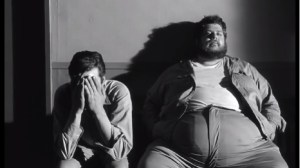
film review

Fat Fuck: Nymphomaniac (2014, dir. Lars von Trier) and Concussion (2013, dir. Stacie Passon)

[CW diet talk, discussion of consensual sex]

Two recent films, Nymphomaniac and Concussion, spend ample time exploring the marginalized sexualities of their (thin) female protagonists. Joe (Charlotte Gainsboug/Stacy Martin), the titular character of von Trier’s epic, labels herself as a nymphomaniac and constructs her life around her insatiable libido; Abby (Robin Weigert), the heroine of Passon’s directorial debut, is a lesbian who subverts her life as a mainstream upper middle-class homemaker by involving herself in sex work. Both women have fat sex partners over the course of their respective stories, neither of whom function as a source of comedy or disgust.

A common observation of fat characters is that they possess an inappropriate sexuality relative to thin characters in the same film, either lacking in sexual desire or experience (based on the assumption that nobody wants to have sex with fat people) or being too assertive or indulgent with regards to their sexuality (based on the assumption that fat people desire more and control themselves less than thin people). Fat people in movies are often treated as de facto repugnant or pathetic, but even more so when they are seen as sexual beings. A portrayal of fat people experiencing lust the same as thin people, even being accepted as a thin person’s lover, is enough to make these movies stand out as unusually fair-minded with regards to body diversity. However, both F and Woman #1 are portrayed as less exciting than their thin counterparts, and evoke a sense of family and domesticity, elements which the protagonists of both films are trying to avoid or escape.

Nymphomaniac presents a series of flashbacks, where Joe relates her story Seligman (Stellan Skaarsgard), an asexual bookworm who compares the details of her life to his various intellectual pursuits. As the title suggests, a large portion of these flashbacks deal with Joe’s sex life. Nearing the end of Volume 1, almost 2 hours in, I found myself getting bored with scene after scene of Joe having rather vanilla sex with male partners, mostly young and thin. F’s arrival was perfectly timed. Joe describes a time when her sex life was a perfect balance of harmonizing elements, like a polyphonic organ piece, with F (Nicolas Bro) as the bass voice. If memory serves, this is the first time we see someone go down on Joe, shown in extreme closeup. F focuses on Joe and her satisfaction. “Without words, he knew exactly what I wanted, where he should touch me and what he should do. The most sacred goal for F was my orgasm.” Because he is so trustworthy and stable, Joe privileges him with activities she does not her other sexual partners. While she explains this in voice over, we see him gently washing her in a bathtub.
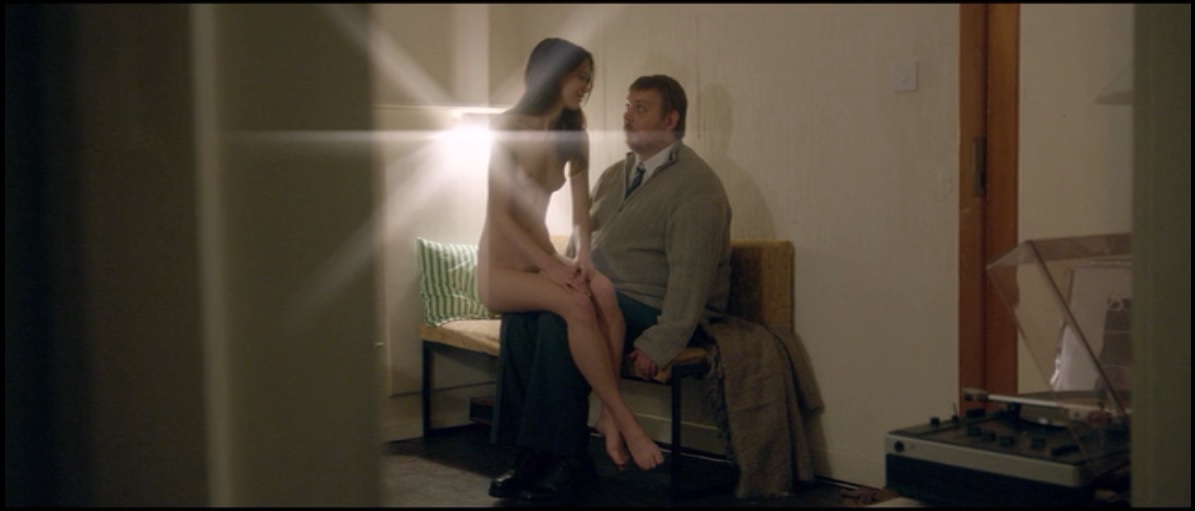
nicolas bro, nymphomaniac, stacy martin

The entire time we see Joe and F together, he is clothed and she is naked, heightening the contrast between their ages and body sizes. F is not Joe’s only extragenerational partner, but he is certainly the most paternal. Immediately after seeing them have sex, we cut to an image of Joe sitting on F’s lap, giggling as he tells her a fairytale. F’s arrival in Joe’s story immediately follows the death of her father (Christian Slater); perhaps it is not coincidental that she would so fondly remember a lover who would be “reassuring” and a “foundation,” while so strongly feeling the absence in her life of her dad, who provided her with a sense of security and consistency. F also contrasts with H, a previous lover of Joe’s who leaves his wife and children– his role as a father– to be with her. We have no information of who F is outside of his relationship with Joe, but if he is a father (or some other form of caregiver), he manages to merge the elements of that identity with being Joe’s lover.

F is accepting of Joe’s multiple partners and is actively in deference to her lifestyle, as he often arrives early and patiently waits for her in his car (which was bought used, she points out) with a bouquet of flowers, or in Joe’s living room while she has sex with someone else in the bedroom. F’s patience an example of one of Nymphomaniac‘s strong points: the refreshingly personal and straightforward portrayal of deviations (so to speak) from normative sexuality: monogamous, possessive, not extractable from idealized romantic love. However, F seems emasculated and powerless when Joe compares him to the other members of Joe’s sexual polyphony– and this comparison is explicitly illustrated, in split screen. G (Christian Gade Bjerrum), designated the second voice, is “the only one [Joe] had to and wanted to wait for.” Instead of arriving early, G stands on her threshold when she invites him in, entering as he pleases. Joe finds this exciting because it takes away her control of the situation; she compares G to a predatory wild cat. The sex that she has with G is rough and feral, polarized from F’s “predictable” lovemaking. The two create a spectrum of sexual experience that is beyond limited descriptions of a binary of straight/gay (sometimes expanding to dominant/submissive). As we see an image of a leopard killing a deer, representing G, we also see F waiting in his car for Joe to see him. In between these two is the cantus firmus, Jerome, the closest character to a typical One True Love a viewer might expect to see in a film that focuses on a woman’s love life. These series of images also show Joe’s face while she has sex with them. With G she is wantonly excited; with Jerome she seems transported by the intimacy and soulfulness of their lovemaking; but with F she appears placid and peaceful.

nymphomaniac, lars von trier, stacy martin, shia la boeuf, nicolas bro

Joe describes F as essential to her happiness, but ultimately unsatisfying on his own; Jerome, however, she entreats to “fill all [her] holes,” to complete her, and the fate of the film brings them back together again and again. Even if F displays generosity beyond her other lovers and is seemingly supernatural in his ability to anticipate her desires, what he offers is ultimately incomplete on its own.

Concussion‘s opening sequence is composed of voice overs of women talking about maintaining their aging bodies and images of a gym, showing a spin class of fit women in slow motion, sneaking competitive glances at each other. The film is about a lot of things– queer assimilation, aging– but the body is a prominent and recurring theme. Abby’s dissatisfaction with her life as a stay-at-home is brought to a head by a concussion she suffers accidentally at the hands of her son; there is an early scene of her running on a treadmill until she vomits. She deals with the dissatisfaction by going back to work in New York City, then patronizing sex workers, then finally becoming a sex worker herself, seeing women clients at the condo she is renovating. Like her protagonist, director Stacie Passon is a lesbian, and Concussion does step away from the normative male gaze in some significant ways, including showing sex between women who do not have all the characteristics required to be a woman with a sex life by most films. Some of the women Abby has sex with are older, some have extensive tattoos, one client has a mastectomy scar, and– in case you haven’t guessed where I’m going with this– another is fat.

Abby’s fat client (Daria Rae Feneis) is only known as Woman #1, all clients of Abby’s only being referred to by numbers. It would be easy to see someone patronizing a sex worker as a sign of their inability to attract a partner without the exchange of money, and that sex workers will do anything (or anyone) as long as they’re paid. However, the film makes clear that Abby wants to have sex with Woman #1. Abby is very particular about her clients: she is not willing to go to their homes, and she insists on having coffee with them first, even though The Girl (Emily Kinney), her manager, screens them. Abby even rejects her first potential client for doing homework while she waits for their rendezvous. Abby wants to have sex with Woman #1 as an individual, not solely because she wants (or needs) the money.
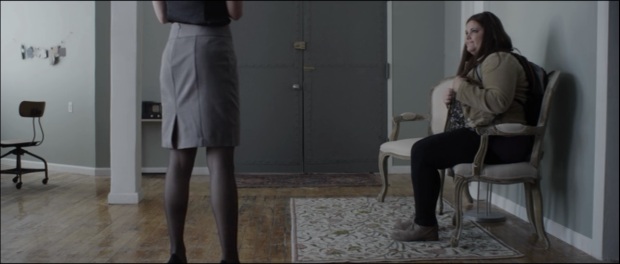
daria feneis, concussion

Woman #1 embodies some characteristics often seen in fat film characters. She initiates the conversation awkwardly, talking about a Women’s Studies class she is taking where she has to draw her vulva and talk about her drawing in every class. She even brings a folder of these drawings to show Abby, who politely declines, recreating a common dynamic in films where a fat person’s social inappropriateness is highlighted or regulated by a thinner person. (Slight tangent: as someone who has taken over a dozen Women’s and Gender Studies courses– none at NYU, granted– this class exercise strikes me as absurd.) Women #1 describes drawing her vulva as having a force field around it, because she is 23 and has never had sex or even been kissed. The character comes across as shy and awkward (although she is very pretty), and her lack of experience is never explicitly linked to her weight, but given the setting and sexual/relational experience of the other characters, her late-bloomer status sticks out like a sore thumb. Women #1’s appointment with Abby– a first time for both of them– is quietly drawn out with tension and tenderness. Abby reassures her that she doesn’t have to do anything, can stop at any time, and Abby will do things that she wants to do. Woman #1 is still awkward, however; she neglects to take off her backpack, and after their kiss, she remarks that Abby “smells like oranges.”

During a subsequent visit, Abby finds the ingredients for a Master Cleanse in Woman #1’s bag, which her mother has given her to “start [her] off.” Abby assumes a maternal role in this scene, overriding Woman #1’s mother’s influence by giving her three books to read: Simone de Beauvoir’s feminist classic The Second Sex (“the Bible”), a book on vegetarianism, and a collection of Gandhi’s writings, which Abby describes as “an excellent book for weight loss.” (Another slight tangent. Overall I liked this movie, but the script rubbed me the wrong way at times, this line possibly being the worst example. I trust, reader, that I don’t have to go in-depth as to why it’s hugely problematic for rich white Americans to appropriate aspects of anti-colonial resistance to support their own assimilation into a beauty standard. I confess I’ve never read Gandhi’s writings, what about them makes them excellent for weight loss? Is Woman #1 supposed to fast? Because that slows your metabolism down. Is she supposed to use white guilt as an inspiration to be self-denying in her food choices? Does Gandhi talk about tips for cutting carbs at some point?) She then encourages Woman #1 to throw away her cleanse materials, “because that shit will kill you.” Woman #1 glows as she looks at Abby, who is treating her as a human being whose health needs to be prioritized, not a fatty problem to be eradicated using any means possible. I’m guessing that she experiences the latter attitude from the other people in her life more frequently than the former. We never find out if she herself wants to lose weight, though.

The third and final session we see between Abby and Woman #1 shows a progress in both of their explorations of sexuality. Their attitude with each other is relaxed and intimate; the camera is closer to them than ever. Woman #1 says that she read the books Abby loaned her, but didn’t lose any weight. This scene subverts the expected story beats that Woman #1 would have lost weight, or that a dramatic moment would occur between them (Abby giving some inspirational speech, Woman #1 revealing a dark secret), as the two laugh over this fact and move on with their conversation, as Abby strokes her hair affectionately. Woman #1 also says that she wants to move on from their arrangement and “try something new, like, maybe a guy.” The other woman who Abby loses to a man is Sam (Maggie Siff), another mom from her social group who shares a passionate liason with Abby, and understands her dissatisfaction, but ultimately decides to stay with her husband. Sam, like Woman #1, ties Abby to her inescapable role as a mother.

daria feneis, concussion

Losing her client is paralleled with scenes of Abby’s children waiting for her to pick them up at school, her failing to be a mother. As Abby has chosen to be unfaithful by having sex with women other than her wife, Kate (Julie Fain Lawrence), she is also unfaithful to her role in her family in that she is mothering someone who is not one of her children, neglecting them in the process.

As so much of the energy and rhetoric of the needs of LGBT folks is channeled into marriage equality, and the “we’re just like you” message, there is a dearth of questioning the merits of a white picket house in the suburbs as a desirable goal. Marriage equality and liberal social values allow Abby and Kate to have their American dream in an affluent suburb, but it shouldn’t come as a surprise that Abby would find that dream ultimately as hollow as Lester does in American Beauty. (Considering this film is about college-educated white folks, the attainability of that goal unfortunately doesn’t figure in to its critique.) Concussion‘s main story raises some radical questions about values and stories that we take for granted. This spirit is extended to Woman #1 to an extent– Abby finds her desirable, she isn’t punished for not losing weight– but some toxic presumptions remains intact: the inherent awkwardness of fat people; the inherent struggle to not be fat, even when failing to meet that goal comes as no surprise.

Concussion is a bit unrefined and Nymphomaniac a bit arduous, but ultimately it was a pleasure to watch both them. Even in their failings, it’s always refreshing to consider a film’s drawbacks through a feminist lens that called for more consideration and nuance than “hey, this film doesn’t pass the Bechdel test.” Both have interesting things to say about women’s sexuality, and what it means for a woman to search for happiness and fulfillment. The combination of these ideas puts both protagonists at odds with domesticity. However, even in searching for personal evolution through sex, the characters find themselves in dynamics that parallel their roles as members of their respective families, both with fat lovers. Despite the radical portrayal of fat people as desirable, the films ultimately don’t go far enough, and saddle these characters with drawbacks that can neither offer liberation or stand up when compared with more normatively attractive partners.
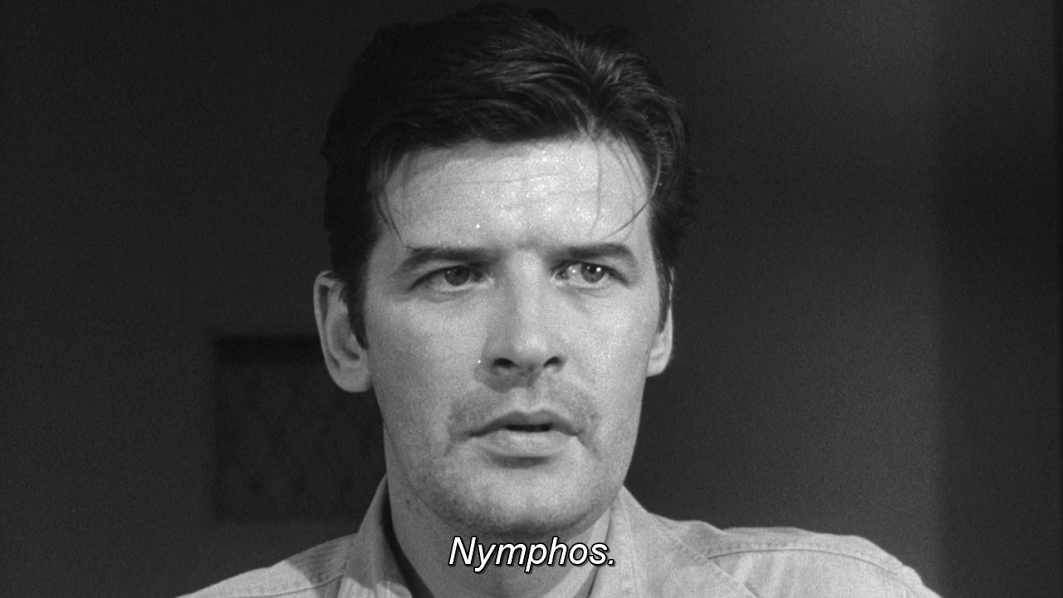
Fat Girl’s Shoes: The Wolf of Wall Street (2013, dir. Martin Scorcese)

[CW: sexist language, description of sex scene]

I resisted watching The Wolf of Wall Street when it was in theaters; I didn’t see it until a few weeks ago, when it hit Redbox and Patrick wanted to rewatch it.  The production of this film is admirable, but in the same way that some people can’t stomach slasher movies, I have trouble finding entertainment in stories about predatory capitalists.  I’m not keen on writing anything that would necessitate a rewatch of the full three hours, but a few thoughts sprang to mind.

The world that Wolf portrays constructs a binary of winners and losers, the divide only quantified by one’s bank account.  Characters do not gain or lose weight as part of the story to inform us that they have crossed the divide from one category to the other, as in Death Becomes Her or Dodgeball: a True Underdog Story.  The type of characters who those films are about– the women of Beverly Hills and gym-goers– have statuses that are tied into their ability to maintain the ideal body type, which both films comment on.  Compare this to the main characters in The Wolf of Wall Street:  the stockbrokers statuses are directly wealth-based, and they make this wealth from manipulating the people they associate with, their clients and employees.  Thus it is appropriate to Wolf‘s logic that associating with fat people, over one’s own body being fat, is one of the ways in which the film signifies loserdom, synonymous with being anything but upper class.

The Wolf of Wall Street is conspicuously absent of fat women, the possible exception being Jordan’s (Leonardo diCaprio) housekeeper (Johnnie Mae), who, tellingly, is also the only black person in the film.  The reason I say this is a conspicuous absence, unlike other movies that lack fat female characters, is that hypothetical fat women are symbolically attached to male characters to mark them as losers.  In a passionate speech to his sales team, Jordan spurs them to success by presenting two futures:  driving a new Porsche with a beautiful, large-breasted wife in the passenger seat (and if Jordan’s own wife is any example, the winner’s wife is thin), or driving a beat-up Pinto with “some disgusting wildebeest with three days of razor stubble in a sleeveless muumuu, crammed in next to you”– an image that evokes laughter from his team, his “room of winners.”  Anyone who doesn’t see Jordan as a role model is instructed to “work at McDonalds,” low-paying jobs and low-quality food being the shameful realm of losers.  Stratton Oakmont has some female stockbrokers as well; even if they are not seeking trophy wives for themselves, they still distance themselves from fat women to prove they are winners.  In one scene, shoe designer Steve Madden presents his company to the Stratton Oakmont team but lacks Jordan’s charisma: the pack quickly turns on him.  “They’re fat girl’s shoes!” one of the female brokers shouts out derisively, as her coworkers throw things at him.

The winners constantly surround themselves with thin, beautiful, sexually available women.  However, even these women are broken into categories of winner and loser.  Jordan describes three types of sex worker whom Stratton Oakmont hires, describing them in terminology he uses for the product he sells.  The “blue chip” women who charge the most are “model material,” the example being a beatifically lit, model-thin woman who floats towards the viewer from among a small group of stockbrokers, laughing and holding a flute of champagne.  The “NASDAQs” are the mid-tier sex workers: a curvier woman who jiggles her body suggestively at the larger group of office workers around her; she is drifting like the “blue chip” woman, but moving across the screen as though she were on a conveyor belt at a grocery store checkout.  Finally, the “pink sheets” are the “skanks” who charge the least, represented by a larger woman still who is bored and stationary, braced against a desk while her flesh bounces from the force of the stockbroker who is fucking her, a horde of his coworkers packed in the office, waiting for their turn.  None of these women could rightly be called fat, but this is a context where the range of body size considered beautiful is as slender as those who fall within it; the trimmer the body, the more monetary worth assigned, the more exclusive her company.

But what of the gentlemen?  A few of the guys in Jordan’s “pack” are chubby, and ostensibly winners, but they are only winners through their connection to Jordan.  The pack are initially presented as losers, all of whom are weed-dealing hometown buddies of Jordan’s who are slow to understand his business philosophy.  Jordan has to groom them into aggressive salesman through giving them a literal script.  They live through him vicariously to an extent, egging him on to seduce Naomi (Margot Robbie) while they watch from a balcony; this is the dynamic that Jordan’s success thrives on.  “I know they’re knuckleheads,” he tells his dad (Rob Reiner) in order to explain why sex workers’ services are billed as business expenses, “I need them to want to live like me.”  Jordan embodies the winner, inspiring his employees to be more ambitious and aggressive.  Not only is Jordan the man with the Porsche and the $40,000 watch he can throw away without batting an eye, he is the provider of thin, beautiful women.  Moreover, Jordan has learned the secrets to hyper-success in his field from Mark (Matthew McConaughey), one of the slenderest male characters in the film.

Donnie (Jonah Hill), Jordan’s right hand man, is the prime example of the fat man who can’t quite be a winner on his own.  He is desperate for Jordan’s approval from the start, offering to work for him minutes after introducing himself.  He does things that are socially awkward and downright taboo, such as marrying his first cousin and masturbating in the middle of a crowded room.  Jordan and the others make fun of him when he’s more inebriated than they are.  He may be sexually attracted to men, not a trait that is looked upon favorably in the movie’s world.  He mirrors Jordan’s ruthlessness, but in a way that is less inspiring than Jordan’s speeches.  During a crucial trading day, Donnie shames a stockbroker who has taken a few minutes to clean his fishbowl by swallowing his goldfish in front of the whole office.  Donnie asserts dominance over his employee, but the self-imposed frat house dare that he utilizes is model behavior for a goofy fat sidekick.  Even after he becomes wealthy, Donnie stays married to his cousin, suggesting his inability to leave behind either his boorish personality or his middle-class beginnings.  Jordan, on the other hand, becomes more charismatic and assertive as he gains wealth, divorcing his first wife who he married before making it big in favor of gorgeous, blonde Naomi.

There are several factors and turns of events that bring about Jordan’s downfall, but Donnie is a factor in a few of them.  He calls their banker on a tapped phone under the influence of quaaludes (before choking on a piece of ham).  Through his awkward way of socializing, he provokes another pack member into a fight in public, which gets the police involved.  Donnie’s poor decision making is not the only harbinger of doom for Jordan:  Jordan alerts Donnie that he is wearing a wire, which incriminates Jordan in tampering with an investigation.  Jordan’s friendship with a fat person, making a decision to protect that friend in contrast to his materialistic winner persona, has contributed to his departure from the “winner” category.  In a final stroke of fate, Jordan’s high class position unravels for good due to a bourgeois restaurant chain.

Despite imagery in media such as political cartoons that cling to using fat as a symbol of privileged wealth, the reverse has been true in USian culture for generations.  A slender body is the ultimate sign of wealth that people of every class are mandated to strive for, a body that has the time and resources to be sculpted by plastic surgery, personal trainers, fad diets, and cocaine, a body that symbolizes the willpower and drive required to survive in the bootstrap narrative we tell ourselves.  Fat bodies are seen as lower class, associated with overindulgence, lack of social ability, and poor decisions, qualities that contribute to failure.  Despite the characters in The Wolf of Wall Street adhering to this mentality, we see that Jordan, despite his straight-sized body and financial success, can’t separate himself from “fat” behaviors and characters, showing us how fleeting and unstable the conditions for winning are.

The Grotesque: Shock Corridor (1962, dir. Samuel Fuller)

Go on stage, while I’m nearly delirious?
I don’t know what I’m saying or what I’m doing!

— “Vesti la giubba,” Pagliacci, Ruggero Leoncavallo

[CW: mental illness, ableism]

An Icarus myth for the post-Freudian era, Shock Corridor follows Johnny (Peter Breck), a ruthless journalist who goes undercover at a psych ward to solve a murder and write a Pulitzer-winning article, but suffers damage to his own mind in the process.  The murder mystery plays out with all the complexity of a videogame fetch quest, but the the film has cult status due to its evocative exploration of the protagonist’s downfall.  Exploitation excitement is applied liberally, including how the plot kicks off:  Johnny gains admittance to the mental hospital by pretending that he has an overwhelming sexual attraction to his sister– played by his exotic dancer girlfriend Carol (Constance Towers)– which manifests in part as a fetish for long hair.

Once inside, he meets a number of astonishing characters among his fellow patients, who can be roughly separated into two categories.  The first category is patient-characters, those with a tragic backstory steeped in social conflict that causes delusions of a false identity; of note is Trent (Hari Rhodes, whose performance blazes), a young black man whose sanity crumpled under the racist backlash of being the first black student at a segregated college, and now believes himself to be a white supremacist and founder of the KKK.  The second is patient-caricatures, bit players who crudely cater to the conflation of mental illness with freakishness, such as the predacious pack of nymphomaniacs who assault Johnny, or the catatonic schizophrenics furnishing the ward hallway where much of the action takes place.

shock corridor, samuel fuller, peter breck

Among the inmates of the hospital that Johnny meets is Pagliacci (Larry Tucker), a fat man who is mentally immersed in opera.  Pagliacci occupies a space in between these two kinds of inmate.  He isn’t a patient-caricature: he has a name, a personality, an ongoing relationship with Johnny.  He is more like the patient-characters, those patients whom the audience are shown to be something apart from their mental illness.  The veracity of these personal details are open to question, however; Johnny’s voiceover, serving as an objective narrator, gives us information about the patient-characters’ lives before they talk about themselves.  Pagliacci is not afforded this confirmation.  Similarly, the three patient-characters have lucid moments where they monologue about their personal histories, explicitly detailing how contemporary issues intersected with their personal struggles (a signature of Samuel Fuller films), whereas Pagliacci is never given a monologue that connects him to a macro-level conflict.

The entire film can be read as grotesque, but its most vivid embodiment is Pagliacci.  I use this term not as an aesthetic or value judgment on his body, but in reference to the grotesque as an artistic concept, “a hesitation between horror and comedy… often rooted heavily in the physical…the inside becomes the outside, and the outside becomes the inside.”  He manifests the grotesque through a presence that speaks to the threat of potential disorder, through his defiance of easy categorization, and through his subversion of expectations set up by the other characters.

Pagliacci delivers the chaos and abnormality that the audience expects from a film set in an asylum.  When the audience is still being introduced to the hospital as the movie’s main setting, he starts a melee in the cafeteria.  This facet of the character is arguably the one most blatantly symbolized the most by actor Larry Tucker’s body.  Pagliacci is not husky or chubby: he is markedly fatter than most film characters, even most people than the “typical” audience member would know in real life.  His body differentiates him from the other characters, and likely alienates him from viewers, making him more of a spectacle than a sympathetic character.  The patient-characters all have some external display of their psychological conflict– Stuart wears a Civil War-era hat, Trent obsessively makes Klan hoods out of pillowcases, Boden sits on the floor like a child and draws with his crayons– but Pagliacci’s difference is intrinsic to his body, a body unlike any other on the screen.  He also has longer hair than any of the other male patients and is the only one with a beard, adding to the physical manifestation of his abnormality.  However, his mental state and personal history is hidden behind a veil of music, the external event that brought him to the hospital forever a mystery– the Samuel Fuller School of Psychology teaches us that mental illness is triggered by stressful life events– unlike the other patient-characters, whose histories are richly communicated to the audience.

shock corridor, samuel fuller, peter breck, larry tucker

The fat body is often used as a warning to straight-sized people: this could be you, if you fail to regulate your own body according to social norms.  Pagliacci is a portent of Johnny’s loss of control, and the last scene shows a catatonic Johnny who has indeed lost control of his body. But Shock Corridor’s horror is fueled by losing control over one’s brain.  Johnny has dangerously neglected to regulate his mind by entering into the world of the mental hospital, and the film tracks the downfall that is due to that choice.  Pagliacci also provides foreshadowing for Johnny’s fate through the script: “When we’re asleep, no one can tell a sane man from an insane man.”  Late in the film, Johnny’s breakdown begins when he hallucinates an indoor rainstorm.  “I like the rain,” Pagliacci comments peacefully, validating his friend’s psychosis. Now that Johnny is also insane, Pagliacci has shifted from the childish kookiness he displays at the beginning of the film to placidity. Johnny screams in fear and agony, causing Pagliacci to chuckle.  “That was such a sour note, John.  You were way off key.”

Pagliacci conducts himself socially in a way that is markedly different from the other patients.  He is the first patient Johnny interacts with, and is the only one to initiate interaction (except for the nymphomaniacs).  After Johnny has been shown his room, Pagliacci welcomes him, grabbing his hair and putting his arm around Johnny’s shoulders.  He rouses him from sleep several times.  His transgression of social boundaries, coupled with his annoying habits and erratic behaviors, fulfill the audience’s expectations of him based on both his size and his insanity.  Fat movie characters often act in socially inappropriate ways, tied closely to the idea that fat people are stupid and lack control, while at the same time providing comic relief or plot-driving villainy.  This overlaps with how mentally ill people are often portrayed, acting in outlandish ways to signify their lack of control and provide a spectacle for the audience, usually making us fear for the protagonist’s safety.  And between comic and horrific lies the grotesque.

Like the patient-characters and Johnny, we are given insight into Pagliacci’s mind.  However, unlike the memories of life on the outside shared by the patient-characters or Johnny’s increasingly frantic scheming, Pagliacci’s thoughts are music, specifically “Largo al Factotum” from Giacomo Rossinni’s opera The Barber of Seville (aka “Figaro Figaro Figaro”).  This is the song that Pagliacci sings constantly, creating a repetitive, off-key soundtrack that quickly becomes annoying.  What is most likely is that the opera references in Shock Corridor are chosen for their recognizability.  However, intentional or not, they create an interesting paradox: a character whose mind is apparently looping an aria from a comedy about a clever jack-of-all-trades who helps two people fall in love, but whose namesake is a tragedy about an actor who murders his unfaithful wife.  After singing “Largo al Factotum” while he mimes stabbing Johnny, paralleling how Canio stabs his wife and her lover at Pagliacci’s climax, he recites its final line “La commedia è finita!”  (Pagliacci is Italian for “clowns,” referring to the main characters’ travelling commedia dell’arte troupe. Canio is the protagonist’s name, the character on whom the image of the sad operatic clown is based.)  Once again, Pagliacci is situated between categories.

Pagliacci subverts Johnny’s expectations of his fellow patients.  Johnny’s motivation in going undercover at the mental hospital is to solve a murder, and his motivation for solving the murder is to win the Pulitzer Prize as a reward for his stunt.  Even in solving the murder, he has no interest in raising concerns about the safety and fair treatment of the hospital patients (in contrast to Nellie Bly’s investigative journalism, presumably a historical inspiration for the film).  Johnny treats his fellow patients as means to an end, treating the murder witnesses with empathy and understanding until they have lucid moments of reality.  When this seeming miracle occurs, they want to talk about their lives and their trauma, but Johnny only wants to ask them about Sloane’s murder.  Even when speaking to the final witness, who reveals that the murderer is an orderly who rapes patients, Johnny can only focus on getting the final piece of information needed to solve the murder.  In a sense, the way Johnny treats the patient-characters is a microcosm of the way Fuller treats them, avoiding the temptation to create well-rounded characters who are living with mental illness in favor of human megaphones for his opinions on controversial issues and puzzles for his protagonist to solve.  Pagliacci, however, is not a passive font of information waiting for Johnny to open him up.  He does confirm that Sloane was killed in the kitchen with a knife, and demonstrates to Johnny that the hospital patients are capable of lucidity (what a revelation).  But he reveals these things to Johnny on his own initiative.  He pushes himself on Johnny.  This serves to both protect the protagonist, such as encouraging him to chew gum to help him fall asleep, and to terrorize him, reminding the audience of the potential danger Johnny is in.

Pagliacci tells Johnny that he “died of a heart attack caused by overweight [sic],” and claims that many people came to his funeral because “they wanted to make sure [he] was dead.”  In claiming a fatal heart attack and funeral as part of his history, Pagliacci presents himself as a living dead man, another paradox.  This is a small but curious moment in the film, one that unsurprisingly lingered in my mind.  Pagliacci subverts the pathologization of his body, a “morbidly obese” body that is prescriptively assigned an early heart attack and death, a fate that he claims but obviously has not come to pass.  Perhaps he shares more in common with the other patient-characters than at first glance.  Perhaps, in accordance with Shock Corridor’s logic, Pagliacci’s mental illness stems from being told so often that his heart would give out that his mind finally accepted the role of a dead man as the only acceptable way to exist in a culture that assigns fat people an early death, similarly to how Trent’s mind assumed the role of a white supremacist to exist in a culture that maintains racism as the status quo.  This moment speaks to a mind uncontrolled by psychiatry, materialized in a physique uncontrolled by medicine.

He then tells Johnny that he killed his wife: “I despite butchery!  I didn’t want my wife to die like Sloane, so I gently sang her to sleep.”  Obviously Pagliacci is alive, so this statement throws a shadow of doubt over the rest of his words.  Is Johnny sleeping next to a murderer?  Or is Pagliacci conflating his own history with his namesake’s plot?  Disorienting the truth of Shock Corridor also undermines what the audience expects from Pagliacci.  Is he the dangerous person we expect from a mentally ill character?  Or is he guilty of the crime of passion we expect from the climax of a dramatic opera?  Is he the degenerate we expect fat men to be?

The grotesque unsettles us, presents us with something outside our ordinary experience that provokes simultaneous, divergent reactions.  The paradoxes in Pagliacci’s identity put us as audience members at this crossroads.  Is he the dead man to be pitied, the zany buffoon to be laughed at, or the unstable murderer to be feared?  We don’t have one simple reaction to Pagliacci, but all three options are common ways the audience is led to react to fat characters, and none of the possibilities lead to empathy.

The Alien Gender: Under the Skin (2014, dir. Jonathan Glazer)

Content warning: discussions of transphobia, violence, sexual assault

This isn’t a piece about fat characters, but I think a piece about transgressive bodies, especially when it’s such a strong theme in one of the best movies of the first half of 2014, is appropriate for this site. I also wrote a short piece about the perception of time in Boyhood compared with other Linklater films, also unrelated to fat characters, which you can find here on my Tumblr. This is also a work in progress, so feedback would be extra appreciated. I’m not super enthralled with how it’s currently organized, but I’ve been working on it for a hot minute and I wanted to share my ideas.

yesterday i went to the daley center to provide moral support for a friend who had a court appearance.  on the way in, there are metal detectors, with two separate lines for “male” and “female.”  i pretended the signs meant my preference for the security guard’s gender, should the state deem it necessary for a stranger to put their hands in my pants.  i hoped that of the group of folks who would potentially show up, the one friend who knows about my nonbinary gender identity would be there so i could vent to her.  she wasn’t able to make it.

on the way back to the l, a guy stopped me on the street because i’m a “lady with short hair,” and he was selling salon services to “ladies” to do lady things like buy product to enhance some of the hair on my lady body and get the rest of it removed. i usually try to end these kinds of sales pitches as soon as possible, but i was so nonplussed at being categorized as a “lady” every other sentence, i let him go on for several minutes before turning him down.

there’s no space for me here.  you don’t know who i am.

attraction to cisgender women is difficult for me because my internalized transphobia often gets in the way, the nagging proviso to experiencing those erotic or romantic feelings that invariably tells me that she’s better than me, because she’s doing gender “right.”  as you might imagine, those contrasting feelings are prone to arise when i see an actress in a movie.  but i didn’t feel that way about scarlett johansson’s unnamed character in under the skin— perhaps because she is so achingly beautiful in this movie it overwhelmed my hangups, or perhaps because she isn’t a cisgender woman.

of course, that last observation comes from my interpretation of the movie.  we have no information about how she identifies in terms of her gender, if she even has one.  she acts and dresses in ways women are expected to, we see that she has breasts and it’s strongly implied that she has a vulva.  she scores a woman-bingo if we’re playing by binary gender rules.  these are all trappings of her human disguise, though. under the skin (ooh) of her gender normativity is a body and history that subverts expectations.  this isn’t someone who has been designated female by a medical professional, based on her anatomy.  she isn’t human, her body is outside of our human knowledge of what peoples’ bodies look like.  we don’t have the language to describe her body or her identity, and the film doesn’t give it to us.

i read several articles about under the skin before seeing it in theaters when it came to chicago in april.  there was a repeating observation of viewers feeling detached from her, seeing her as a “non-character.”  i was shaken by my reaction to the film, because despite johansson’s reserved performance, i felt a deep sense of relation to her.  i honestly thought there was something wrong with me; i have since realized that odd feeling of recognition stemmed from looking at someone who is disguised as a woman, but just below the surface has a self that is outside the normative understanding of gender.

that last sentence can function both as my reaction to under the skin and as a nano-memoir.

the film begins with the literal construction of her body: her eye is assembled, her voice is trained. the first scene where we see her whole is in the mall, where she buys a fur coat, a second skin that suggests sensuality, that she can access through consumerism.  this is how she acts for most of the film, through the conscious artifice of being a woman, acting out femininity as a means to an end in ways that reflect culturally constructed desires and expectations.

on the prowl, she embodies the phallic mother archetype, the woman who wields masculine power while retaining her femininity (paradoxical in the context of patriarchy). perhaps a more familiar variation on this archetype would be the “modern” woman, who remains sexually pleasing to men while adopting the competitive, unemotional approach to work and sex that men supposedly aspire to.  while the people on the beach react emotionally, struggling to save their family members despite lacking the physical strength to do so, she remains opportunistically focused on her goal.  her disregard for the welfare of a baby seems especially shocking from some-body who is presumed to have an innate maternal instinct.

she caters to a “typical” straight male fantasy: a gorgeous woman who finds you interesting and propositions you.  the static shots from hidden cameras in the van during these scenes even suggest the low-budget voyeurism of amateur porn.  i haven’t heard anybody who has seen under the skin question the believability or logic of this sequence of events that repeats itself and flows without hesitation from the men, even when she brings them to dilapidated buildings– despite driving a large, windowless van– then into a room with a physics-defying lighting scheme.  however, she is simultaneously embodying the male role in this scenario, calling out to the object of her desire from the driver’s seat, an interaction that plays out in popular fantasy (e.g. bang bus) and reality (e.g. multiple times every day out of car windows across the globe). her third victim is first seen hollering at her from a car window; later, a male driver stuck in the same traffic jam as she sends a rose to her van.  she fulfills a dual role in this fantasy, allowing the straight male viewer to simultaneously imagine what it would be like to be propositioned by scarlett johansson and what it would be like to be as alluring as scarlett johansson in his traditionally gendered role of propositioner, the role he may even resume as soon as he drives his own vehicle out of the cinema parking lot.

Under-The-Skin-trailer-2

the scenes of the seduced men being devoured are heavily coded as feminine.  mica levi’s score is buzzing and mechanical, but the soundtrack of the men descending into the blackness to their fates is an eerie deconstruction of music from a seduction scene in a more conventionally romantic movie.  (levi described this part of the score as something the character puts on like makeup.)  the act of killing is not the physical violence associated with masculine-coded combat, although we see from the beach scene that she is capable of that kind of violence.  no, this killing is the climax of an act of seduction that is never consummated, man brought to ruin through the promise of sex.  she undresses as she walks away, hips swaying and glances beckoning, the man in pursuit. here she embodies another archetypal paradox: she is walking the line between virgin and whore, simultaneously sexually available and untouched. it is as if she has learned how to be a woman through the lens of commercialism: her gender performance is intensely focused on attracting, ingratiating, persuading, creating the illusion of uniqueness and intimacy when each interaction is ultimately the same thing.

her lair’s physical aspects symbolize cisgender women’s bodies.  where means of violence in movies are commonly and often iconically phallic, the consumption of the men by the blackness is vaginal.  beneath the surface is womblike: darker than the surface where she walks, the naked men look small and indistinct, like fetuses, and are suspended in a liquid.  the third victim reaches out to touch the previous victim, both of them in a regressed state of helplessness.  their fate is to have their insides sucked out, leaving limp bags of skin. we don’t know her reasons, but it is a vivid depiction of the culturally ingrained fear for men of being sucked dry by a seductive woman, for financial or emotional security.

images of glasglow street life are transposed on each other, building into a kinetic golden haze from which her visage emerges, aphrodite arising from the foam of social embodiment.  however, she is reflecting femininity of a culture where to be feminine is to be vulnerable.  her balancing act of passing as a woman is unsustainable, as going through the world as a woman leaves her open to violence, such as when the group of young men attack her van, demanding she get out of her seat of power.

the change comes when she picks up the man with facial deformities. people with disabilities are marginalized in many ways, including commonly having their gender identity or sexuality denied or ignored by the able-bodied people around them.  he is not playing by the normative script of her seduction; he doesn’t enter their interaction with the assumption that she would be sexually available to him.  she has to convince him of the situation’s reality, which requires making more of a connection with him.  there is more negotiation, more probing questions, beyond assessing how long before someone would notice him missing.  he questions the reality of the situation; instead of the static hidden camera shots, we see a closeup of his hands as he pinches himself, then him looking around her lair.  on some level, he realizes the artificiality of the situation, which speaks to a hidden truth.  “look at me,” she commands him, ostensibly to direct his focus towards the seduction.  she is in closer proximity to him than the others, fully naked in front of one of her conquests for the first time.  he is not the only one being commanded to look, for it is this scene where we first see her featureless alien form, her true self.  he asks if he’s dreaming; she confirms that he is.  even if this is a way of pacifying him, she is admitting that the seduction is an illusion, that she is an illusion.  after the man with facial deformities descends into the blackness, we see a closeup of her in profile, with a mid shot of her alien form superimposed over her.  we see her true, transgressive body.

when leaving the lair, she stops and gazes at herself in a mirror for a long time.  this largely wordless film leaves much to individual interpretation; some see the change in her as an attempt to become human, or growing empathy with humans, but i see this moment as the first time she truly confronts her human disguise as it contrasts with her alien self, and her ability to perform her previous gender role is subverted.  she frees the man with facial deformities, leaving him naked in a field, mirroring her own state: vulnerable, wandering through an unfamiliar environment.

she abandons her van on the side of the road and wanders through a fog bank, emerging on the other side. she is no longer able to perform as an idealized paradox of woman, but is still in her woman disguise.  without the end of seducing victims into her lair, what is her means?  her womanness does not exist on its own as an authentic identity for her, it is a disguise that fulfills a function.

she seems repelled by sensuality: she is without her fur coat, and cannot ingest chocolate cake.  she has lost her phallic power both in terms of external symbols and personal drive.  she wanders aimlessly, at the mercy of the elements; she trades in her van for a seat on a bus being driven by a man who warns her that she is underdressed for the cold.  she only vocalizes to admit to the concerned man that she needs help, after he asks her repeatedly.  the vacuum left by the loss of her formerly powerful gender role practically fills itself, the concerned man and bus driver write vulnerability onto her.  she replaces her own coat with the concerned man’s, and takes shelter in his guest room instead of her van and alien lair. she has become the damsel in distress.

when i first saw the film, i balked at the idea that the concerned man would have been as generous and trusting if not to a beautiful young white woman, but on the second viewing, i similarly wondered if she would have accepted his offer if he wasn’t a decent-looking man.  the closest she comes to interacting with human women is when a group of young clubgoers sweep her along with them, where she looks so confused that it borders on concern. i am skeptical that her performance of femininity includes interacting with women.

she has no script for the care she receives from the concerned man.  she remains silent and passive as he helps her in the ways he assumes she needs help.  he carries her over a puddle, leads her tentatively down a set of stairs. she initiates sex with him, but does so by childishly holding her face to him for a kiss and takes a passive role during their lovemaking, lying still under him in his bed, still wearing her lacy pink camisole.  it’s ambiguous as to how much of this is due to her genuine love for him and how much is due to not knowing how else to drive an interaction with a human being, grasping at scraps of knowledge of how to act in this new permutation of femininity.

the sex scene becomes arguably the most jarring and sad scene of the film when she realizes mid-coitus that something is horribly wrong.  she pushes him off her and inspects her crotch with a light before tossing it aside despondently.   oliver balaam of abstract magazine read this moment as her discovery that the engineers of her human body did not factor in her ability to have sex or take pleasure in it when constructing her disguise.  i saw her shock as the realization of what is expected of her body during sex, something that had not been part of her femininity informed by normative marginalization of honest discussion of sex, and her rejection of it.  i can understand balaam’s interpretation, even if i’m not willing to dismiss my own in favor of it, because both of us saw her distress at a sexual role that had been constructed for her by outside forces (either others of her own kind or human cultural expectations).

again, she is alone, on foot, this time in the wilderness.  the final sequence of the film could be interpreted as the tables being turned on her, but i don’t think it’s that simple.  i don’t believe that the scene was constructed as poetic justice; rather, i think it builds on her interactions with the concerned man and speaks to the inescapability of being seen as vulnerable when one is feminine.  there are parallels between the logger’s victimization of her and her victimization of her male passengers.  the conversation he strikes up gauges her lack of power (she is alone and unfamiliar with her surroundings), much like the line of questioning she conducts with her passengers.  the bothy is her third place of rest in the film.  unlike her lair or the concerned man’s home, it is a public place, accessible to anyone. away from her alien directive, or the expectations of a romantic relationship with the concerned man, she sleeps peacefully.  her prone form is superimposed over the trees being tossed in the wind, suggesting that she is able to find a comfortable, natural state in this solitude.

Under the Skin Official Trailer

once more, her freedom and solitude is not a state where she can find and assert her own identity; rather, the logger makes her a victim.  while being pursued through the woods, she attempts to drive away in the logger’s truck, but is only able to make herself more vulnerable by setting off its alarm, in direct contrast to the power and agency afforded her by her van.  the same music that scored her seductions plays sickeningly over this scene. there is a significant difference between the two:  rather than being a mysterious, abstracted act of violence that leaves the audience wondering her motives and goals, we know exactly why he is chasing and subduing her, what he sees, and what he intends to do.

her disguise has been coming apart– lipstick gone, fur coat replaced with a borrowed one; jeans and boots dirty, and finally, when her human skin tears in the logger’s hands.  she has endured mounting strains over the course of the film: the gendered cycle she is expected to carry out over and over, despite knowing that she being seen as a hollow illusion of herself;  the confusion and lack of direction once she leaves that forced disguise behind; the new identity she gains on the bus, and how she is unable or unwilling to achieve the romantic/sexual satisfaction tacit to that identity;  her ultimate inability to escape violent power struggles.  her disguise, her attempt to function in a system that was not constructed for her and never considered her existence to begin with, cannot be sustained.  she removes her skin, revealing a featureless, androgynous alien with skin like starstuff.  she holds her beautiful face in her hands, the eyes through which she perceived the human kyriarchy now gazing at her true self.  despite its authenticity, this is a self that cannot exist for long, that will not be allowed to exist, as the logger returns to set her on fire.  this stands in sickening parallel to the very real dangers that transgender women often face if they are discovered to be trans.  (note: in this comparison i am not suggesting that transwomen are “wearing a woman disguise”– transwomen are women– as she does in the film, rather that these are people who risk harm when they are discovered to subvert social expectations about their bodies.)  she collapses at the edge of a field as snow falls, the black smoke of her remains ascending to the sky she presumably came from and dissipating, as white snowflakes descend on the camera.  perhaps it is a natural elegy for her, or perhaps it is the way of the world overtaking and dissipating her.

under the skin speaks to the toxicity of gender roles, how the expectations that the place on everyone can be misleading at best and destructive at worst.  in it, i see an outsider who stands as an allegory for how i try to maintain my woman disguise through enacting roles written on me by others, and my fears of what will happen if that disguise tears too much.

The Paranoia of Being a Fat Audience Member: Snowpiercer (dir. Bong Joon-Ho, 2014); Lawrence of Arabia (dir. David Lean, 1962)

…and a few thoughts on why I started writing this blog.

Snowpiercer is a high concept sci-fi movie whose opening scenes are densely packed with exposition.  Humanity has fucked with the environment one final, glorious time, a handful of survivors have been circling the globe for the past 17 years via train in a self-sustaining and strictly hierarchal ecosystem.  We begin in the back of the train with our underclass protagonists.  Their existence is claustrophobic, dirty, meager, strictly regimented by cleaner passengers with uniforms and guns.  But the tipping point of their oppression comes when two of their children are taken for an unspecified purpose by Claude, the woman in yellow (Emma Levie):

image from moviestillsdb.com

It is a shocking scene: both for the sickening sense of doom that builds while she wordlessly measures the children’s height and arm length, and the dazzling nature of her appearance.  Claude’s appearance is the first time in the movie that we have seen the color yellow, the first time we have seen clean, glistening hair, the first time we have seen someone wearing eyeliner.  She glides through a jungle of filthy rags and dull uniforms with restraint, a beautiful, venomous creature.

Despite the allegorical nature of Snowpiercer, this isn’t a crude political cartoon where sides are drawn based on waistline.  Slim Minister Mason (Tilda Swinton) is a distillation of repressive politicians everywhere; Tanya (Octavia Spencer), mother to one of the kidnapped, is a determined fighter who convinces Curtis (Chris Evans) to make her part of the resistance team because her fat body is stronger than that of the skinny men helping him.  And yet we have a plump woman as the final straw before revolt, the spectacle of feminized wealth among drab poverty, the consumer of children.

It’s not like a larger body is Emma Levie’s only attribute; she’s effective at portraying the ice-cold Claude.  Snowpiercer is her second film; her debut was the titular role of Lena (2011), where she portrays an adolescent struggling with her weight.  I haven’t seen Lena, but the character’s struggle with body image is mentioned in every description of the film I’ve read, and it is the only professional baggage she brings to this role.

Lawrence of Arabia is a magnificent epic about T.E. Lawrence (Peter O’Toole), a British army officer, and his role in the Arab Revolt of World War I.  The film combines the macro-level war and sweeping views of the desert landscape with the micro-level of Lawrence’s navigation of identity between his British roots and love of the Arab people, conveyed through O’Toole’s passionate, charismatic performance.  He speaks about his sense of himself as an outsider in British society early in the film with his Bedouin guide:

LAWRENCE: [I am] from Oxfordshire.
TAFAS: Is that a desert country?
LAWRENCE: No; a fat country; fat people.
TAFAS: You are not fat?
LAWRENCE:  No. I’m different.

With this monosyllabic word, Lawrence could be, and probably is, referring to a number of dichotomies he perceives between himself and his fellow countrymen.  He is physically slimmer than his superior officers, but he is also portrayed in contrast to them as empathetic to the Arabic people, an unconventional thinker, and restless in his sense of himself and the world.  However, the “fatness” of Oxforshire, which we only see a glimpse of in the beginning sequence, also stands in contrast to Arabia: verdant and peaceful, as opposed to harsh and troubled.  A more forgiving and abundant land, whose residents presumably don’t have to resort to the extreme measures that Lawrence does, such as killing his close companions for the survival of the group he is leading.

image from flickersintime.com

Lawrence doesn’t position himself with Tafas and his people; just as “different” from the other British people, who are largely portrayed in Lawrence of Arabia as stuffy, bureaucratic colonizers. Is that the people who Lawrence is different from, the stout officers who make secret deals with the French to split up the land and resources of brown people?  Or is it a Britain that we don’t see, but stands in contrast to the ruthless, desperate shell of a man that Lawrence becomes in the second half of the film?

Snowpiercer and Lawrence of Arabia have a few elements in common, but the reason that I chose to write about them in the same post is because I saw them within a day of each other (and both at the Music Box Theatre, check it out if you’re in Chicago), and the two moments in each that I discussed provoked similar responses in me.  How specific were these choices? I wondered.  Is fatness an intentional symbol on the part of the filmmaker, and if so, what is it representing?

I thought that I could write a blog about fat characters where the role of fatness would be more explicit, like Shallow Hal.  I didn’t give enough consideration to how ambiguous that role can be.

This is the insidiousness that comes with being different, with not belonging to your group, and how, like Lawrence, that feeling can provoke and corrode you.  You have something that marks you as an outsider, something you can’t leave at home when you walk out the door, and you don’t often have explicit knowledge of how it factors into how you’re seen.  One of the reasons I chose to write about fat people in movies because these are the images and connected values that are consumed by virtually everyone I interact with every day.  Not having a good read on a movie’s fat semiotics can leave me nonplussed in a way similar to wondering if my appearance was a factor on why I was passed over for a job.

I’m committed to continuing this project, but only a few entries in, this blog is already starting to feel like trying to make sense of a house of mirrors.  And like a house of mirrors, when the viewer sees themself everywhere, from every angle, they tend to become disoriented and lose trust in what is seen.

Link: The Trials of ‘Tammy’: Stop Policing Melissa McCarthy’s Body

So here’s the deal: I’m wrestling with my desire to see Tammy.

On one hand, I think Melissa McCarthy is great and her star status never fails to put a little sunshine in my day.  I’d like to support a film that she not only starred in, but co-wrote.  It’s rare to see a film where a fat character is written by the person portraying them.  (The example that immediately springs to mind is the British TV series Gavin and Stacey, written and acted by James Corden and Ruth Jones, complimenting each other as unstoppable force/immovable object sassy fat best mates of the nice normal title characters.  I digress.)   On the other hand, I currently need to budget my trips to the theater, which I’d rather use to focus on imaginative visuals (i.e. Snowpiercer) and movies I’ve been anticipating for a while (i.e. Boyhood).  Luckily, there are professional film critics who have been compensated for seeing Tammy, due largely to the fact that they are much better at this sort of thing than I.

Nathan Rabin of the Dissolve declared, “a crowd-pleasing, proudly working-class celebration of large women, old women, broke women, and women who love women,Tammy isn’t just consistently funny and unexpectedly touching and tender, it’s also genuinely subversive.” Today’s roundtable discussion at the same site about women in comedy was generally amiable towards it as well. The critical reviews (beyond the website where I daydream about being friends with most of the writers, that is) have been on the negative side of mixed, with a current Metacritic score of 39.

Teo Bugbee’s piece in the Daily Beast doesn’t afford Tammy commendations the same way that Rabin’s review does, but it does provide a smart analysis of Melissa McCarthy’s celebrity and career, looking specifically at the concern trolling directed towards her:

Sookie [McCarthy’s character on Gilmore Girls] was a “good representation” of obese women. She is also entirely unfeasible as a lead character. Her relative lack of drama made her perfect as a sidekick, but a show or a film structured around Sookie St. James would be like making a movie about Robin with no Batman. What’s the point?

The nastiness masquerading as concern is always present around McCarthy, policing her body in ways that her films never even come close to suggesting. If these concerned citizens were really upset about Hollywood’s mistreatment of actresses, they’d only have to look to McCarthy’s left to find Susan Sarandon, amiably stranded as a grandma in Tammy because Hollywood has no clue what to do when faced with a woman who’s just as volcanically sexy now as she was 40 years ago.

No, the distress of McCarthy’s fans has very little to do with women’s roles, and everything to do with distaste for working-class women and their bodies.


The Fat Person as Community Member: True Stories (1986, dir. David Byrne)

True Stories is a visit to Virgil, a small town in Texas where characters and situations are based on tabloid stories David Byrne collected while on tour and interwoven with songs like “Wild Wild Life” and “Puzzlin’ Evidence.”  This movie features John Goodman in one of his earliest roles, playing country bachelor Louis Fyne with a finely tuned balance of vulnerability and amiability.

Louis makes his size part of his identity, through the lens of bearishness.  At the night club, he refers to himself as “Louis the Dancing Bear;” this self-appointed nickname is reflected on his date with the Cute Woman (Alix Elias).  He describes his body, in a phrase you may have heard before, as “a very consistent, panda bear shape.”  There isn’t shame or self-hatred in this label; rather, Louis seems to use it to describe his size in relation to masculinity and vigor (as evidenced in the nightclub scene).  There isn’t an overt connection to the bear identity used in gay male subculture, but the sentiment is not dissimilar.

Similar to Maurice from Secrets and Lies, Louis is largely defined by emotions and creativity.  He is a snappy dresser, a singer/songwriter, and “just [wants] to be loved.”  He is preoccupied with finding a wife and settling down; we see him on dates with several mismatches throughout the movie.  We don’t see his size as a detraction from his potential as a husband; these connections don’t last due to personality or lifestyle differences.  There is one scene that depicts Louis’ relationship with a yogini, but since the movie was filmed in the 80s before yoga had become normalized the way it is today, I’m assuming that the humor in the scene is more based on his girlfriend being a hippy weirdo than on his inability to do yoga (likewise I assume that someone struggling with a yoga position was still a fresh joke at the time).  His quest for a bride goes to extremes: he makes a television commercial advertising himself as an eligible bachelor and enlists the spiritual help of a Vodou practicioner (Pops Staples) to help him find love.

(Quick sidenote about the aforementioned scene:  There are certainly many more insensitive and inaccurate portrayals of Vodou in American cinema, but its inclusion feels shoehorned in to make use of the song “Papa Legba.”  I don’t know enough about Vodou to talk about how authentic the ritual scene is, but considering that Papa Legba is associated with crossroads, travel, and communication, I’m skeptical.  To its merit, it does, along with the “Puzzlin’ Evidence” preacher, undermine assumptions about the homogeneity of religion in small town America that viewers would likely otherwise make about the film’s setting.)

Louis is a character of excess, but instead of making him an outlier or moral lesson, this trait fits him in perfectly with the other characters in the movie.  Swoozie Kurtz plays a woman who is so lazy she elects to spend her life in bed watching tv.  In one scene, the Narrator (David Byrne) has dinner with the Culvers, a well-to-do married couple who have not spoken directly to each other in years.  Slothfulness and social maladjustment are usually attributes of fat characters, turning them into buffoons and isolating them from the thin characters around them, but none of these characters are fat.  Virgil is a community that is united in its paradoxically banal weirdness.

This unity is further evidenced in the group lip-sync that is kicked off by an energetic fat woman in a fierce yellow jumpsuit, and the fashion show that seamlessly includes fat people who model everything from business suits to powder blue formal wear to vegetation.  These scenes also incorporate age and racial diversity in a low-key way; this just happens to be a small town where different people come together to share their love of modeling grass suits and pretending to sing.

True Stories is about a community, but if one had to choose a protagonist, Louis is the most likely candidate.  The Narrator joins the audience in outsider status, learning about Virgil’s inhabitants through the course of the movie, but the detached quality of Byrne’s performance and details such as the self-aware fakeness of his driving scenes render him as an abstraction, a lens through which we can gaze at the town.  Louis, on the other end of the spectrum, is more human than the other characters.  In a movie that embraces performance and artifice, the most grounded moment comes at the end of Louis’ date with the Cute Woman, where they put aside their small-town geniality and admit that they aren’t making a love connection:

Goodman’s performance and Louis’ character relative to the other citizens of Virgil make True Stories stand in contrast to many films where fat people are depicted with the intent of rendering them as less relatable or sympathetic to the audience than their thin counterparts.

A few things I’m still pondering:  to what extent is Louis an embodiment of Virgil?  Is his size connected with perceptions of Virgil as a cookie-cutter small town USA, the ugly American stereotype that often comes packaged in a big body?

Emotional Intelligence and Fatness: Secrets and Lies (1996; dir. Mike Leigh)

Hortense (Marianne Jean-Baptiste), a middle-class black optometrist, seeks out and connects with her birth mother, Cynthia (Brenda Blethyn), a white factory worker and general hot mess, inadvertently inheriting the rest of her biological family at the same time.  Secrets and Lies received critical acclaim upon its release, including the Palm d’Or and several Oscar nominations, largely for its talented cast and nuanced characters.  This includes Maurice, Cynthia’s financially better-off brother who is trying to keep his cooling marriage alive, played by Timothy Spall (or, as nerds might know him better, Peter “Wormtail” Pettigrew).

In Fat Boys: a Slim Book, Sander L. Gilman analyzes different ways fat male bodies are used in Western cultural narratives to signify values and beliefs about human nature.  One of the archetypes he discusses is the fat detective, largely citing British characters such as Dr. Edward “Fitz” Fitzgerald on the BBC series Cracker, as portrayed by Robbie Coltrane (if this blog takes off, I’m apparently going to have to do at least one post about Harry Potter).

“His oversized body invokes… his mode of inquiry… Such an obese body seems more feminine, but certainly not female; it is expressive of the nature of the way the detective seems to ‘think.’  His thought processes strike us as intuitive and emotional rather than analytic and objective.  In other words, the fat detective’s body is read as feminine.”  (Gilman, 154, 155)

Maurice isn’t a detective, but like the fat detectives Gilman describes, he does rely on intuitive and emotional skills to navigate both his personal and professional lives.  He often becomes a paternal figure in both of these spheres.  However, instead of being cold or autocratic (or absent, like every biological father in the film) his approach to fatherly tasks is gentle and nurturing.

When we see him in his role as a portrait photographer, he is interacting in a warm manner with a diverse array of people in varying situations, from a nervous bride to a bitter plaintiff, trying to make a connection and get them to smile.  While his detached offscreen voice and constant insistence on drawing his subjects’ attentions to his camera give him an air of authority, what comes across more strongly in these scenes is a sense that Maurice can see beauty and humanity in everyone in front of his lens.  These traits also apply to his role as a businessman.

Stuart (Ron Cook), the former owner of his photography studio, pays an unexpected visit, drunk and on the verge of aggression. Maurice patiently listens to him rant about his string of bad luck, but also sets firm boundaries around Stuart’s claim to his business and the stay of his visit, while his wife Monica (Phyllis Logan) and his assistant Jane (Elizabeth Berrington) wait nervously in the next room, expecting a conflict to erupt.

Maurice is in a paternal position in his family, although given that his and Cynthia’s father is long dead and Cynthia won’t even disclose who sired her own daughter Roxanne (Claire Rushbrook), this is his place by default.  He is a provider for his sister, niece, and wife, whose reliance on him and volatile relationships with each other are reaching a breaking point.  He describes his own situation best: “I’ve spent my entire life trying to make people happy, and the three people I love the most in the world hate each others’ guts, I’m in the middle, I can’t take it anymore!”  When the film opens, he hasn’t seen Cynthia in two years; backstory that makes him seem cold at first is quickly understood by the audience during their reunion scene, where her neediness for his affection uncomfortably borders on incestuous.  (She also jiggles his belly and makes a comment about how well-off he is, connecting his fatness to a bourgeois lifestyle that separates him from Cynthia and his working class roots).  His interactions with his wife Monica are similarly nurturing but off-kilter, despite his good intentions.  In an early scene in the movie, he comes home to find her frustrated over something she won’t talk about.  He tries to take her mind off whatever it is by offering to pour her a glass of wine and make small talk; however, his indirect approach backfires and leads to her storming out of the house.

During the climactic birthday party scene, kicked into high gear by Cynthia’s ill-timed confession that Hortense is her daughter, Maurice becomes an active force for repairing communication and relationships in his family.  “We’re all in pain,” he implores his loved ones, “Why can’t we share our pain?” He tells his family that Monica is infertile when she can’t bring herself to do so.  When Hortense is nearly paralyzed by her discomfort and isolation, he praises her bravery for seeking the truth and welcomes her to the family.  His ability to wrangle the mistruths and resentment that have built up for years with honesty and love are deeply moving to Jane:  “Oh Maurice, I wish I’d had a dad like you.  You’re lovely.”  He reaches across the table to take her hand as she breaks down crying.

https://www.youtube.com/watch?v=tzX1sPoZVZk

Gilman’s analysis of the fat detective archetype includes another trait besides emotional sagacity: feminization.  Despite the masculine attributes discussed above, Maurice could not be described as a paragon of masculinity, especially the masculinity that is often celebrated in Western cinema.   His photography relies on empathy, intuition, and patience, and often has him as witness to familial scenarios.  His caretaker role in his own family is feminized as well, such as in scenes where he cares for Monica when she is bedridden (he would probably be described as “henpecked”).  The responsibility for his and Monica’s childlessness is placed on her body, but the lack of children also detracts from his virility.  Directly after the birthday party scene, we see Maurice and Monica spooning in bed together (a setting where previously we had only seen him taking care of her).  His plea to his family for greater communication has brought them closer together, but the sexuality between man and wife is only suggested: his bare chest, her nightie, the intimacy of the closeup shot.  Compare this to the more frankly sexual scene between Roxanne and her boyfriend.  Maurice stands in even greater contrast to his sister, who is firmly ensconced in roles and character traits that are “appropriate” to her gender.  Cynthia’s history and own sense of worth is strongly tied to her attractiveness to men (her “feminine charms”), her relationships to the people in her life, and her sexuality.

Fat bodies are degendered to a certain degree in Western culture, often detracting from the fat person being characterized fully within masculine power or feminine beauty.  Even the rare image of androgyny (that isn’t played for laughs) is usually conveyed with a slender body, such as Tilda Swinton’s.  In Maurice’s case, however, the softening of masculinity and embracing of traditionally feminine characteristics put him in a position to bring about family healing, and give the emotionally fraught story of Secrets and Lies a happy ending.

Teaching and Holding Back: Strictly Ballroom (1992, dir. Baz Luhrmann)

Strictly Ballroom is Luhrmann’s directorial debut, a romantic comedy about Scott, an impatient and talented competitive ballroom dancer who gains an unlikely partner in awkward amateur Fran mere weeks before the Big Competition he’s been working towards (and groomed for) his entire life.  The story is well-trod territory: part underdog sports story, part Pygmalion, with some rage against the machine thrown in for good measure, but the film charms with its energy, sweetness, and colorful mise en scene.  Plus I’m a sucker for films that are ensconced in insular subcultures, making characters’ goals simultaneously low stakes and very, very high stakes.  I didn’t watch this movie with the intent of writing about it, but you find fat characters in the darndest places.

I would describe three of the characters in the movie as fat: Les, Barry, and Ya Ya (Fran’s grandmother).  Their fatness isn’t explicitly part of how any of them are characterized; the movie doesn’t draw attention to the size of their bodies, nor are they coded as markedly different from the thinner characters.  All three characters are of the previous generation, those who have raised the protagonists.  Their influence is that of authority, albeit in different ways.

Barry, as the president of the ballroom association and competition judge, is the most direct authority figure.  He has the power to designate who the champion is, and his rulings influence “the future of dancesport” itself.  He also cleverly manipulates the politics of the Australian competitive ballroom world.  Strictly Ballroom values veracity in artistic expression, and as self-styled puppet master of a world of sequined costumes and heavy eyeshadow, Barry is the master of the artificial.  He’s even shown to be wearing a wig, the perfect accessory for a blustering, red-faced judge who is wrapped up in the antiquated status quo and his own self-importance.

Les, although still a member of the ballroom old guard, is more balanced than Barry.  A self-described “experienced professional,” he is Scott’s teacher who encourages him to win by sticking to traditional ballroom dance moves and finding an acceptable partner for him to compete with.  While still a part of the world of ballroom artifice, he ultimately prioritizes the integrity of the competition over Barry’s machinations.

At the other end of the spectrum from Barry, we have Ya Ya, Fran’s grandmother, who embodies the veracity of dance.  She dresses plainly with no makeup or hair styling, and imparts the two central pieces of wisdom Strictly Ballroom has to offer, teaching Fran that “a life lived in fear is a life half lived” and teaching Scott that the rhythm is in his heart.  (Seriously, Scott, you’ve been dancing since you were 6 and you’ve never had a mentor or a book or another movie about a dancer teach you that?  At least it gave Ya Ya an excuse to touch his chest.)  Her approach to dance is more soulful than that of Barry or Les, but she’s also reinforcing norms. She teaches the paso doble that has the veracity of tradition behind it, a dance that is more “real” than Scott’s ballroom version.  She, along with Fran and Rico, rein in Scott’s headstrong individualism, helping him learn humility and cooperation as he corrals his flamboyantly athletic style into one (admittedly sweet) slide onto the dancefloor during the film’s climax.

So we have three fat characters who represent the authority of age and the different forms that can take.  However, their positions as elders makes their fat somewhat more acceptable, and none of them are remarkable outliers in terms of size (Barry would probably be described as “paunchy”).  If anything, the actors chosen to embody these characters are stout as part of showing their age, and perhaps as a visual counterbalance to thinner partners who represent the same point of view (Les and Shirley; Ya Ya and Rico; Barry and his blonde co-judge consort) and in contrast to the slim, young protagonists who receive their teachings.

In fact, there are plenty of movies that feature older people whose bodies are “stout” or “matronly” or “paunchy”; I’m sure that if I were to write about every one I saw, this blog would be full of those reviews, and likely say very similar things.  Barry, Les, and Ya Ya are all elders, keepers of tradition. Their fatness is somewhat incidental, something that we recognize as a common marker of age and being past one’s prime.  These three want to see the prime of their own youth repeated by their progeny and their slimmer, more relevant bodies, despite the different ways they have of achieving their goals.

II.

It took me until the day after viewing to think about the fat characters in Strictly Ballroom, because the first representation of fatness that caught my eye was a bit player.  At the beginning of the movie, Fran is at the peak of her ugly duckingness (ducklingitude?).  Not only is she insecure and unpolished (the standard trifecta of no makeup, frizzy hair, and glasses),  she is a “beginner” dancer: not only beneath the serious attentions of Scott, Les, and Shirley, but– as she repeats a few times at the beginning of the film– without a partner.

This isn’t technically true, however:  while Fran is awkwardly by herself for a few numbers during the opening scene at the dance studio, she is paired with another woman, specifically the only fat student there.  In the third act, Scott is spurred into reconciling and reuniting with Fran in part by the pity-inducing sight of her dancing at the Pan Pacific Grand Prix in the beginner’s category, with the same fat partner.  Fran is marginalized and diminished by the characters in power and the hierarchy of merit that they uphold, those who don’t recognize her as an able or appropriate dance partner for Scott.  She is placed in categories in the dance world that are wrong for her given her place in the narrative: she is  the beginner’s dance category, despite having authentic knowledge of dance that she is able to share with Scott, and she is made to dance the man’s role, despite fulfilling a very classically feminine role in a romantic story.

Strictly Ballroom: Fran and the Fat Dancer at the Pan Pacific Grand Prix

Her fat partner is a physical manifestation of this humiliation and ostracization.  Even after her skin clears up and her frizzy hair turns into curls, even after her need for eyeglasses has faded into memory, the painful relapse into being a nobody beginner is the presence of the fat dancer.  The fat dancer is a non-person, not even considered a partner by the person she’s dancing with.  She is a competent dancer (at least, to my untrained eye), but because of her body size (as in the dance studio, she is the only fat person on the Pan Pacific dance floor), she is even less a part of the world of acceptability than Fran.  Her presence is unwelcome, presenting a pathetic and humorous contrast to dreamy Scott.  The fat dancer accessorizes and amplifies Fran’s humiliation.  As we see here and in other movies– Justin Long’s cheerleader tryout scene in Dodgeball: a True Underdog Story springs to mind– slender characters are vulnerable to mocking and humiliation just through pairing with a fat person for an activity.  Straight-sized readers: consider this your warning.