usa

Link: The Howling Fat Men of the Coen Brothers

(CW: violence, profanity, spoilers for Blood SimpleBarton Fink, and Miller’s Crossing)

Behold: Ian Larsen’s supercut of shouting, bellowing, and howling fat men from early Coen Brothers films, from Blood Simple up through O Brother, Where Art Thou.  It probably will not surprise Coen Brothers fans that most of the video is John Goodman, but hey, I’m not complaining.

Fat Girl’s Shoes: The Wolf of Wall Street (2013, dir. Martin Scorcese)

[CW: sexist language, description of sex scene]

I resisted watching The Wolf of Wall Street when it was in theaters; I didn’t see it until a few weeks ago, when it hit Redbox and Patrick wanted to rewatch it.  The production of this film is admirable, but in the same way that some people can’t stomach slasher movies, I have trouble finding entertainment in stories about predatory capitalists.  I’m not keen on writing anything that would necessitate a rewatch of the full three hours, but a few thoughts sprang to mind.

The world that Wolf portrays constructs a binary of winners and losers, the divide only quantified by one’s bank account.  Characters do not gain or lose weight as part of the story to inform us that they have crossed the divide from one category to the other, as in Death Becomes Her or Dodgeball: a True Underdog Story.  The type of characters who those films are about– the women of Beverly Hills and gym-goers– have statuses that are tied into their ability to maintain the ideal body type, which both films comment on.  Compare this to the main characters in The Wolf of Wall Street:  the stockbrokers statuses are directly wealth-based, and they make this wealth from manipulating the people they associate with, their clients and employees.  Thus it is appropriate to Wolf‘s logic that associating with fat people, over one’s own body being fat, is one of the ways in which the film signifies loserdom, synonymous with being anything but upper class.

The Wolf of Wall Street is conspicuously absent of fat women, the possible exception being Jordan’s (Leonardo diCaprio) housekeeper (Johnnie Mae), who, tellingly, is also the only black person in the film.  The reason I say this is a conspicuous absence, unlike other movies that lack fat female characters, is that hypothetical fat women are symbolically attached to male characters to mark them as losers.  In a passionate speech to his sales team, Jordan spurs them to success by presenting two futures:  driving a new Porsche with a beautiful, large-breasted wife in the passenger seat (and if Jordan’s own wife is any example, the winner’s wife is thin), or driving a beat-up Pinto with “some disgusting wildebeest with three days of razor stubble in a sleeveless muumuu, crammed in next to you”– an image that evokes laughter from his team, his “room of winners.”  Anyone who doesn’t see Jordan as a role model is instructed to “work at McDonalds,” low-paying jobs and low-quality food being the shameful realm of losers.  Stratton Oakmont has some female stockbrokers as well; even if they are not seeking trophy wives for themselves, they still distance themselves from fat women to prove they are winners.  In one scene, shoe designer Steve Madden presents his company to the Stratton Oakmont team but lacks Jordan’s charisma: the pack quickly turns on him.  “They’re fat girl’s shoes!” one of the female brokers shouts out derisively, as her coworkers throw things at him.

The winners constantly surround themselves with thin, beautiful, sexually available women.  However, even these women are broken into categories of winner and loser.  Jordan describes three types of sex worker whom Stratton Oakmont hires, describing them in terminology he uses for the product he sells.  The “blue chip” women who charge the most are “model material,” the example being a beatifically lit, model-thin woman who floats towards the viewer from among a small group of stockbrokers, laughing and holding a flute of champagne.  The “NASDAQs” are the mid-tier sex workers: a curvier woman who jiggles her body suggestively at the larger group of office workers around her; she is drifting like the “blue chip” woman, but moving across the screen as though she were on a conveyor belt at a grocery store checkout.  Finally, the “pink sheets” are the “skanks” who charge the least, represented by a larger woman still who is bored and stationary, braced against a desk while her flesh bounces from the force of the stockbroker who is fucking her, a horde of his coworkers packed in the office, waiting for their turn.  None of these women could rightly be called fat, but this is a context where the range of body size considered beautiful is as slender as those who fall within it; the trimmer the body, the more monetary worth assigned, the more exclusive her company.

But what of the gentlemen?  A few of the guys in Jordan’s “pack” are chubby, and ostensibly winners, but they are only winners through their connection to Jordan.  The pack are initially presented as losers, all of whom are weed-dealing hometown buddies of Jordan’s who are slow to understand his business philosophy.  Jordan has to groom them into aggressive salesman through giving them a literal script.  They live through him vicariously to an extent, egging him on to seduce Naomi (Margot Robbie) while they watch from a balcony; this is the dynamic that Jordan’s success thrives on.  “I know they’re knuckleheads,” he tells his dad (Rob Reiner) in order to explain why sex workers’ services are billed as business expenses, “I need them to want to live like me.”  Jordan embodies the winner, inspiring his employees to be more ambitious and aggressive.  Not only is Jordan the man with the Porsche and the $40,000 watch he can throw away without batting an eye, he is the provider of thin, beautiful women.  Moreover, Jordan has learned the secrets to hyper-success in his field from Mark (Matthew McConaughey), one of the slenderest male characters in the film.

Donnie (Jonah Hill), Jordan’s right hand man, is the prime example of the fat man who can’t quite be a winner on his own.  He is desperate for Jordan’s approval from the start, offering to work for him minutes after introducing himself.  He does things that are socially awkward and downright taboo, such as marrying his first cousin and masturbating in the middle of a crowded room.  Jordan and the others make fun of him when he’s more inebriated than they are.  He may be sexually attracted to men, not a trait that is looked upon favorably in the movie’s world.  He mirrors Jordan’s ruthlessness, but in a way that is less inspiring than Jordan’s speeches.  During a crucial trading day, Donnie shames a stockbroker who has taken a few minutes to clean his fishbowl by swallowing his goldfish in front of the whole office.  Donnie asserts dominance over his employee, but the self-imposed frat house dare that he utilizes is model behavior for a goofy fat sidekick.  Even after he becomes wealthy, Donnie stays married to his cousin, suggesting his inability to leave behind either his boorish personality or his middle-class beginnings.  Jordan, on the other hand, becomes more charismatic and assertive as he gains wealth, divorcing his first wife who he married before making it big in favor of gorgeous, blonde Naomi.

There are several factors and turns of events that bring about Jordan’s downfall, but Donnie is a factor in a few of them.  He calls their banker on a tapped phone under the influence of quaaludes (before choking on a piece of ham).  Through his awkward way of socializing, he provokes another pack member into a fight in public, which gets the police involved.  Donnie’s poor decision making is not the only harbinger of doom for Jordan:  Jordan alerts Donnie that he is wearing a wire, which incriminates Jordan in tampering with an investigation.  Jordan’s friendship with a fat person, making a decision to protect that friend in contrast to his materialistic winner persona, has contributed to his departure from the “winner” category.  In a final stroke of fate, Jordan’s high class position unravels for good due to a bourgeois restaurant chain.

Despite imagery in media such as political cartoons that cling to using fat as a symbol of privileged wealth, the reverse has been true in USian culture for generations.  A slender body is the ultimate sign of wealth that people of every class are mandated to strive for, a body that has the time and resources to be sculpted by plastic surgery, personal trainers, fad diets, and cocaine, a body that symbolizes the willpower and drive required to survive in the bootstrap narrative we tell ourselves.  Fat bodies are seen as lower class, associated with overindulgence, lack of social ability, and poor decisions, qualities that contribute to failure.  Despite the characters in The Wolf of Wall Street adhering to this mentality, we see that Jordan, despite his straight-sized body and financial success, can’t separate himself from “fat” behaviors and characters, showing us how fleeting and unstable the conditions for winning are.

The Grotesque: Shock Corridor (1962, dir. Samuel Fuller)

Go on stage, while I’m nearly delirious?
I don’t know what I’m saying or what I’m doing!

— “Vesti la giubba,” Pagliacci, Ruggero Leoncavallo

[CW: mental illness, ableism]

An Icarus myth for the post-Freudian era, Shock Corridor follows Johnny (Peter Breck), a ruthless journalist who goes undercover at a psych ward to solve a murder and write a Pulitzer-winning article, but suffers damage to his own mind in the process.  The murder mystery plays out with all the complexity of a videogame fetch quest, but the the film has cult status due to its evocative exploration of the protagonist’s downfall.  Exploitation excitement is applied liberally, including how the plot kicks off:  Johnny gains admittance to the mental hospital by pretending that he has an overwhelming sexual attraction to his sister– played by his exotic dancer girlfriend Carol (Constance Towers)– which manifests in part as a fetish for long hair.

Once inside, he meets a number of astonishing characters among his fellow patients, who can be roughly separated into two categories.  The first category is patient-characters, those with a tragic backstory steeped in social conflict that causes delusions of a false identity; of note is Trent (Hari Rhodes, whose performance blazes), a young black man whose sanity crumpled under the racist backlash of being the first black student at a segregated college, and now believes himself to be a white supremacist and founder of the KKK.  The second is patient-caricatures, bit players who crudely cater to the conflation of mental illness with freakishness, such as the predacious pack of nymphomaniacs who assault Johnny, or the catatonic schizophrenics furnishing the ward hallway where much of the action takes place.
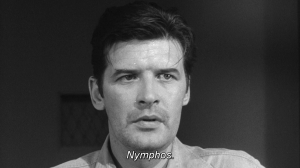
shock corridor, samuel fuller, peter breck

Among the inmates of the hospital that Johnny meets is Pagliacci (Larry Tucker), a fat man who is mentally immersed in opera.  Pagliacci occupies a space in between these two kinds of inmate.  He isn’t a patient-caricature: he has a name, a personality, an ongoing relationship with Johnny.  He is more like the patient-characters, those patients whom the audience are shown to be something apart from their mental illness.  The veracity of these personal details are open to question, however; Johnny’s voiceover, serving as an objective narrator, gives us information about the patient-characters’ lives before they talk about themselves.  Pagliacci is not afforded this confirmation.  Similarly, the three patient-characters have lucid moments where they monologue about their personal histories, explicitly detailing how contemporary issues intersected with their personal struggles (a signature of Samuel Fuller films), whereas Pagliacci is never given a monologue that connects him to a macro-level conflict.

The entire film can be read as grotesque, but its most vivid embodiment is Pagliacci.  I use this term not as an aesthetic or value judgment on his body, but in reference to the grotesque as an artistic concept, “a hesitation between horror and comedy… often rooted heavily in the physical…the inside becomes the outside, and the outside becomes the inside.”  He manifests the grotesque through a presence that speaks to the threat of potential disorder, through his defiance of easy categorization, and through his subversion of expectations set up by the other characters.

Pagliacci delivers the chaos and abnormality that the audience expects from a film set in an asylum.  When the audience is still being introduced to the hospital as the movie’s main setting, he starts a melee in the cafeteria.  This facet of the character is arguably the one most blatantly symbolized the most by actor Larry Tucker’s body.  Pagliacci is not husky or chubby: he is markedly fatter than most film characters, even most people than the “typical” audience member would know in real life.  His body differentiates him from the other characters, and likely alienates him from viewers, making him more of a spectacle than a sympathetic character.  The patient-characters all have some external display of their psychological conflict– Stuart wears a Civil War-era hat, Trent obsessively makes Klan hoods out of pillowcases, Boden sits on the floor like a child and draws with his crayons– but Pagliacci’s difference is intrinsic to his body, a body unlike any other on the screen.  He also has longer hair than any of the other male patients and is the only one with a beard, adding to the physical manifestation of his abnormality.  However, his mental state and personal history is hidden behind a veil of music, the external event that brought him to the hospital forever a mystery– the Samuel Fuller School of Psychology teaches us that mental illness is triggered by stressful life events– unlike the other patient-characters, whose histories are richly communicated to the audience.
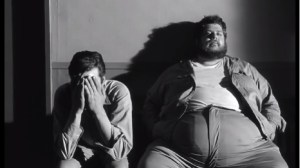
shock corridor, samuel fuller, peter breck, larry tucker

The fat body is often used as a warning to straight-sized people: this could be you, if you fail to regulate your own body according to social norms.  Pagliacci is a portent of Johnny’s loss of control, and the last scene shows a catatonic Johnny who has indeed lost control of his body. But Shock Corridor’s horror is fueled by losing control over one’s brain.  Johnny has dangerously neglected to regulate his mind by entering into the world of the mental hospital, and the film tracks the downfall that is due to that choice.  Pagliacci also provides foreshadowing for Johnny’s fate through the script: “When we’re asleep, no one can tell a sane man from an insane man.”  Late in the film, Johnny’s breakdown begins when he hallucinates an indoor rainstorm.  “I like the rain,” Pagliacci comments peacefully, validating his friend’s psychosis. Now that Johnny is also insane, Pagliacci has shifted from the childish kookiness he displays at the beginning of the film to placidity. Johnny screams in fear and agony, causing Pagliacci to chuckle.  “That was such a sour note, John.  You were way off key.”

Pagliacci conducts himself socially in a way that is markedly different from the other patients.  He is the first patient Johnny interacts with, and is the only one to initiate interaction (except for the nymphomaniacs).  After Johnny has been shown his room, Pagliacci welcomes him, grabbing his hair and putting his arm around Johnny’s shoulders.  He rouses him from sleep several times.  His transgression of social boundaries, coupled with his annoying habits and erratic behaviors, fulfill the audience’s expectations of him based on both his size and his insanity.  Fat movie characters often act in socially inappropriate ways, tied closely to the idea that fat people are stupid and lack control, while at the same time providing comic relief or plot-driving villainy.  This overlaps with how mentally ill people are often portrayed, acting in outlandish ways to signify their lack of control and provide a spectacle for the audience, usually making us fear for the protagonist’s safety.  And between comic and horrific lies the grotesque.

Like the patient-characters and Johnny, we are given insight into Pagliacci’s mind.  However, unlike the memories of life on the outside shared by the patient-characters or Johnny’s increasingly frantic scheming, Pagliacci’s thoughts are music, specifically “Largo al Factotum” from Giacomo Rossinni’s opera The Barber of Seville (aka “Figaro Figaro Figaro”).  This is the song that Pagliacci sings constantly, creating a repetitive, off-key soundtrack that quickly becomes annoying.  What is most likely is that the opera references in Shock Corridor are chosen for their recognizability.  However, intentional or not, they create an interesting paradox: a character whose mind is apparently looping an aria from a comedy about a clever jack-of-all-trades who helps two people fall in love, but whose namesake is a tragedy about an actor who murders his unfaithful wife.  After singing “Largo al Factotum” while he mimes stabbing Johnny, paralleling how Canio stabs his wife and her lover at Pagliacci’s climax, he recites its final line “La commedia è finita!”  (Pagliacci is Italian for “clowns,” referring to the main characters’ travelling commedia dell’arte troupe. Canio is the protagonist’s name, the character on whom the image of the sad operatic clown is based.)  Once again, Pagliacci is situated between categories.

Pagliacci subverts Johnny’s expectations of his fellow patients.  Johnny’s motivation in going undercover at the mental hospital is to solve a murder, and his motivation for solving the murder is to win the Pulitzer Prize as a reward for his stunt.  Even in solving the murder, he has no interest in raising concerns about the safety and fair treatment of the hospital patients (in contrast to Nellie Bly’s investigative journalism, presumably a historical inspiration for the film).  Johnny treats his fellow patients as means to an end, treating the murder witnesses with empathy and understanding until they have lucid moments of reality.  When this seeming miracle occurs, they want to talk about their lives and their trauma, but Johnny only wants to ask them about Sloane’s murder.  Even when speaking to the final witness, who reveals that the murderer is an orderly who rapes patients, Johnny can only focus on getting the final piece of information needed to solve the murder.  In a sense, the way Johnny treats the patient-characters is a microcosm of the way Fuller treats them, avoiding the temptation to create well-rounded characters who are living with mental illness in favor of human megaphones for his opinions on controversial issues and puzzles for his protagonist to solve.  Pagliacci, however, is not a passive font of information waiting for Johnny to open him up.  He does confirm that Sloane was killed in the kitchen with a knife, and demonstrates to Johnny that the hospital patients are capable of lucidity (what a revelation).  But he reveals these things to Johnny on his own initiative.  He pushes himself on Johnny.  This serves to both protect the protagonist, such as encouraging him to chew gum to help him fall asleep, and to terrorize him, reminding the audience of the potential danger Johnny is in.

Pagliacci tells Johnny that he “died of a heart attack caused by overweight [sic],” and claims that many people came to his funeral because “they wanted to make sure [he] was dead.”  In claiming a fatal heart attack and funeral as part of his history, Pagliacci presents himself as a living dead man, another paradox.  This is a small but curious moment in the film, one that unsurprisingly lingered in my mind.  Pagliacci subverts the pathologization of his body, a “morbidly obese” body that is prescriptively assigned an early heart attack and death, a fate that he claims but obviously has not come to pass.  Perhaps he shares more in common with the other patient-characters than at first glance.  Perhaps, in accordance with Shock Corridor’s logic, Pagliacci’s mental illness stems from being told so often that his heart would give out that his mind finally accepted the role of a dead man as the only acceptable way to exist in a culture that assigns fat people an early death, similarly to how Trent’s mind assumed the role of a white supremacist to exist in a culture that maintains racism as the status quo.  This moment speaks to a mind uncontrolled by psychiatry, materialized in a physique uncontrolled by medicine.

He then tells Johnny that he killed his wife: “I despite butchery!  I didn’t want my wife to die like Sloane, so I gently sang her to sleep.”  Obviously Pagliacci is alive, so this statement throws a shadow of doubt over the rest of his words.  Is Johnny sleeping next to a murderer?  Or is Pagliacci conflating his own history with his namesake’s plot?  Disorienting the truth of Shock Corridor also undermines what the audience expects from Pagliacci.  Is he the dangerous person we expect from a mentally ill character?  Or is he guilty of the crime of passion we expect from the climax of a dramatic opera?  Is he the degenerate we expect fat men to be?

The grotesque unsettles us, presents us with something outside our ordinary experience that provokes simultaneous, divergent reactions.  The paradoxes in Pagliacci’s identity put us as audience members at this crossroads.  Is he the dead man to be pitied, the zany buffoon to be laughed at, or the unstable murderer to be feared?  We don’t have one simple reaction to Pagliacci, but all three options are common ways the audience is led to react to fat characters, and none of the possibilities lead to empathy.
The Paranoia of Being a Fat Audience Member: Snowpiercer (dir. Bong Joon-Ho, 2014); Lawrence of Arabia (dir. David Lean, 1962)

…and a few thoughts on why I started writing this blog.

Snowpiercer is a high concept sci-fi movie whose opening scenes are densely packed with exposition.  Humanity has fucked with the environment one final, glorious time, a handful of survivors have been circling the globe for the past 17 years via train in a self-sustaining and strictly hierarchal ecosystem.  We begin in the back of the train with our underclass protagonists.  Their existence is claustrophobic, dirty, meager, strictly regimented by cleaner passengers with uniforms and guns.  But the tipping point of their oppression comes when two of their children are taken for an unspecified purpose by Claude, the woman in yellow (Emma Levie):

image from moviestillsdb.com

It is a shocking scene: both for the sickening sense of doom that builds while she wordlessly measures the children’s height and arm length, and the dazzling nature of her appearance.  Claude’s appearance is the first time in the movie that we have seen the color yellow, the first time we have seen clean, glistening hair, the first time we have seen someone wearing eyeliner.  She glides through a jungle of filthy rags and dull uniforms with restraint, a beautiful, venomous creature.

Despite the allegorical nature of Snowpiercer, this isn’t a crude political cartoon where sides are drawn based on waistline.  Slim Minister Mason (Tilda Swinton) is a distillation of repressive politicians everywhere; Tanya (Octavia Spencer), mother to one of the kidnapped, is a determined fighter who convinces Curtis (Chris Evans) to make her part of the resistance team because her fat body is stronger than that of the skinny men helping him.  And yet we have a plump woman as the final straw before revolt, the spectacle of feminized wealth among drab poverty, the consumer of children.

It’s not like a larger body is Emma Levie’s only attribute; she’s effective at portraying the ice-cold Claude.  Snowpiercer is her second film; her debut was the titular role of Lena (2011), where she portrays an adolescent struggling with her weight.  I haven’t seen Lena, but the character’s struggle with body image is mentioned in every description of the film I’ve read, and it is the only professional baggage she brings to this role.

Lawrence of Arabia is a magnificent epic about T.E. Lawrence (Peter O’Toole), a British army officer, and his role in the Arab Revolt of World War I.  The film combines the macro-level war and sweeping views of the desert landscape with the micro-level of Lawrence’s navigation of identity between his British roots and love of the Arab people, conveyed through O’Toole’s passionate, charismatic performance.  He speaks about his sense of himself as an outsider in British society early in the film with his Bedouin guide:

LAWRENCE: [I am] from Oxfordshire.
TAFAS: Is that a desert country?
LAWRENCE: No; a fat country; fat people.
TAFAS: You are not fat?
LAWRENCE:  No. I’m different.

With this monosyllabic word, Lawrence could be, and probably is, referring to a number of dichotomies he perceives between himself and his fellow countrymen.  He is physically slimmer than his superior officers, but he is also portrayed in contrast to them as empathetic to the Arabic people, an unconventional thinker, and restless in his sense of himself and the world.  However, the “fatness” of Oxforshire, which we only see a glimpse of in the beginning sequence, also stands in contrast to Arabia: verdant and peaceful, as opposed to harsh and troubled.  A more forgiving and abundant land, whose residents presumably don’t have to resort to the extreme measures that Lawrence does, such as killing his close companions for the survival of the group he is leading.

image from flickersintime.com

Lawrence doesn’t position himself with Tafas and his people; just as “different” from the other British people, who are largely portrayed in Lawrence of Arabia as stuffy, bureaucratic colonizers. Is that the people who Lawrence is different from, the stout officers who make secret deals with the French to split up the land and resources of brown people?  Or is it a Britain that we don’t see, but stands in contrast to the ruthless, desperate shell of a man that Lawrence becomes in the second half of the film?

Snowpiercer and Lawrence of Arabia have a few elements in common, but the reason that I chose to write about them in the same post is because I saw them within a day of each other (and both at the Music Box Theatre, check it out if you’re in Chicago), and the two moments in each that I discussed provoked similar responses in me.  How specific were these choices? I wondered.  Is fatness an intentional symbol on the part of the filmmaker, and if so, what is it representing?

I thought that I could write a blog about fat characters where the role of fatness would be more explicit, like Shallow Hal.  I didn’t give enough consideration to how ambiguous that role can be.

This is the insidiousness that comes with being different, with not belonging to your group, and how, like Lawrence, that feeling can provoke and corrode you.  You have something that marks you as an outsider, something you can’t leave at home when you walk out the door, and you don’t often have explicit knowledge of how it factors into how you’re seen.  One of the reasons I chose to write about fat people in movies because these are the images and connected values that are consumed by virtually everyone I interact with every day.  Not having a good read on a movie’s fat semiotics can leave me nonplussed in a way similar to wondering if my appearance was a factor on why I was passed over for a job.

I’m committed to continuing this project, but only a few entries in, this blog is already starting to feel like trying to make sense of a house of mirrors.  And like a house of mirrors, when the viewer sees themself everywhere, from every angle, they tend to become disoriented and lose trust in what is seen.

Link: The Trials of ‘Tammy’: Stop Policing Melissa McCarthy’s Body

So here’s the deal: I’m wrestling with my desire to see Tammy.

On one hand, I think Melissa McCarthy is great and her star status never fails to put a little sunshine in my day.  I’d like to support a film that she not only starred in, but co-wrote.  It’s rare to see a film where a fat character is written by the person portraying them.  (The example that immediately springs to mind is the British TV series Gavin and Stacey, written and acted by James Corden and Ruth Jones, complimenting each other as unstoppable force/immovable object sassy fat best mates of the nice normal title characters.  I digress.)   On the other hand, I currently need to budget my trips to the theater, which I’d rather use to focus on imaginative visuals (i.e. Snowpiercer) and movies I’ve been anticipating for a while (i.e. Boyhood).  Luckily, there are professional film critics who have been compensated for seeing Tammy, due largely to the fact that they are much better at this sort of thing than I.

Nathan Rabin of the Dissolve declared, “a crowd-pleasing, proudly working-class celebration of large women, old women, broke women, and women who love women,Tammy isn’t just consistently funny and unexpectedly touching and tender, it’s also genuinely subversive.” Today’s roundtable discussion at the same site about women in comedy was generally amiable towards it as well. The critical reviews (beyond the website where I daydream about being friends with most of the writers, that is) have been on the negative side of mixed, with a current Metacritic score of 39.

Teo Bugbee’s piece in the Daily Beast doesn’t afford Tammy commendations the same way that Rabin’s review does, but it does provide a smart analysis of Melissa McCarthy’s celebrity and career, looking specifically at the concern trolling directed towards her:

Sookie [McCarthy’s character on Gilmore Girls] was a “good representation” of obese women. She is also entirely unfeasible as a lead character. Her relative lack of drama made her perfect as a sidekick, but a show or a film structured around Sookie St. James would be like making a movie about Robin with no Batman. What’s the point?

The nastiness masquerading as concern is always present around McCarthy, policing her body in ways that her films never even come close to suggesting. If these concerned citizens were really upset about Hollywood’s mistreatment of actresses, they’d only have to look to McCarthy’s left to find Susan Sarandon, amiably stranded as a grandma in Tammy because Hollywood has no clue what to do when faced with a woman who’s just as volcanically sexy now as she was 40 years ago.

No, the distress of McCarthy’s fans has very little to do with women’s roles, and everything to do with distaste for working-class women and their bodies.


The Fat Person as Community Member: True Stories (1986, dir. David Byrne)

True Stories is a visit to Virgil, a small town in Texas where characters and situations are based on tabloid stories David Byrne collected while on tour and interwoven with songs like “Wild Wild Life” and “Puzzlin’ Evidence.”  This movie features John Goodman in one of his earliest roles, playing country bachelor Louis Fyne with a finely tuned balance of vulnerability and amiability.

Louis makes his size part of his identity, through the lens of bearishness.  At the night club, he refers to himself as “Louis the Dancing Bear;” this self-appointed nickname is reflected on his date with the Cute Woman (Alix Elias).  He describes his body, in a phrase you may have heard before, as “a very consistent, panda bear shape.”  There isn’t shame or self-hatred in this label; rather, Louis seems to use it to describe his size in relation to masculinity and vigor (as evidenced in the nightclub scene).  There isn’t an overt connection to the bear identity used in gay male subculture, but the sentiment is not dissimilar.

Similar to Maurice from Secrets and Lies, Louis is largely defined by emotions and creativity.  He is a snappy dresser, a singer/songwriter, and “just [wants] to be loved.”  He is preoccupied with finding a wife and settling down; we see him on dates with several mismatches throughout the movie.  We don’t see his size as a detraction from his potential as a husband; these connections don’t last due to personality or lifestyle differences.  There is one scene that depicts Louis’ relationship with a yogini, but since the movie was filmed in the 80s before yoga had become normalized the way it is today, I’m assuming that the humor in the scene is more based on his girlfriend being a hippy weirdo than on his inability to do yoga (likewise I assume that someone struggling with a yoga position was still a fresh joke at the time).  His quest for a bride goes to extremes: he makes a television commercial advertising himself as an eligible bachelor and enlists the spiritual help of a Vodou practicioner (Pops Staples) to help him find love.

(Quick sidenote about the aforementioned scene:  There are certainly many more insensitive and inaccurate portrayals of Vodou in American cinema, but its inclusion feels shoehorned in to make use of the song “Papa Legba.”  I don’t know enough about Vodou to talk about how authentic the ritual scene is, but considering that Papa Legba is associated with crossroads, travel, and communication, I’m skeptical.  To its merit, it does, along with the “Puzzlin’ Evidence” preacher, undermine assumptions about the homogeneity of religion in small town America that viewers would likely otherwise make about the film’s setting.)

Louis is a character of excess, but instead of making him an outlier or moral lesson, this trait fits him in perfectly with the other characters in the movie.  Swoozie Kurtz plays a woman who is so lazy she elects to spend her life in bed watching tv.  In one scene, the Narrator (David Byrne) has dinner with the Culvers, a well-to-do married couple who have not spoken directly to each other in years.  Slothfulness and social maladjustment are usually attributes of fat characters, turning them into buffoons and isolating them from the thin characters around them, but none of these characters are fat.  Virgil is a community that is united in its paradoxically banal weirdness.

This unity is further evidenced in the group lip-sync that is kicked off by an energetic fat woman in a fierce yellow jumpsuit, and the fashion show that seamlessly includes fat people who model everything from business suits to powder blue formal wear to vegetation.  These scenes also incorporate age and racial diversity in a low-key way; this just happens to be a small town where different people come together to share their love of modeling grass suits and pretending to sing.

True Stories is about a community, but if one had to choose a protagonist, Louis is the most likely candidate.  The Narrator joins the audience in outsider status, learning about Virgil’s inhabitants through the course of the movie, but the detached quality of Byrne’s performance and details such as the self-aware fakeness of his driving scenes render him as an abstraction, a lens through which we can gaze at the town.  Louis, on the other end of the spectrum, is more human than the other characters.  In a movie that embraces performance and artifice, the most grounded moment comes at the end of Louis’ date with the Cute Woman, where they put aside their small-town geniality and admit that they aren’t making a love connection:

Goodman’s performance and Louis’ character relative to the other citizens of Virgil make True Stories stand in contrast to many films where fat people are depicted with the intent of rendering them as less relatable or sympathetic to the audience than their thin counterparts.

A few things I’m still pondering:  to what extent is Louis an embodiment of Virgil?  Is his size connected with perceptions of Virgil as a cookie-cutter small town USA, the ugly American stereotype that often comes packaged in a big body?

Link: The School of Rock Wails Against the Man– For Fat Acceptance

 But Dewey’s gradual transformation into a better, more self-aware version of himself is wholly divorced from his fat, which remains on his person, as permanent as his love of Black Sabbath. Fat can’t be a sign of sloth and self-indulgence if it remains when those characteristics disappear. More importantly, Dewey’s successful performance at the Battle of the Bands, where he careens and showboats all over the stage, proves that rock need not be attached to a scrawny, screeching rock-monkey aesthetic but can come in any size.

Inkoo Kang’s 2013 article for Badass Digest looks at fat tropes, specifically with regards to its chubby protagonist rocker Finn (Jack Black), in Richard Linklater’s 2003 comedy School of Rock.  It’s a short piece; one of the reasons I wanted to start this blog is because, after reading it, I very much wanted the conversation to continue.