1990s

“Straighten, Tighten:” Intersections of Fatness and Queerness in The Birdcage (1996, dir. Mike Nichols)

When I woke up on a Friday morning a few weeks ago to Twitter blowing up about SCOTUS declaring same sex marriage legal in all 50 states, I was happy that my home country was finally moving away from a gender-discriminatory policy.  Not deliriously happy, mind you.  I feel some kinda way about the political energy and focus poured into marriage equality.  But I do have a sentimental side, and I see how much joy getting married has brought to the people in my life who decided to take the plunge.  (This post isn’t more timely because I traveled halfway across the country to attend the wedding of one of my oldest friends.)  I had a solo mini-celebration for marriage equality that evening with The Birdcage, which I was fond of in high school and had been meaning to revisit.  I remembered the excellent comic performances; it’s enjoyable enough to take the film at face value.  What surprised me was how deeply I empathized with the character at the epicenter of the film’s tumultuous humor, Albert (Nathan Lane).

The opening scene in which Armand (Robin Williams) and their houseman Agador (Hank Azaria) cajole a hysterical Albert into rallying herself* for a drag performance ushers the audience into a first impression of her that is intertwined with her self-image. She describes herself as “fat and hideous”– a declaration Armand, her director and significant other, knows so well that he mouths the words along with her– and says that she’s “gained and lost over 100 pounds in the past year” in an effort to be thin and beautiful enough to maintain her star status and his love.  Although not an extremely large person, she does have a stocky body, where the other performers at the Birdcage (and many of the thong-clad extras in scenes of the public milieu of South Beach) are slender and muscular.

the birdcage, nathan lane, albert

Albert’s sensitivity and flamboyant nature are frequent sources of humor.  Armand and his son Val (Dan Futterman) react to Albert’s outbursts with a certain level of weariness that suggests a routine scenario for their family.  But even though she is an outlandish character in a farce, her anxieties come from a very real place.  The nonplussed reactions she receives from strangers, plus Val’s unwillingness to introduce her to his conservative future in-laws speak to her outsider status in the vast majority of the world.  Despite being a headliner who plays to sold-out houses and is more than willing to self-advocate, she lacks necessary social capital to navigate on her own outside her South Beach bubble.  In a subplot, she wants Armand to sign a palimony agreement so that she will be provided for in case their relationship ends.  Although talented, there is no denying that she is older and fatter than the other performers; who’s to say what her career would look like without Armand and the Birdcage?

The Goldmans’ underlying family tensions are exacerbated when Val declares his intention to marry Barbara (Callista Flockheart), the daughter of staunch conservative Senator Kevin Keely (Gene Hackman) and his wife Louise (Dianne Wiest), who is Barbara Bush by way of Lady Macbeth.  Hit with scandal when Kevin’s “common redneck” colleague dies in bed with an underage black prostitute, Louise suggests using the wedding as a distraction technique to symbolize a return to family values.  Convinced that the Keelys will never connect themselves to a gay, Jewish** family, Val asks Armand to pretend he’s the father of the heterosexual “Coleman” family.  Val initially asks that Albert not be present for the Keelys’ dinner, but Armand insists they compromise and pretend that his companion is heterosexual Uncle Al.  Although the Goldmans want their son to be happy, there is ultimately no sugarcoating that Armand is willing to side with Val and pretend Albert isn’t part of their family unit so that Val can access a social institution the two of them can’t by ingratiating himself to a politician who thinks they’re destroying America.  Her reactions, oversized in most situations, are appropriate in this case. When she refers to herself as “the monster, the freak,” neither Armand nor Val deny that she is characterized thus by their plans to hide her.

For the Goldmans, achieving normalcy is largely about restraining (“straighten, tighten”).  Not only is Val the beneficiary of the charade, he is the main orchestrator, the ambassador of straightness in a queer enclave.  He is a man of few words, forever tolerantly waiting for the exuberance around him to die down.  “Don’t add, just subtract,” he repeatedly advises the Birdcage staff, who help transform the Goldmans’ colorful home into a “monastery.”  The subtraction includes wanting to present Katherine (Christine Baranski), Val’s biological mother, as Armand’s wife.  Albert can barely hide her discomfort around reserved, athletic Katherine, who owns and operates a successful gym.

the birdcage, nathan lane

Although Armand is more masculine and paternal than Albert, Val asks him to tone down his stereotypically gay mannerisms (eg. how he walks, talks, and gestures).  Armand, in turn, coaches Albert to restrain herself, emotionally and physically, in order to play is straight.  “Look at your pinky!  Look at your posture!”  He tells her to hold her unruly body more firmly and tone down her emotional responses.  Dismissing small setbacks (e.g. breaking a piece of toast) seems like a revelation to her:  “Of course!  There’s no need to get hysterical.  All I have to remember is I can always get more toast.”  But the couples’ desire to help their child achieve the life he wants comes at the expense of their own.  Right before the Keelys’ arrival, the family gathers in the master bedroom, their vivacity stripped away in the pursuit of heteronormativity.  Armand remarks that he looks like his grandfather, who “killed himself when he was 30.”  Their clothing and demeanors suggest a funeral, Albert the most uncomfortable of all.

The performance of straightness that the Goldmans put on is a wickedly funny inversion of the colorful, campy drag show that is their profession.  Agador calls himself “Spartacus” and lowers his voice by an octave or two, Armand is so stiff that Val feels the need to fabricate a football injury for his father, and Albert presents herself as an old-fashioned housewife from Smalltown, USA whose ludicrously conservative political views terrify her family, but manage to charm Kevin.  Appropriately, the Keelys themselves are practically drag versions of straight conservatives, wearing clothing so drab as to practically be Orwellian and barely hiding their elitist, repressive viewpoints under jes’ folks rhetoric.  One of my favorite moments in the film is after the two families first meet, when Kevin responds to a polite question about his trip to South Beach with a soporific monologue that spins out into a patriotic travelogue gone wrong.  Of course, they too look at the dinner party as a path to social legitimacy (or, as Louise puts it, “salvation”) that will hide their own connection to deviance.  The Keelys too have a fat skeleton in their closet, as Lousie tries to prevent Kevin from stress-bingeing on candy, and they are stalked by a tabloid journalist (Tom McGowan) who’s “put on so much weight since the Simpson trial.”

As a fat, gender nonconforming person, I deeply felt Albert’s need to be loved and, when people do express love for her, the fragility of her trust.  It’s rough living in an environment where people like you are constantly positioned as inherently unworthy of respect.  Even in the safety of home, family, and community, it is impossible to completely forget the hostility of the outside world, or how easy it is for that hostility to be present in a loved one.  As Albert says, fed up with the emotional burden of being a source of shame for Val, “…everyone laughs at me.  I’m quite aware of how ridiculous I am.”  She says this as she is leaving for the cemetery, dramatically communicating that she feels she is dead to her family.  The scene is not completely serious, as her tone and gestures mimic a diva in a classic melodrama, but it does reflect the real emotional fallout that many LGBTQ people have experienced due to being rejected by their families, including suicide in some instances.

This isn’t the first film I’ve seen with parallels between fatness and queerness, even if fatness is a less explicit factor in The Birdcage than In & Out.  They are barriers to achieving a goal (in both cases, a wedding that will provide social legitimacy).  Albert’s size doesn’t threaten Val and Barbara’s engagement, but she does worry that Armand isn’t attracted to her any longer and doesn’t want to make their partnership legally binding.  Albert’s body, specifically her emotions and mannerisms, is seen as excessive to the point of threatening the family’s social legitimacy.  Her queerness is irrepressible, and the men of the family take it upon themselves to orchestrate a solution.  However, once her influence is removed from the family, Val and Armand alone are not enough to win Kevin and Louise’s trust.  It is only through relying on her “threatening” inclinations to be feminine and maternal (Armand describes her as “practically a breast”), and her skill as a drag queen, that Albert can pass as Mother Coleman.  Once seen as a heterosexual, female mother, she becomes a legitimate (and favored) member of the family in the eyes of Kevin, who is the apex of power in the film, both in terms of social capital and allowing Val to marry Barbara.  The facade of normativity cannot be maintained for long, but the temporary diversion from her outcast status is enough for Albert to sustain the dinner party longer than Val or Armand could on their own.  Her drag skills come in handy again to prevent the Keelys from being spotted by the press, ending the film with a power reversal where the heterosexual elite are sheepishly reliant on the queers for a different kind of salvation than Louise originally anticipated.

Albert and Armand’s happy ending isn’t just because they get to be themselves, but because they triumph due to how their lives have been shaped by being marginalized.  It’s not an explicit score for the fat kids, like Hairspray, but it does find power in qualities that get combined with fatness: femininity, sensitivity, and excess.

*Albert identifies as a gay man and is referred to with both masculine and feminine pronouns.  There are several points in the movie where Albert shows a preference for feminine pronouns, thus my use of she/her/hers in this article.  Apologies if this is confusing.

** Sander Gilman’s Fat Boys: a Slim Book includes an interesting history of the conflation of Jews and fatness in the historical Gentile imagination.  Suffice it to say that there are stereotypical characteristics common to Jewishness, fatness, and effeminacy, such as a lack of athleticism and a penchant for heavy foods (“When the schnecken beckons!”).

Link: Director’s Club Podcast Bonus Episode: Cape Fear & Shutter Island

Director’s Club Podcast is going on hiatus, but not before putting out a series of bonus episodes over the next few months.  The topics are requests from listeners who donated $50 or more to the production of Most Likely by Bang! Films, an independent romantic comedy featuring the acting talents of my bff Jess Conger.  (You can’t fight synergy, Lemon.  It’s bigger than us all.)

I was a guest commentator on the first of this series of bonus episodes, in which Patrick and I talk about Martin Scorcese’s divisive thrillers Cape Fear (1991) and Shutter Island (2010).

Listen to the episode here, or download it from the iTunes store.

The Irrepressible Body: In & Out (1997, dir. Frank Oz)

(CW weight loss)

Maybe after this blog becomes wildly successful and they make the Tessa Racked biopic, the opening scene summarizing my childhood and heralding my adult preoccupation with queer liberation and fat people in movies could very well when I was 12 years old and saw In & Out in theaters. At the time, however, it had two main draws. It was rated PG-13, and some scenes had been filmed a town over from where I lived. If you haven’t seen this film and are so inspired, I urge you to spend some of it admiring the background. I had positive memories of it and wanted to see how it held up over time.

Summary of the plot: a rural town in Indiana is sent into upheaval when high school English teacher Howard (Kevin Kline) is outed by former student turned celebrity Cameron (Matt Dillon) during an Oscar acceptance speech. Howard is surprised that Cameron perceives him as gay, as he is marrying Emily (Joan Cusack) in a week’s time. Emily has more than the desire for a lifetime commitment invested in their wedding: not only has their engagement lasted 3 years, but Emily has lost 75 pounds in order to be a thin bride.

in & out, kevin kline, howard brackett, joan cusack, emily montgomery

In & Out uses topical humor liberally, but two unutilized mid-nineties news stories actually fit in neatly with the film’s subject matter: the supposed discoveries of a “gay gene” and a “fat gene.” Biological determination is often used as an excuse for fatness or queerness to exist within a culture where “normal” people are straight and thin. We aren’t unnatural, we’re born that way. However, as Kathleen LeBesco points out: “This form of narration is particularly dangerous, however, in that the uses of biological research can cut both ways: science might be used as the basis for legal protection and moral respectability just as easily as it might be used as the proof of pathology and justification for eradication” (Rothblum and Solovay 77).

In & Out takes the optimistic approach to biological determinism. The film speaks not only to the virtue of acceptance, but also the folly of suppression. Emily’s and Howard’s bodies betray the false selves they have created in the interest of fitting into a heteronormative ideal, the achievement of which is in service to unobtainable cultural ideals and in conflict with their true natures. She is not a thin bride, he is not a groom who wants to have sex with a thin bride, “Macho Man” plays over the end credits. However, In & Out doesn’t fully deconstruct the conventional understandings of acceptability that constrict its characters.

Kline gracefully portrays Howard’s ambiguity with an undertone of innocence. In the beginning of the film, he doesn’t seem to be actively denying his sexuality as much as he’s lived his life in a completely heterocentric world without any cause to question his straight identity. Howard’s straightness becomes less and less viable as the film begins to question the omnipresence of heterosexuality, and characterizes it as a bundle of compulsory, restrictive gendered stereotypes. “At all costs, avoid rhythm, grace, and pleasure,” he is instructed by a self-help tape during an attempt to unlock his machismo; the audience immediately knows that musical-loving Howard will not be able to maintain this abstinence for long. But even when he isn’t consciously embracing it, his gayness is constructed in the film as an innate physical aspect. Even a casting choice suggests that Howard’s sexual orientation is a genetic trait: Howard’s mother is played by Debbie Reynolds, a gay icon who is best known for her roles in studio musicals like Singing in the Rain. His body is constantly betraying him, even as he tries to assert his straightness (as it is conflated in the film with manliness). When Cameron “outs” him at the Oscars, Howard’s shocked reaction includes letting his wrist go limp. In the best scene in the film, Howard tests his masculinity by trying not to dance to “I Will Survive,” but cannot prevent his body’s reaction to the disco beat.

in & out, debbie reynolds, kevin kline, joan cusack, wilford brimley, frank oz

Emily’s repeated sentiment is that she can’t believe that she is a thin bride; this not only conveys her happiness, but foreshadows that her current state is a fleeting fantasy. Of course, the fantasy alluded to is her and Howard’s romance, but her thin body is intrinsic. Even if Emily and Howard did get married, it’s not likely that she would be able to maintain a 75 pound weight loss in the long run, if multiple studies are to be believed. Even the threat that she will return to her original weight is verbalized as a threat that she will “start eating again,” a hyperbole that characterizes her goal as requiring the impossible denial of something essential, but also characterizes her as being a typical food-obsessed fat girl just underneath her controlled, trim surface. Emily’s quest to regulate her body is paralleled with Cameron’s supermodel girlfriend Sonya (Shalom Harlow), who includes vomiting as part of her daily agenda and is insulted by the suggestion that she eat a meal after a long trip. Thinness, like straightness, can only be achieved through hypervigilance and self-denial. As soon as the wedding is called off and Howard’s illusion of straightness has dissipated, Emily too begins to drop her illusion and seeks food to binge on. Her fantasy of being a thin bride leaves her collapsed in a heap in her wedding dress, wailing, “I’m starving!”

The least explicit but most present pressure on Howard and Emily to marry is the threat of being categorized as unmarriageable. When Emily blows up at Howard after he comes out during their wedding ceremony, she cries, “I base my entire concept of self-esteem on the fact that you’re willing to marry me!” For Emily, validation comes through marriage, which she sees as evidence that she is worth of love and desire. Deeper into her meltdown, she runs along the side of the road in her wedding dress, begging passing cars to marry her. Being a bride hinges on being thin. Emily describes herself as having been fat her whole life, but that she “didn’t want to waddle down the aisle.” She says that her deceased parents never thought she would get married; her fatness is the only given possibility as to why they would think that. But her achievement of this goal also depends on Howard’s heterosexuality. “You still want to [get married], right?” she asks him. “That’s why I transformed myself, isn’t it? Do you want me to start eating again? …I can, Howard! I’m very fragile!”

But Howard is also using Emily as a means of validating his own normalcy, as cancelling the wedding would mean disappointing his community’s expectations. Howard’s mother tells him immediately after suspecting he might be gay that she loves him no matter what, but forces him to marry so that she can have some excitement in her life through planning the wedding. The pressure to be regain his straight identity through getting married is most poignant at his school, as his beloved students suddenly become uncomfortable around him and Principal Halliwell (Bob Newhart) suggests that he could lose his job.

Although his friends and family all want to believe that he is straight, openly gay TV journalist Peter (Tom Selleck) thinks Howard is gay and calls him out on marrying Emily for the wrong reason. Peter encourages Howard to trust his friends and family will support him. His advice proves to be wise, as the town rallies around Howard in a Spartacus-esque show of solidarity at his school’s graduation ceremony, everyone declaring themselves to be gay as well. Howard maintains his place in his various social units, and the film ends with him attending his parents’ wedding vow renewal ceremony.

Emily’s victory comes when Cameron shows up to replace (and supersede) Howard as the desirer of her as an object. The handsome, successful actor confesses that he fell in love with her when she was a fatter student teacher who tutored him, and chooses her over his supermodel girlfriend (who he says “looks like a swizzle stick”).

Although given more license to exist, presumably her confidence and happiness still depend on being physically attractive. Cameron and Emily express their feelings for each other by reciting lines from Romeo and Juliet, using a literal performance of heterosexuality as a means of connecting to each other. Even if Howard and Emily end the film with more freedom to be themselves, this freedom was given to them by members of the entertainment industry. They are still bound by the somewhat modified cultural norms that initially pressured them into adopting false identities in the first place.

Ironically, it is the film itself that ultimately restricts Howard’s queerness and Emily’s fatness, as these traits are only present in the film in their lack. Howard’s sexual orientation is expressed solely as effete traits, the only erotic exchange with another man is a kiss that is performed as an experimentation (and didn’t even involve tongue). In an odd mirror image, Emily’s happy ending is solely behavioral– during the denouement dance party we see her eating cheese puffs– but we never see her as a fat person. Therein lies the discrepancy of the film’s message: are we truly accepting of something that we can’t bring ourselves to actually look at?

The Fat Detective and the Rogue Cowboy: Die Hard (1988, dir John McTiernan); Die Hard 2: Die Harder (1990, dir Renny Harlan)

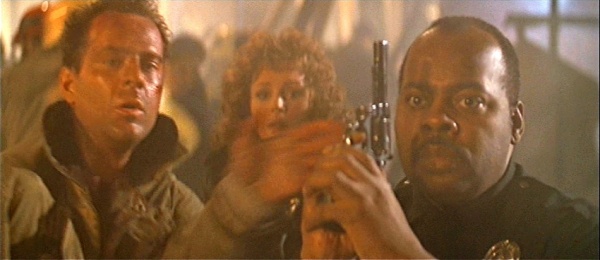
My last few posts have focused on male/masculine fat best friends.  Thus far I haven’t sought out films specifically for their portrayals of fat people– or, to be more accurate, I’ve been heard to whine “But I don’t wanna rewatch Bridesmaids”– so it’s not surprising that most of the films default to having male protagonists with another man, somehow coded as less heroic, in a support role.  I decided to lean into the trend and revisit the first two Die Hard films.  I first saw Die Hard and Die Hard 2:  Die Harder a few years ago; while I wasn’t actively looking at the role that body size plays in the character dynamics, I found the developing bromance between John McClane (Bruce Willis) and Al Powell (Reginald VelJohnson) to be one of the more intriguing parts of the film.

As we’ve seen in previous films, McClane and Powell form a contrasting duo; the differences between them go beyond body type and race.  Both are archetypal cop characters, but from opposite ends of that spectrum.  McClane is a fiercely independent male power fantasy.  Explicitly identified with cowboys, he’s the rogue agent who breaks all the rules because his ideas are invariably more effective than the protocols set by those in power.  Even his personal life finds him bristling against cooperation: he has become estranged from his family because of his reluctance to leave New York after his wife Holly (Bonnie Bedelia) lands a great job in Los Angeles.  There were several reasons that I prefer the original movie to the sequel, which isn’t surprising in and of itself, but the most unexpected reason was that I don’t find McClane nearly as interesting when he’s put in a situation that requires teamwork.  It’s somewhat surprising that he outranks Powell by the second film. 

McClane is defined by his profession, but specifically by being part of the NYPD.  New York City as part of McClane’s identity is an expression of regionalism, but it also seems to be an inherent part of his stubbled, streetwise masculinity.  He is out of place at the Nakatomi Christmas party, especially when another man greets him with a kiss on the cheek, and is practically a different species than Ellis (Hart Bochner), Holly’s smarmy, coke-snorting coworker.  The film portrays association with LA as a symptom of a character being phony and weak:  after moving to LA, Holly goes by her maiden name; McClane has a much harder time gaining respect with his LAPD badge in Die Hard 2.   Even the local news team turns into a minor antagonist, as reporter Richard Thornburg (William Atherton) forces himself into the McClane home for the sake of his scoop.

McClane’s likability and authenticity comes not only from Bruce Willis’ charisma, but from his alliances with average joes, especially black men.  McClane is initially characterized as an unpretentious populist by making friends with his limo driver Argyle (De’voreaux White)– naturally, he sits shotgun and puts his kids’ giant teddybear in the back seat where the LA phonies ride.  In the sequel, McClane forms an alliance with nerdy director of communications Leslie Barnes (Art Evans).  However, he is more brusque with other average joe characters: possibly due to the stress of having so many people standing between him and the bad guys, or a change in director and writing team, but it may be that LA is rubbing off on McClane.  However, the role of Grounding Black Friend is fulfilled most strongly by Sgt. Powell, both in terms of the depth of their relationship and by balancing out the milieu of upper class white LA.

Powell is a by-the-book cop, representing the everyman who supports and roots for McClane.  He isn’t as phony as the other LA-based characters, but he is an emasculated figure.  His lack of power is visually manifested through fat stereotypes; in both Die Hard and Die Hard 2, he is introduced by an armful of Twinkies.  In the first film, he tells a convenience store cashier that the Twinkies are for his pregnant wife, which is met with skepticism.  McClane is also introduced while fulfilling a paternal role– wrangling a giant teddy bear for his children– but flirts with a pretty flight attendant in the process.  Powell doesn’t have the skilled action hero control of McClane:  he doesn’t realize that the Nakatomi Tower is overrun by bad guys until McClane throws one of them onto the hood of his cop car.

 reginald veljohnson, die hard, al powell, powell, sgt powell, twinkies

Powell is sensitive and emasculated when compared with McClane, but his sensitivity also serves as a strength, in line with the fat detective trope.  Not only does Powell form a correct hunch that McClane is a cop, but he does so after one brief conversation. Deputy Chief of Police Dwayne T. Robinson (Paul Gleason), Powell’s superior, arrives just as this conversation ends.  His approach to the as-yet-unnamed McClane is cautious, but the audience is more attuned to the need for immediate action:  his blowhard skepticism reads like a waste of precious time.  Powell also proves himself to be a step ahead of Robinson when he correctly surmises that the terrorists are shooting at the cops’ floodlights, which Robinson loudly repeats as his own revelation once the lights are starting to shatter.  However, Powell is a team player.  While he directly disagrees with Robinson, he ultimately lacks McClane’s ability to undermine authority.  At one point, Robinson interrupts Powell and McClane’s conversation, snatching the radio from Powell’s hand.  Powell grimaces at the affront, but says nothing.  McClane, on the other hand, responds to Robinson’s demand that the LAPD take over by calling him a “jerkoff” and demands that he give the radio back to Powell.

Powell’s fat detective sensitivity also facilitates the growth of his relationship with McClane.  The initial conversation where Powell establishes that McClane is a cop is also enough for them to decide not only to trust each other, but to form an alliance; by their first sign-off, they are calling each other “partner.” The two partners provide each other with necessary information, but Powell also provides the moral support McClane needs, including making McClane laugh by reciting the ingredients of a Twinkie and telling him “I love you, and so do a lot of the other guys down here.”

It’s worth noting that the majority of Powell and McClane’s relationship takes place via radio; they are essentially two voices connecting with each other.  In the context of a mainstream action film, McClane is white and athletic, aspects of a default representation of legitimacy.  Not so for Powell, who is marginalized as a fat person and as a black person.  However, on the radio, Powell is separated from the aspects of his corporeality that could otherwise detract from McClane viewing him as legitimate.  We see the different ways McClane and Robinson treat Powell; we could chalk it up to McClane being a heroic everyman and Robinson being a blowhard boss, but it’s worth considering the fact that McClane is separated from the preconceived notions that are inexorably tied to Powell’s body.

The most obvious marker of Powell’s lack of (masculine) power is that he’s been put on desk duty because he has lost his ability to shoot his gun, following an incident where he accidentally shot and killed a kid.  He triumphantly regains the ability to fill a human body with bullets at the end of the film, when it means defending McClane from the final bad guy. Even if the scene is a black cop killing a homicidal Aryan, in light of the recent publicized lack of accountability from police departments for police brutality, it’s very uncomfortable to consider that regaining the ability to kill is considered a happy resolution to Powell’s character arc.

reginald veljohnson, mcclane, bruce willis, powell, al powell, john mcclane, die hard

Despite having his masculinity redeemed through his friendship with McClane at the end of Die Hard, Powell fills the same role of less masculine, more cooperative foil in his brief appearance in Die Hard 2.  He faxes a criminal background check to McClane as he chews on a Twinkie, gently laughing at his friend’s refusal to “wake up and smell the 90s” and learn how to use the technology that has become a basic tool of his profession, untameable cowboy that he is.  And again, Powell is more of a friend to McClane than the other law enforcement in the film, notably Captain Lorenzo (Dennis Franz), the head of airport police who impedes McClane’s process every step of the way, along with his brother Sgt. Lorenzo (Robert Costanzo).  Both of the Lorenzos are fat; McClane calls Captain Lorenzo a “fat ass” during their unending tennis match of insults.  All three fat characters are shown as ineffectual cops when compared to McClane; the Lorenzos’ ineffectiveness comes from complacency and arrogance, treating McClane rudely while failing to see the big picture.  Captain Lorenzo initially describes himself as a “big fish” in a “little pond,” but towards the end of the film, he is dismissed as a “bureaucrat.”  He is unable to see reality; namely, that John McClane, Supercop is in his airport trying to foil an unfolding terrorist plot.  Powell, on the other hand, realizes what’s going on, but isn’t able to garner the respect needed to convey it to those around him.

dennis franz, die hard 2

Captain Lorenzo and Powell are both fat men who are socially inappropriate.  They have character arcs where the begin their film with problematic relationships to their profession that are ultimately corrected through their association with McClane.  Powell is initially deferential and emasculated (relative to the world of male power fantasy), but finds the strength to argue with his superior in order to advocate for McClane, and then the ability to shoot his gun in order to defend McClane.  Lorenzo, on the other hand, is rigid and arrogant, but is eventually humbled when McClane proves the worth of his disorderly methods.  I see race as the more component of the difference in these fat characters’ trajectories.  McClane spends Die Hard and Die Hard 2 clashing with power-hungry white men (whether military-trained terrorists or jagoff yuppies) and building alliances with salt-of-the-earth black men.  We know that he will never become the former because of how he treats the latter, and the latter ultimately exist to accessorize McClane’s quests.  The politics of fat in Die Hard cannot be separated from similar questions about the politics of race.

Fat at a Movie Marathon

[CW: discussions of violence and sexual assault]

There are a fair amount of spoilers in this post; if that’s a concern, click on the provided link to see what films I’ll be talking about.

This weekend I attended [most of] the 10th annual Music Box of Horrors, a 24-hour marathon of horror films from across the world and history of film.  It’s only my second time attending, and it’s been great fun both times.  Instead of doing a separate post for each movie– which would take a long time and I am so very, very tired– I’m opting to give a brief rundown of fat representation in this year’s lineup, to document my experience as a fat audience member.  For extra fun, I’ll include my favorite moments of misandry, as I was pleased to note that a good number of the movies in this year’s lineup had interesting and kickass female characters.

The Phantom Carriage (1921, dir. Victor Sjöström): no fat characters.

The Man They Could Not Hang (1939, dir. Nick Grinde): we skipped all but the last 15 minutes in the interest of getting lunch, but no fat people in the part I did see.

Cat People (1942, dir. Jacques Tourneur) no fat characters.
Misandry Moment: slimy psychiatrist refuses to stay friendzoned by his patient (ick), she turns into a panther and mauls the crap out of him.

The Curse of the Werewolf (1961, dir. Terence Fischer) Leon, the main character, has a fat best friend.  Jose is his cheerful, hedonistic coworker; he suggests that the two of them spend their wages at a brothel.  Unfortunately, Leon turns into a werewolf and mauls the crap out of him.

The Borrower (1991, dir. John McNaughton) in a group of potentially victimizable young people:  a heavy metal (I guess) band is shown filming a music video of a song about how they want to kill their parents.  The fat lead singer is an egomaniacal bully; when they hear the neighbor’s dog barking, he goes out to the backyard and sprays it down with the garden hose, laughing all the while.  However, the neighbor’s dog is actually the titular serial killer alien, who kills the fat lead singer.  (This was a weird one.)  His bandmates survive unharmed, while…
Misandry Moment: …the young person who has their shit together enough to load a gun and blast a hole in the baddie is the band’s camerawoman.  Also at least three scenes of a female cop shooting and beating up a rapist.

Nosferatu the Vampyre (1979, dir. Werner Herzog) no fat people.
Misandry Moment: this film follows the classic Dracula story, except that Lucy is the one who is solely responsible for killing the vampire, while Dr. Van Helsing is a skeptical milquetoast.

Dead Snow 2: Red vs. Dead (2014, dir. Tommy Wirkola) no fat people.
Misandry Moment: a professional zombie killing team that is two-thirds women, raising the film’s undead Nazi body count with shovels, shears, and homemade fertilizer bombs.

I went home for a few hours’s sleep, but stalwart Patrick stayed the whole night.  His not-entirely-awake testimony is as follows:

Nightmare, aka Nightmares in a Damaged Brain (1981, dir. Romano Scavolini) no fat people.

Shakma (1990, dir. Tom Logan) no fat people.

Don’t Look in the Basement (1973, dir. S.F. Brownrigg) Takes place in a psychiatric hospital; some of the patients are fat.

The marathon also plays shorter pieces in between the features; a short at one point overnight there was a screening of “Space Werewolf”, which features a fat protagonist.

I returned for the last two features:

Just Before Dawn (1981, dir. Jeff Lieberman)  My cup runneth over.  The bad guys are fat psycho hillbilly twins, terrorizing and murdering a group of sexy young campers.  The sexy young campers are given harbingers in the form of a large-bodied park ranger (George Kennedy) who eventually comes to their rescue, and a hillbilly family comprised of a friendly but shy waif daughter, a hostile old dad, and a fat mom in an ill-fitting dress who isn’t given much to do except remind the audience that hillbillies are grotesque, I guess?  The first killer twin to die is shot by Ranger Kennedy and falls on top of the Final Girl who he is attacking, leading some of the audience to vocalize disgust.  It’s pretty gross to have a bloody corpse fall on you, but I feel like the disgust factor was heightened by the fact that the corpse in question is a fat man who looks like he hasn’t bathed in a while.
Misandry Moment: the Final Girl rams her fist down the second killer twin’s throat and chokes him to death while her traumatized boyfriend cowers in the background.  One of the campers is murdered after he mansplains a rope bridge in the forest to the girl who lives in the forest and has presumably had her entire life to figure out the rope bridge.

Audition (1999, dir. Takashi Miike)  no fat people.
Misandry Moment: it’s Audition.

There weren’t any surprises as far as representation of fat people goes.  While nothing was grossly fatphobic, most of the films didn’t incorporate fat characters, and the fat characters that did appear were pretty typical, and in small supporting roles.  Hopefully I’ll end up seeing a horror film with a meatier (ha) role for a fat person that I can write about before Halloween; if I have to resort to writing about Tucker and Dale vs. Evil, one of my favorite horror films, so be it.

Link: The Howling Fat Men of the Coen Brothers

(CW: violence, profanity, spoilers for Blood SimpleBarton Fink, and Miller’s Crossing)

Behold: Ian Larsen’s supercut of shouting, bellowing, and howling fat men from early Coen Brothers films, from Blood Simple up through O Brother, Where Art Thou.  It probably will not surprise Coen Brothers fans that most of the video is John Goodman, but hey, I’m not complaining.

Emotional Intelligence and Fatness: Secrets and Lies (1996; dir. Mike Leigh)

Hortense (Marianne Jean-Baptiste), a middle-class black optometrist, seeks out and connects with her birth mother, Cynthia (Brenda Blethyn), a white factory worker and general hot mess, inadvertently inheriting the rest of her biological family at the same time.  Secrets and Lies received critical acclaim upon its release, including the Palm d’Or and several Oscar nominations, largely for its talented cast and nuanced characters.  This includes Maurice, Cynthia’s financially better-off brother who is trying to keep his cooling marriage alive, played by Timothy Spall (or, as nerds might know him better, Peter “Wormtail” Pettigrew).

In Fat Boys: a Slim Book, Sander L. Gilman analyzes different ways fat male bodies are used in Western cultural narratives to signify values and beliefs about human nature.  One of the archetypes he discusses is the fat detective, largely citing British characters such as Dr. Edward “Fitz” Fitzgerald on the BBC series Cracker, as portrayed by Robbie Coltrane (if this blog takes off, I’m apparently going to have to do at least one post about Harry Potter).

“His oversized body invokes… his mode of inquiry… Such an obese body seems more feminine, but certainly not female; it is expressive of the nature of the way the detective seems to ‘think.’  His thought processes strike us as intuitive and emotional rather than analytic and objective.  In other words, the fat detective’s body is read as feminine.”  (Gilman, 154, 155)

Maurice isn’t a detective, but like the fat detectives Gilman describes, he does rely on intuitive and emotional skills to navigate both his personal and professional lives.  He often becomes a paternal figure in both of these spheres.  However, instead of being cold or autocratic (or absent, like every biological father in the film) his approach to fatherly tasks is gentle and nurturing.

When we see him in his role as a portrait photographer, he is interacting in a warm manner with a diverse array of people in varying situations, from a nervous bride to a bitter plaintiff, trying to make a connection and get them to smile.  While his detached offscreen voice and constant insistence on drawing his subjects’ attentions to his camera give him an air of authority, what comes across more strongly in these scenes is a sense that Maurice can see beauty and humanity in everyone in front of his lens.  These traits also apply to his role as a businessman.

Stuart (Ron Cook), the former owner of his photography studio, pays an unexpected visit, drunk and on the verge of aggression. Maurice patiently listens to him rant about his string of bad luck, but also sets firm boundaries around Stuart’s claim to his business and the stay of his visit, while his wife Monica (Phyllis Logan) and his assistant Jane (Elizabeth Berrington) wait nervously in the next room, expecting a conflict to erupt.

Maurice is in a paternal position in his family, although given that his and Cynthia’s father is long dead and Cynthia won’t even disclose who sired her own daughter Roxanne (Claire Rushbrook), this is his place by default.  He is a provider for his sister, niece, and wife, whose reliance on him and volatile relationships with each other are reaching a breaking point.  He describes his own situation best: “I’ve spent my entire life trying to make people happy, and the three people I love the most in the world hate each others’ guts, I’m in the middle, I can’t take it anymore!”  When the film opens, he hasn’t seen Cynthia in two years; backstory that makes him seem cold at first is quickly understood by the audience during their reunion scene, where her neediness for his affection uncomfortably borders on incestuous.  (She also jiggles his belly and makes a comment about how well-off he is, connecting his fatness to a bourgeois lifestyle that separates him from Cynthia and his working class roots).  His interactions with his wife Monica are similarly nurturing but off-kilter, despite his good intentions.  In an early scene in the movie, he comes home to find her frustrated over something she won’t talk about.  He tries to take her mind off whatever it is by offering to pour her a glass of wine and make small talk; however, his indirect approach backfires and leads to her storming out of the house.

During the climactic birthday party scene, kicked into high gear by Cynthia’s ill-timed confession that Hortense is her daughter, Maurice becomes an active force for repairing communication and relationships in his family.  “We’re all in pain,” he implores his loved ones, “Why can’t we share our pain?” He tells his family that Monica is infertile when she can’t bring herself to do so.  When Hortense is nearly paralyzed by her discomfort and isolation, he praises her bravery for seeking the truth and welcomes her to the family.  His ability to wrangle the mistruths and resentment that have built up for years with honesty and love are deeply moving to Jane:  “Oh Maurice, I wish I’d had a dad like you.  You’re lovely.”  He reaches across the table to take her hand as she breaks down crying.

https://www.youtube.com/watch?v=tzX1sPoZVZk

Gilman’s analysis of the fat detective archetype includes another trait besides emotional sagacity: feminization.  Despite the masculine attributes discussed above, Maurice could not be described as a paragon of masculinity, especially the masculinity that is often celebrated in Western cinema.   His photography relies on empathy, intuition, and patience, and often has him as witness to familial scenarios.  His caretaker role in his own family is feminized as well, such as in scenes where he cares for Monica when she is bedridden (he would probably be described as “henpecked”).  The responsibility for his and Monica’s childlessness is placed on her body, but the lack of children also detracts from his virility.  Directly after the birthday party scene, we see Maurice and Monica spooning in bed together (a setting where previously we had only seen him taking care of her).  His plea to his family for greater communication has brought them closer together, but the sexuality between man and wife is only suggested: his bare chest, her nightie, the intimacy of the closeup shot.  Compare this to the more frankly sexual scene between Roxanne and her boyfriend.  Maurice stands in even greater contrast to his sister, who is firmly ensconced in roles and character traits that are “appropriate” to her gender.  Cynthia’s history and own sense of worth is strongly tied to her attractiveness to men (her “feminine charms”), her relationships to the people in her life, and her sexuality.

Fat bodies are degendered to a certain degree in Western culture, often detracting from the fat person being characterized fully within masculine power or feminine beauty.  Even the rare image of androgyny (that isn’t played for laughs) is usually conveyed with a slender body, such as Tilda Swinton’s.  In Maurice’s case, however, the softening of masculinity and embracing of traditionally feminine characteristics put him in a position to bring about family healing, and give the emotionally fraught story of Secrets and Lies a happy ending.

Teaching and Holding Back: Strictly Ballroom (1992, dir. Baz Luhrmann)

Strictly Ballroom is Luhrmann’s directorial debut, a romantic comedy about Scott, an impatient and talented competitive ballroom dancer who gains an unlikely partner in awkward amateur Fran mere weeks before the Big Competition he’s been working towards (and groomed for) his entire life.  The story is well-trod territory: part underdog sports story, part Pygmalion, with some rage against the machine thrown in for good measure, but the film charms with its energy, sweetness, and colorful mise en scene.  Plus I’m a sucker for films that are ensconced in insular subcultures, making characters’ goals simultaneously low stakes and very, very high stakes.  I didn’t watch this movie with the intent of writing about it, but you find fat characters in the darndest places.

I would describe three of the characters in the movie as fat: Les, Barry, and Ya Ya (Fran’s grandmother).  Their fatness isn’t explicitly part of how any of them are characterized; the movie doesn’t draw attention to the size of their bodies, nor are they coded as markedly different from the thinner characters.  All three characters are of the previous generation, those who have raised the protagonists.  Their influence is that of authority, albeit in different ways.

Barry, as the president of the ballroom association and competition judge, is the most direct authority figure.  He has the power to designate who the champion is, and his rulings influence “the future of dancesport” itself.  He also cleverly manipulates the politics of the Australian competitive ballroom world.  Strictly Ballroom values veracity in artistic expression, and as self-styled puppet master of a world of sequined costumes and heavy eyeshadow, Barry is the master of the artificial.  He’s even shown to be wearing a wig, the perfect accessory for a blustering, red-faced judge who is wrapped up in the antiquated status quo and his own self-importance.

Les, although still a member of the ballroom old guard, is more balanced than Barry.  A self-described “experienced professional,” he is Scott’s teacher who encourages him to win by sticking to traditional ballroom dance moves and finding an acceptable partner for him to compete with.  While still a part of the world of ballroom artifice, he ultimately prioritizes the integrity of the competition over Barry’s machinations.

At the other end of the spectrum from Barry, we have Ya Ya, Fran’s grandmother, who embodies the veracity of dance.  She dresses plainly with no makeup or hair styling, and imparts the two central pieces of wisdom Strictly Ballroom has to offer, teaching Fran that “a life lived in fear is a life half lived” and teaching Scott that the rhythm is in his heart.  (Seriously, Scott, you’ve been dancing since you were 6 and you’ve never had a mentor or a book or another movie about a dancer teach you that?  At least it gave Ya Ya an excuse to touch his chest.)  Her approach to dance is more soulful than that of Barry or Les, but she’s also reinforcing norms. She teaches the paso doble that has the veracity of tradition behind it, a dance that is more “real” than Scott’s ballroom version.  She, along with Fran and Rico, rein in Scott’s headstrong individualism, helping him learn humility and cooperation as he corrals his flamboyantly athletic style into one (admittedly sweet) slide onto the dancefloor during the film’s climax.

So we have three fat characters who represent the authority of age and the different forms that can take.  However, their positions as elders makes their fat somewhat more acceptable, and none of them are remarkable outliers in terms of size (Barry would probably be described as “paunchy”).  If anything, the actors chosen to embody these characters are stout as part of showing their age, and perhaps as a visual counterbalance to thinner partners who represent the same point of view (Les and Shirley; Ya Ya and Rico; Barry and his blonde co-judge consort) and in contrast to the slim, young protagonists who receive their teachings.

In fact, there are plenty of movies that feature older people whose bodies are “stout” or “matronly” or “paunchy”; I’m sure that if I were to write about every one I saw, this blog would be full of those reviews, and likely say very similar things.  Barry, Les, and Ya Ya are all elders, keepers of tradition. Their fatness is somewhat incidental, something that we recognize as a common marker of age and being past one’s prime.  These three want to see the prime of their own youth repeated by their progeny and their slimmer, more relevant bodies, despite the different ways they have of achieving their goals.

II.

It took me until the day after viewing to think about the fat characters in Strictly Ballroom, because the first representation of fatness that caught my eye was a bit player.  At the beginning of the movie, Fran is at the peak of her ugly duckingness (ducklingitude?).  Not only is she insecure and unpolished (the standard trifecta of no makeup, frizzy hair, and glasses),  she is a “beginner” dancer: not only beneath the serious attentions of Scott, Les, and Shirley, but– as she repeats a few times at the beginning of the film– without a partner.

This isn’t technically true, however:  while Fran is awkwardly by herself for a few numbers during the opening scene at the dance studio, she is paired with another woman, specifically the only fat student there.  In the third act, Scott is spurred into reconciling and reuniting with Fran in part by the pity-inducing sight of her dancing at the Pan Pacific Grand Prix in the beginner’s category, with the same fat partner.  Fran is marginalized and diminished by the characters in power and the hierarchy of merit that they uphold, those who don’t recognize her as an able or appropriate dance partner for Scott.  She is placed in categories in the dance world that are wrong for her given her place in the narrative: she is  the beginner’s dance category, despite having authentic knowledge of dance that she is able to share with Scott, and she is made to dance the man’s role, despite fulfilling a very classically feminine role in a romantic story.

Strictly Ballroom: Fran and the Fat Dancer at the Pan Pacific Grand Prix

Her fat partner is a physical manifestation of this humiliation and ostracization.  Even after her skin clears up and her frizzy hair turns into curls, even after her need for eyeglasses has faded into memory, the painful relapse into being a nobody beginner is the presence of the fat dancer.  The fat dancer is a non-person, not even considered a partner by the person she’s dancing with.  She is a competent dancer (at least, to my untrained eye), but because of her body size (as in the dance studio, she is the only fat person on the Pan Pacific dance floor), she is even less a part of the world of acceptability than Fran.  Her presence is unwelcome, presenting a pathetic and humorous contrast to dreamy Scott.  The fat dancer accessorizes and amplifies Fran’s humiliation.  As we see here and in other movies– Justin Long’s cheerleader tryout scene in Dodgeball: a True Underdog Story springs to mind– slender characters are vulnerable to mocking and humiliation just through pairing with a fat person for an activity.  Straight-sized readers: consider this your warning.