October was a busy month for me, but I did manage to squeeze in some quality moviegoing experiences at the Chicago International Film Festival and the Music Box of Horrors. Unsurprisingly, it was a month of fat villains and fat victims.
Behind the Mask: the Rise of Leslie Vernon (2006, dir. Scott Glosserman)
This charmingly deconstructionist mockumentary features a group of journalism students who are following an up-and-coming slasher Leslie (Nathan Baesel) who aspires to follow in the footsteps of Freddie, Jason, and Michael. Once the stock character teens start to get murdered, though, interviewer Taylor (Angela Goethals) and her crew lose their professional objectivity and turn against their subject. One of Taylor’s goofball cameramen, Todd (Britain Spellings), nobly sacrifices himself by distracting Leslie. He lures the killer away form the main group and across a field, presenting himself as an easy kill and taunting him to chase after the “dough-boy.”
Maniac (1980, dir. William Lustig)
Speaking of slasher films, Maniac is 90 minutes of grimy, minimalist violence. The titular character is Frank (Joe Spinell, who co-wrote the script with C.A. Rosenberg), a fat man who murders women, dresses mannequins in their clothing, and uses their scalps as wigs. As the film progresses, it is revealed that the source of Frank’s madness is his problematic relationship with his mother (either she was a sex worker or there’s an Oedipal complex going on? I couldn’t tell, to be honest). Maniac felt to me like a spiritual sibling of Misery, as Frank’s violence is, like Annie’s, about maintaining the stasis of his little fantasy world. I should have taken notes on that theory right after seeing this, but it was a movie marathon and there was alcohol, so CPBS was on the back burner. C’est la vie. Maniac was remade in 2012 with Elijah Wood in Spinell’s role.
The Devil’s Candy (2015, dir. Sean Byrne)
A horror film that plunks likable characters into a story that practically throbs with foreboding. The best way I can describe the tone of this film via text is to tell you that Sunn O))) provided the score. A metalhead artist (Ethan Embry) and his family are stalked by the previous resident of their new house (Pruitt Taylor Vince), a large man who radiates sadness and vulnerability, but is also allegiant to Satan.
To Sleep with Anger (1990, dir. Charles Burnett)
Lovely, grounded character-driven drama about a black family in Los Angeles who carry on their rural Southern lifestyle. A visitor from their past, Harry (Danny Glover) shows up unannounced and begins to cause trouble in the community. His influence is as direct as inspiring other members of the community to drink and gamble, but also more mysterious, as the fat patriarch of the family, Gideon (Paul Butler) suddenly falls ill.
Suspiria (1977, dir. Dario Argento)
Can Suspiria be spoken about without using a phrase like “visually stunning”? I think it’s a legal requirement. Anyway, an American dance student Suzy (Jessica Harper) attends a German boarding school that is run by a coven of murderous witches. Among the creepy and foreboding sights is a stout old woman, who seems eerily out of place among the young, slender dancers.
Given that the subjects of my last two posts are films about fat kids that take place in summer, I decided to use the dwindling time that remains before Labor Day to write about a third film that utilizes these subjects. Fat Girl is a coming-of-age story about two sisters on summer vacation with their family: chubby 13-year-old Anais (Anais Deboux) and slender 15-year-old Elena (Roxane Mesquida).
A scene in the middle of the film serves as a cypher for the central paradox of the sisters’ relationship. Elena and Anais stand cheek to cheek, regarding themselves in the mirror. “It’s funny. We really have nothing in common,” Elena says. “Look at you. You have small, hard eyes, while mine are hazy. But when I Iook deep into your eyes, it makes me feel Iike I belong, as if they were my eyes.” The core of Fat Girl is these two girls, who contrast each other in some very essential ways, but are inexorably bound together by shared experiences. Both are adolescents grappling with the early throes of sexuality, but their divergent appearances and ages leave them in different positions socially, affecting their worldviews. Their different experiences come up in the first conversation we hear between them: Anais claims that boys run from her sister once they see that she “[reeks] of loose morals,” while Elena counters that boys don’t come near Anais in the first place because she’s a “fat slob.”
The ways in which Anais and Elena deviate from cultural standards of conduct are notably different. The Criterion DVD of Fat Girl includes an interview with Breillat after the film’s debut at the 2001 Berlin International Film Festival, in which the director describes Anais’ fatness as her coping mechanism to deal with having her body and sexuality denied by those around her. It would be liberatory if Anais’ body could exist without rationalization, but by now, reader, I think you and I have become used to a fat body paying the admission of meaning in order to be present in a film. Anais is frequently shown eating in Fat Girl. When Elena meets her summer love Fernando (Libero de Rienzo) at a cafe, their flirtation and first kiss is paralleled with Anais ordering and eating a banana split, “[her] favorite.” The girls’ mother (Arsinee Khanjian) initially defends Anais when Elena criticizes her for eating “like a pig.” At the end of the film, however, fed up with her daughters’ adolescent shenanigans, Mother snaps at her for opening a snack after they have a meal. Anais’ transgression is explicitly evident on her body, making her an easy target of criticism by her family. Elena’s sexual activity, however, is also transgressively excessive by cultural standards, especially considering her age. She is waiting to have PiV sex with someone special, but has been sexually active with casual partners. Elena is able to have her metaphorical cake and eat it too, satisfying her desire for sex without the effects of those desires physically manifesting on her body that would open her up to criticism and judgment, the kind of which she lavishes on Anais.
Breillat’s BIFF interview delves more directly into her philosophy of the two sisters: “Since [Anais’] body makes her unlovable, since she isn’t looked at and desired, she’s more intelligent about the world. She can create herself and be herself, with a kind of rebellion, certainly, which is painful, but all the same, she exists. While her sister, to her internal devastation, isn’t able to exist.” Her analysis reduces the characters to what they experience based on their looks, but it is certainly an applicable factor to understanding not only the girls of Fat Girl, but the majority of female film characters. Anais desires sex without romanticizing it, whereas Elena denies her desire for sex because she romanticizes it. Anais wants her own sexual debut to be with a casual partner who won’t have the ability to brag about deflowering her, whereas Elena seeks a partner whose love will validate her decision. Fernando is able to coax a reluctant Elena into sex acts through hollow declarations of love. Anais, on the other hand, playacts being a manipulative lover, pretending two ladders in their swimming pool are different sex partners of hers. She swims back and forth between each, whispering cliche lies and practicing kissing. “Women aren’t like bars of soap, you know,” she tells her pretend-partner, “they don’t wear away. On the contrary, each lover brings them more.”
Anais’ sexual frustration means she observes and contemplates the sex lives of others, namely Elena’s. Her observations are cynical, but more attuned to the film’s reality. The audience may be accustomed to thinking of shots of Anais eating as grotesque or pitiable, but would a similar reaction be expected to the very long scene during which Fernando hounds Elena until she consents to anal sex? Elena is too emotionally involved in the scene to see it for what it is, but Anais, who watches from across the room, is not. The sex scenes in the film are shot from far away, putting Elena and Fernando on a stage of sorts. We aren’t used to sex scenes looking like this; we usually see closeups of hands and faces– how Anais is shot as she tosses and turns in bed, awkwardly watching and trying to ignore the couple. The audience is invited to empathize with her over Elena and Fernando.
Despite all the talk between Anais and Elena about sex, the act causes a rift in their relationship. When Elena shows Anais the engagement ring that Fernando gave her as a proof of his love, Anais immediately smells a rat and begs Elena not to trust him. While Elena and Fernando “go all the way,” we see Anais in her bed in the foreground, quietly crying. Later, Fernando’s mother (Laura Betti)– a tacky woman who is the only other fat character– explains that Fernando stole her ring. The girls’ mother asks Anais where Elena is, to which the girl impertinently replies that she is “not her keeper.” Enraged, their mother ends the family vacation early. On the way home, Anais attempts to comfort her sister. “It’s sick that people think it’s their business. It’s sick, being a virgin,” she tells Elena, who is worried about their father’s reaction and can’t get over Fernando.
The film’s climax further parallels and separates the sisters. Asleep at a highway rest stop, a trucker murders Elena and their mother, chases Anais into the woods, and rapes her. Once again, the introduction of a male character demanding sex disrupts the relationships between the female characters. And, as with Elena’s experience with Fernando, the rape is a desecration of the sex that she wants to have. However, Anais’ reaction is to assert agency within the horrible situation. She puts her arms around her assailant. When the police find her in the morning, one tells another, “She says he didn’t rape her,” to which she defiantly adds, “Don’t believe me if you don’t want to.” It’s a troubling ending; what first sprang to my mind when I saw it was how fat rape survivors are often met with disbelief or derision. Breillat is a feminist, it would be difficult to believe that she would be dismissive of young girl being raped. The film doesn’t excuse the attacker’s actions, but it does disturb the notion of Anais as a passive victim. Elena’s experience was a subversion of her idealized notion of having sex (by her own definition) for the first time with someone she loved; once it became obvious that Fernando had duped her, she felt sadness and shame. But according to Anais, “the first time should be with nobody.” What happens to her at the end of the film should never happen to anyone, ever, but given that she refuses to describe it as a rape to the police, it seems she interpreted the trucker’s attack as a removal of the vulnerability she feared from a sexual debut with a future boyfriend. She certainly does not want to be seen as vulnerable by the uniformed men surrounding her and her dead mother and sister. Elena, whose appearance and ideas about sexuality conform to patriarchal values, has been destroyed by the events of the film. But the outsider, Anais, defiantly survives.
I do agree with Breillat that being an outsider allows a critical vantage point; my own adolescent experience of feeling ostracized due to my weight was a major catalyst of my journey to become the faux-academic, buzzword-dropping, far-left feminist you’ve all come to know and tolerate. On the other hand, Anais verges on being a didactic mouthpiece at times, and it’s undeniably problematic to suggest that her value system is so outside of the mainstream that she would be okay with being violently raped. Fat Girl provides an effective critique of patriarchal sexual values, but beyond that, only a bleak non-alternative.
Although it’s my intention for most of the posts on CPBS to be less about analyses of targeted fat characters and more about my experience as a viewer randomly coming across these characters as I watch films in a more organic fashion, I end up seeing a lot more fat people in film than those I write about here. In what will hopefully be an ongoing monthly feature, here’s a summary of films I saw over the past month that feature fat characters I didn’t write about.
The Texas Chain Saw Massacre (1974, dir. Tobe Hooper)
There are a few fat people in this landmark horror film. Franklin (Paul A. Partain), one of the main characters, is fat and in a wheelchair. Although not the most nuanced character or performance in the history of film, he is given more screen time, dialogue, and personality than the other members of his group. Once scene follows him as he struggles to navigate his chair through an abandoned house, while his friends’ laughter can be heard from the second floor. I was impressed by this, considering that characterization in slasher films is usually pretty sparse, and that fat and disabled characters are usually not shown in a light that leads the audience to empathize with them. Leatherface is arguably fat as well, especially when compared to his family members; his size adds to his menace, and he is able to keep up with Sally (Marilyn Burns) pretty well during the chase scene, especially considering that he is carrying a chainsaw. In a minor part, a fat man of color driving a semi in the last scene runs over the Hitchhiker (Edwin Neal) before he can kill Sally and helps her escape.
The Set-Up (1949, dir. Robert Wise)
This film centers on a boxing match: one of the competitors (Robert Ryan), who is unwilling to accept that he’s past his prime, has been instructed to take a fall. Unfolding in real time, we see the fight from the differing perspectives of a large cast, including several anonymous spectators. One of these spectators is a fat man (Dwight Martin) who is shot from a low angle, emphasizing his girth. He laughs at the violence taking place in the ring, although his schadenfreude is not outstanding relative to other characters in the audience. He shown eating every time he’s on screen, going through several different food items over the course of the competition. I saw this film at a theater; by the last half of the film, a good chunk of the audience was laughing whenever the fat man was shown with a new food item.
Blue Velvet (1986, dir. David Lynch)
Set on terrorizing Jeffrey (Kyle MacLachlan) as revenge for having sex with Dorothy (Isabella Rosselini), Frank (Dennis Hopper) forces the two of them to come on a joyride with his crew to a brothel run by his associate Ben (Dean Stockwell). The scene is consummate Lynch, a tense and menacing tableau that incorporates elements of mid-century American bourgeois culture. Part of this tableau are three fat women. Dressed in a conservative manner, they don’t have names or speak, except for one who Ben refers to as “darling” and requests that she fetch glasses for their guests. Their function is to give Ben’s house an uncomfortable tone.
Martin & Orloff (2002, dir. Lawrence Blume)
A comedy about Martin (Ian Roberts), a man who attempts suicide, and the unorthodox psychiatrist Dr. Orloff (Matt Walsh) who forces him on a bizarre journey of self-discovery, strongly influenced by improv and sketch comedy and featuring a dream team cast of improv actors and comedians (Amy Poelher, Tina Fey, H. Jon Benjamin, Andy Richter, the list goes on). When Patty (Amy Poehler) falls in love with Martin, her boyfriend Jimbo (Sal Graziano) falls into a jealous rage. Jimbo is a large, fat man with an absurdly large penis who spends most of his screentime threatening to beat up Martin, often squatting like a sumo wrestler and charging. Through Dr. Orloff’s incidental help, Jimbo connects his anger to his thwarted football career, and decides to ally with Martin.
When Marnie Was There (2015, dir. Hiromasa Yonebayashi)
Anna, a 12-year-old struggling with asthma and her sense of self-worth, is sent to live in the country with her foster mother’s relatives for the summer to improve her health. One of her temporary guardians, Mrs. Oiwa, is a fat woman. She is a laid-back maternal figure who treats Anna with kindness and respect, even if she doesn’t always have a bead on the girl’s emotional needs. She is often shown in relation to food (snacking, cooking, and tending her vegetable garden), and connects with Anna over the latter two activities. Another fat character in Marnie is Nobuko, a girl who lives in Mrs. Oiwa’s neighborhood. Mrs. Oiwa tries to encourage a connection between her and Anna, but Nobuko’s extroverted personality makes Marnie uncomfortable. When Nobuko asks Anna some overly personal questions, the quiet girl becomes overwhelmed and calls her a “fat pig.” Nobuko retaliates with some insults of her own before suggesting they drop the matter, but Anna runs away in embarrassment. Before she returns to her home in the city, Anna apologizes to Nobuko, who accepts her apology by forcefully insisting that Anna join the neighborhood trash pickup next summer.
Unfinished Business (2015, dir. Ken Scott)
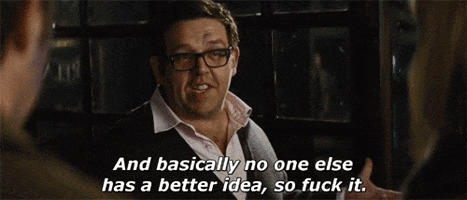
Dan (Vince Vaughn) is the founder of a startup sales firm and has the poor work-life balance of every white collar American dad in every comedy ever. One of the family problems he doesn’t have time to pay attention to is that his teenage son Paul (Britton Sear) doesn’t have any friends and is being cyber-bullied by his classmates because he’s fat. That plotline resolves with Vince Vaughn giving him a pep talk about being himself. Another notable fat character is Bill (Nick Frost), one of Dan’s clients. He is revealed to be a gay man in the leather scene who, because of his commitment to his job, has stopped working out and doesn’t get attention from men anymore. If you’re not at work, here’s some evidence of how there are no gay men in the world who think Nick Frost is a total babe. No siree. He also is spineless when dealing with his boss (James Marsden), but Dan inspires him to go behind his boss’ back (so he can help Dan out).
The Master (2012, dir. Paul Thomas Anderson)
In the beginning of the film, Freddie Quell (Joaquin Phoenix) is directionless and animalistic. Drunk at his job as a portrait photographer at a department store, he harasses a fat client (W. Earl Brown) to the point that the man engages him in fisticuffs. He then meets Lancaster Dodd (Philip Seymour Hoffman), a fat man who is the charismatic leader of a pseudo-scientific religion. Dodd, called the Master, preaches that humans are above animals, and have forgotten their true elevated nature. He makes Freddie’s redemption his pet project; this relationship makes up the bulk of the film.
My article The Blind (Drunk) Leading the Blind (Drunk): Masculinities and Friendship in Edgar Wright’s Three Flavours Cornetto Trilogy is up on BitchFlicks as part of their theme week on masculinity. The Cornetto Trilogy are three of my favorite films, and Andy Knightley (Nick Frost) in The World’s End is one of my favorite fat characters, a topic I hope to explore more in depth on here in the future. I had a lot of fun writing it. Please check it out, as well as the other articles about masculinities in film and television.
Director’s Club Podcast is going on hiatus, but not before putting out a series of bonus episodes over the next few months. The topics are requests from listeners who donated $50 or more to the production of Most Likely by Bang! Films, an independent romantic comedy featuring the acting talents of my bff Jess Conger. (You can’t fight synergy, Lemon. It’s bigger than us all.)
I was a guest commentator on the first of this series of bonus episodes, in which Patrick and I talk about Martin Scorcese’s divisive thrillers Cape Fear (1991) and Shutter Island (2010).
[CW: racism. Unless I’m speaking specifically about one of the films, actors are credited thus: (Actor in Original/Actor in Remake). –TR]
I’m sure John Waters has scoffed at people who try to ascribe a specific political angle to his films, but I can’t help myself. His outsider characters make me feel empowered by their vibrant, unapologetic weirdness. Hairspray’s Tracy Turnblad (Ricki Lake) is probably the most whitebread example of this character, but also one of the most lovable. Tracy is a fat white teenage girl growing up in Baltimore in the Civil Rights Era. Her family is working class, but she dreams of fame. Her dancing skills lead to her being cast on The Corny Collins Show, an American Bandstand-style pop music and dance show, she becomes an ally to the black cast members who want the show to be de-segregated. The film was adapted as a Broadway musical in 2002, which was made into a 2007 film starring Nikki Blonsky as Tracy and John Travolta as Edna Turnblad, a role originated by Divine. Wanting to see how Hairspray’s portrayal of fatness changed after being elevated into the elite subgenre of films based on musicals based on films, I watched the two films back to back.
Ricki Lake as Tracy Turnblad, 1988
I almost put this project aside before it began. Tracy’s size and indefatigable spirit are essential parts of the story; I couldn’t imagine that much could change. And yet, here we are. The characters and story remain intact for the most part, but there is a noticeable change in how both fatness and race are portrayed. The gains in nuance come with the loss of spirit, unfortunately, making the two Hairsprays into narratives that are complementary in their shortcomings.
Nikki Blonsky as Tracy Turnblad, 2007
Tracy Turnblad is one of my favorite fat film characters. She doesn’t let anything hold her back or stop her from being “big, blonde, and beautiful.” Rich snob Amber von Tussle (Colleen Fitzpatrick/Brittany Snow) makes cruel comments about her weight, but Tracy still becomes a wildly popular public figure and wins the love of heartthrob Link Larkin (Michael St. Gerard/Zac Efron). It’s an idealized situation for a fat woman in the 1960s. The 2007 remake is more explicit about the effect of sizeism on its characters: Velma (Michelle Pfeiffer) refuses to hire Tracy for The Corny Collins Show because she’s fat, Tracy misunderstands something that Link says as a dig at her size. Most of the added treatment of characters’ fatness in the remake is attached to Tracy’s mother. John Travolta’s Edna is very insecure about her weight, to the point where she hasn’t left the house in 10 years because she doesn’t want the neighbors to see the weight she’s gained in that time.
Granted, the remake’s treatment of fatness is more grounded in reality. Edna’s subplot reflects a tenet of fat acceptance: rejecting the idea that a fat person must put their life on hold until they achieve a certain weight. It’s important to have narratives that reflect the struggle that many fat people have in accepting themselves and navigating a world that dismisses them based on their size, but that hardly has to be every narrative about fat people. Fat characters who are doing their thing without angst or apology can be just as powerful; the optimism inspired by an idealized setting can mean as much as a more relatable tale. During her audition for The Corny Collins Show Ricki Lake’s Tracy construes her size as a boon, saying that she would be relatable to home viewers who are “pleasantly plump or chunky.” Divine’s Edna similarly charges into the role of Tracy’s agent with no worry that people might not take a fat housewife seriously. The closest the remake comes to the original’s gleeful distortion of stereotypical depictions of fat people is Edna’s self-acceptance being conflated with her appetite (“You can’t stop my knife and fork when I see a Christmas ham,” she sings confidently during the finale). Instead of being completely unapologetic about her deviance from expectations around beauty and propriety and moving forward with the rest of the film, as Divine’s Edna is, Travolta’s Edna starts the film as a sad fat stereotype, gets permission from Tracy, Maybelle, and her husband (Christopher Walken) to accept herself, and blossoms into a more comical fat stereotype. Considering the amount of time the remake gives to Edna’s transformation, the results are disappointing.
Hairspray lacks much of Waters’ signature filth compared to his other films, but it’s hardly sanitized; this is evident when compared to the remake. One of my favorite scenes from the original film is the Hefty Hideaway ad spot. Mr. Pinky (Alan J. Wendl), owner of the plus-size boutique, hires Tracy as his spokesperson. It’s a moment that finds subversive power through the gleeful embracing of stereotypes. Mr. Pinky keeps his store stocked with pastries. “Eat up, girls, eat up,” he encourages his customers, “Big is beautiful!” His commercial spot on The Corny Collins Show features Tracy modelling a chic ensemble, picking up a pink frosted pastry from a display at the end of the runway and taking a bite. The modified exchange in the remake suggests a more comfortable approach to a fat-safe space for audiences. The ad spot is gone. During her visit to the Hefty Hideaway, Mr. Pinky (Jerry Stiller) hands Tracy a platter of donuts, which she hands off without taking one, showing that she’s a “good fatty” with self-control. The underlying current of lasciviousness is redirected into Mr. Pinky trying to guess Edna’s bra size, and his glee when she reveals that she is a few cup sizes larger than he had assumed. The remake, presumably trying to give respectability to fatness the original does not, ends up repeating a regressive trope of fat women’s desirability being chalked up to larger breasts.
Although Tracy is white, the story’s action is largely propelled by racism. The main conflict of the film is the struggle to integrate The Corny Collins Show, which has an all-white cast except for the monthly “Negro Day,” hosted by Motormouth Maybelle (Rita Brown/Queen Latifah). By prioritizing Tracy’s perspective as she stands in solidarity with her black friends, Hairspray inescapably becomes a white savior narrative, which dramatically limits the impact of its critique of the racism it depicts. The remake tries to compensate by increasing the focus on the black characters’ experiences with racism, but fails to give life to these moments without the original’s unruly, rebellious spirit and ultimately proves an ineffective counterbalance to the original film’s shortcoming.
The remake infuses a Message into the story by equating the struggles of fat people with those of black people. Tracy supports Maybelle, Seaweed (Elijah Kelley) and Little Inez (Taylor Parks) because she relates to them as someone else who is “different,” and not seen on television. Tracy’s sense of solidarity being due to ability to connect her personal struggles with those of others is an important element in stories about struggles for justice that isn’t emphasized in the original. However, the film brings that equation into areas where it doesn’t really work. In one scene that neatly synthesizes stereotypes about both fat people and black people, Edna is reluctant to allow Tracy to hang out at Maybelle’s record store, but is won over by a spread of fried chicken, cornbread, and collard greens during the sexy “Big, Blonde and Beautiful” number.
As with fatness, the remake sanitizes the original’s treatment of race. The original seeks to align the audience’s empathy with the black characters and against the racist white grownups. The satirical depiction of racist attitudes (presumably the ones John Waters heard growing up) doesn’t pull any punches. Velma (Debbie Harry) and Amber try to discredit Tracy by insisting that she is “mulatto”. Mrs. Pingleton panics when she has to walk through a black neighborhood, and we are cued in to the degree of her bigotry by a tribal drumming score. These moments are scrubbed out of the remake. All three antagonists are still assholes, but taking them out of the tasteless, ridiculous light cast by the original only serves to soften the ugliness of their behavior. Depictions of racism are also far less subtle. The remake addresses cultural appropriation through a scene where Velma gets angry at the Dynamites for singing a song they wrote on Negro Day because it had previously appeared on a white episode. This is a far more direct illustration than the original, where Link smarmily informs Tracy, “our souls are black, though our skin is white.” Having realistic depictions of racism in the film while remaining family friendly creates a problematic need to gloss over certain aspects, such as police brutality. When Tracy is on the run from the police and seeks shelter at Maybelle’s house, the danger of police backlash Maybelle would risk (to say nothing of her children) is not even a consideration, because they’re so grateful for the allyship Tracy has shown the Negro Day cast for– what? a week?
Perhaps the most illustrative example of how each film regards outsiders is in the contrast of how the outsiders are portrayed attempting to demonstrate political power. The protests in the original film are spontaneous, energetic, and disruptive, but their purpose changes from integrating The Corny Collins Show to freeing Tracy when she is sent to reform school. The remake sees Tracy joining the black community for a somber candlelight march while Maybelle sings the slow, soulful “I Know Where I’ve Been.” The focus stays on integration, which reduces the problematic aspects of the white savior narrative, but is also devoid of the flamboyant energy that pervades the other scenes. Abruptly changing the tone of the film to express the black characters’ call for integration feels oddly distancing, as though the scene was added out of a sense of obligatory liberalism, and frames political protest as something that is not only rigidly somber, but embalmed in a specific point in history (i.e. the Sixties, when the Baby Boomers fixed everything before moving on to middle management positions). A more vivacious protest scene would not only be better suited to a group of teenage dancers demanding their rightful place in rock ‘n roll, but would also be more engaging for the audience.
The moment that best overlaps the spirit of the original Hairspray with the sensibility of the remake is during the climax of the latter, when Inez forces her way onstage during the Miss Hairspray pageant and gains more votes for her dance moves than either Amber or Tracy. By unapologetically ignoring the arbitrary and stifling rules put in place by white authority figures, Inez expresses herself and achieves her dream of dancing on The Corny Collins Show. Her victory isn’t hers alone, though: it is a victory for her marginalized community, and raises the happy ending above individual gain to large-scale progressive change. But if the remake wants to take the civil rights aspect of the story more seriously, why not step away from the white savior narrative altogether and make Inez the protagonist? Tracy Turnblad is an amazing fat heroine, but not an appropriate once for a story about racism.
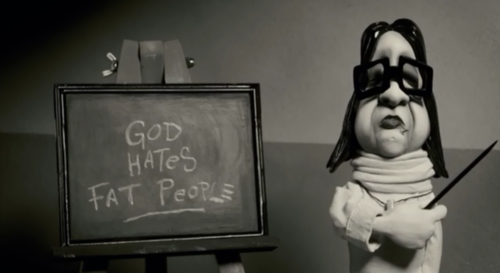
Mary and Max is one of those films that Netflix has been incessantly recommending to me for years and I kept putting off. I recently ended up watching it (instead of, say, Jiro Dreams of Sushi) because I noticed that the two titular characters are described as “a chubby 8-year-old Australian girl” and “an obese, adult New Yorker.” The description of Max’s body stood out. Other films on Netflix with fat protagonists that I’d come across tended to be more euphemistic. Paradise: Hope is summarized as being about a girl sent to a “diet camp;” the heroine of The Hairdresser is described as having a “plump figure;” and in tv series Drop Dead Diva, she’s “plus-sized.” This could be influenced by gender; Max is a man, and the examples I was able to think of and find on Watch Instantly are about women. However, when I searched “obesity,” the seven “titles related to obesity” that I got as results were all documentaries related to health and medicine, like The Waiting Room and Forks Over Knives. As a claymation drama about friendship, Mary and Max seems to have more in common with the aforementioned female-lead narrative films, where fat characters must navigate a world that ostracizes them. For Max, that ostracization often manifests as pathologization.
Deviating from my previous observation that films rarely tell us characters’ height and weight, Max (Philip Seymour Hoffman) informs Mary (Bethany Whitmore, later Toni Collette) that he is 6 feet tall and weighs 352 lbs. Max is described as obese in the text of the film, as one of several labels used by institutions to describe him as in need of fixing. These labels mostly hinder him, but also help: Max was called for jury duty (a position he holds in high esteem) but was dismissed because he had been institutionalized, but later in the film criminal charges brought against him are dismissed because the court deems him “mentally deficient.” Likewise, he is able to restore balance to his life through help from his psychiatrist and being institutionalized, but the medical system also limits him by describing him as disabled and in need of curing due to Asperger’s syndrome (as well as diagnosing him with obesity). Max dissents. He feels that living with Asperger’s (or being an “Aspie,” his preferred term) is as much a part of his identity as the color of his eyes. He is an outsider, but he maintains the integrity and independence to see a world he doesn’t fit into as nonsensical because it doesn’t make allowances for him, instead of giving in to how the world has labeled him. Max’s self-loyalty extends to his dietary habits. He attends Overeaters Anonymous at the advice of his psychiatrist, but doesn’t seem to have any personal motivation for losing weight. Rather, he takes pleasure in eating chocolate and creates new dishes that are more driven by taste than nutritional value. Chocolate is important to both Max and Mary as a shared passion, and their correspondences include sending new types of chocolate to each other along with their letters.
Although the film situated Max in a world where he is labeled and ostracized by medical conditions, the film itself does not assign moral judgment to how Max functions or perceives the world. Max’s eccentricities are occasionally a source of humor, such as his invisible friend Mr. Ravioli. His fat body is not romanticized, as we often hear his heavy breathing (especially after he gains a significant amount of weight) and see the repeated image of his plumber’s crack when he sits at his typewriter. But in a departure from how films often depict fat characters’ bodies as grotesque in comparison to thin characters’, the whole cast of Mary and Max is comparably rabelaisian. I’ve never heard so much incidental farting in a film. If nothing else, casting the late, great Philip Seymour Hoffman to voice Max is a strong indication that the creators of the film intend for the audience to respect Max, as fat outsiders portrayed with warmth and humanity comprise Hoffman’s career.
Neurotypical Mary is better equipped to function in society than Max, but is a ultimately a less-fulfilled person than he. She too is an outsider, but her sense of fulfillment is more subject to outside approval than her friend’s. Her body even seems to be a concentration of her homogeneic suburban environment, which is filmed in sepia tint. (Max’s New York is shown in black and white, perhaps a visual pun on how the Asperger’s mind tends to work.) The first lines of the film’s narration describe Mary’s body in unappealing terms that highlight her brown-ness: “Mary Dinkle’s eyes were the color of muddy puddles. She had a birthmark the color of poo.” She too is fat, but fatness is more of a problem for her as garnering social disapproval than pathologization. “I’m sad to hear you’re fat,” she writes to Max in one of their early exchanges, “I’m fat too, and mum says I’m growing up to be a heffer.” When we see her as an adult, she is slimmer. This physical transformation comes at the same time in her life as voluntary surgery to remove her birthmark and a makeover. Unfortunately, when her crush Damian (Eric Bana) sees the “new and improved” Mary for the first time, he only comments on the dog shit stuck to her shoe. Surface physical changes are not enough to free Mary from her indifferent, brown environment, nor from her reliance on Damian’s approval to fuel her self-confidence. She writes to Max that she wasted her savings, and should have used them to fund a trip to New York.
Although adult Mary’s normative body and ability to navigate institutions like university successfully give her a certain amount of privilege over Max, he subverts the trope of fat best friend who exists to support the maturation of a thinner protagonist. In their initial correspondence, the two interact as peers, seeking advice and information from each other. The power dynamic shifts when Mary goes to university and studies psychology. This is hinted at when she is shown on campus reading a book by Oliver Sachs, a neurologist who has been criticized for exploiting his clients in the interest of his literary career. Mary finds a way of succeeding in the world that had previously rejected her, and through assimilating into that world, she adopts its pathologizing view of her friend. When Mary publishes a book about Asperger’s using Max as her case study without his permission, telling him that she hopes to find a “cure,” he reacts in anger. Instead of one of his typical wordy letters, he sends her the M typebar from his typewriter, dramatically cutting her off from receiving any further communication from him. This shifts the power dynamic in their relationship a third time. Max gains power over Mary, as his withdrawal prompts her to pulp every copy of her book before it can be sold and sends her spiralling into depression. She begs his forgiveness by mailing him the last can of her childhood comfort food, sweetened condensed milk, in her pantry. But even if this power dynamic contradicts the expected course of their relationship, it isn’t healthy for either of them. Mary falls deeper into depression and reliance on alcohol, while Max becomes bitter and angry. When Max learns how to forgive, both of them are redeemed. Max separates himself from the supportive outsider archetype not only through his expression of anger and withdrawal of support, but by developing as a character alongside his thinner, neurotypical friend.
A third important factor that suggests the film wants us to empathize with Max instead of pathologize him is how he subverts the easy symbolism of his size. Max is a fat character, but his size is not a physical indicator of greed or insatiability: he is able to achieve satisfaction. He has three life goals, all of which are acquisitions of things outside of himself: he wants a lifetime supply of chocolate, a complete collection of Noblet figurines, and a friend. These goals seem to have foundation in Max’s concrete way of thinking, as opposed to avarice. In fact, when Max is able to achieve the first two goals when he wins the lottery, he gives the rest of the money to his neighbor. Max might not even see his death at the end of the film as tragic. Mary finds him with a contented smile on his face as he gazes at her letters while The Noblets, their shared ideal of friendship, plays on TV. For Max, their long-distance relationship was fulfilling without them ever being in the same room.
Mary and Max presents us with flawed, eccentric characters who struggle to exist in communities that don’t accommodate them. However, by focusing on their inner lives and their own means of communicating their feelings and experiences, the film invites the viewer to empathize with the protagonists instead of agreeing with the labels and judgments they are forced to live with. Despite being lumps of clay, Mary and Max are considerably more human than many of the flesh-and-blood fat characters given to us by cinema.
But Dewey’s gradual transformation into a better, more self-aware version of himself is wholly divorced from his fat, which remains on his person, as permanent as his love of Black Sabbath. Fat can’t be a sign of sloth and self-indulgence if it remains when those characteristics disappear. More importantly, Dewey’s successful performance at the Battle of the Bands, where he careens and showboats all over the stage, proves that rock need not be attached to a scrawny, screeching rock-monkey aesthetic but can come in any size.
Inkoo Kang’s 2013 article for Badass Digest looks at fat tropes, specifically with regards to its chubby protagonist rocker Finn (Jack Black), in Richard Linklater’s 2003 comedy School of Rock. It’s a short piece; one of the reasons I wanted to start this blog is because, after reading it, I very much wanted the conversation to continue.









 Consistent Panda Bear Shape