2010s

Roundup: June 2015

Although it’s my intention for most of the posts on CPBS to be less about analyses of targeted fat characters and more about my experience as a viewer randomly coming across these characters as I watch films in a more organic fashion, I end up seeing a lot more fat people in film than those I write about here.  In what will hopefully be an ongoing monthly feature, here’s a summary of films I saw over the past month that feature fat characters I didn’t write about.

The Texas Chain Saw Massacre (1974, dir. Tobe Hooper)

There are a few fat people in this landmark horror film.  Franklin (Paul A. Partain), one of the main characters, is fat and in a wheelchair.  Although not the most nuanced character or performance in the history of film, he is given more screen time, dialogue, and personality than the other members of his group.  Once scene follows him as he struggles to navigate his chair through an abandoned house, while his friends’ laughter can be heard from the second floor.  I was impressed by this, considering that characterization in slasher films is usually pretty sparse, and that fat and disabled characters are usually not shown in a light that leads the audience to empathize with them.  Leatherface is arguably fat as well, especially when compared to his family members; his size adds to his menace, and he is able to keep up with Sally (Marilyn Burns) pretty well during the chase scene, especially considering that he is carrying a chainsaw.  In a minor part, a fat man of color driving a semi in the last scene runs over the Hitchhiker (Edwin Neal) before he can kill Sally and helps her escape.

The Set-Up (1949, dir. Robert Wise)

This film centers on a boxing match: one of the competitors (Robert Ryan), who is unwilling to accept that he’s past his prime, has been instructed to take a fall.  Unfolding in real time, we see the fight from the differing perspectives of a large cast, including several anonymous spectators.  One of these spectators is a fat man (Dwight Martin) who is shot from a low angle, emphasizing his girth.  He laughs at the violence taking place in the ring, although his schadenfreude is not outstanding relative to other characters in the audience.  He shown eating every time he’s on screen, going through several different food items over the course of the competition.  I saw this film at a theater; by the last half of the film, a good chunk of the audience was laughing whenever the fat man was shown with a new food item.

Blue Velvet (1986, dir. David Lynch)

Set on terrorizing Jeffrey (Kyle MacLachlan) as revenge for having sex with Dorothy (Isabella Rosselini), Frank (Dennis Hopper) forces the two of them to come on a joyride with his crew to a brothel run by his associate Ben (Dean Stockwell).  The scene is consummate Lynch, a tense and menacing tableau that incorporates elements of mid-century American bourgeois culture.  Part of this tableau are three fat women.  Dressed in a conservative manner, they don’t have names or speak, except for one who Ben refers to as “darling” and requests that she fetch glasses for their guests.  Their function is to give Ben’s house an uncomfortable tone.

Martin & Orloff (2002, dir. Lawrence Blume)

A comedy about Martin (Ian Roberts), a man who attempts suicide, and the unorthodox psychiatrist Dr. Orloff (Matt Walsh) who forces him on a bizarre journey of self-discovery, strongly influenced by improv and sketch comedy and featuring a dream team cast of improv actors and comedians (Amy Poelher, Tina Fey, H. Jon Benjamin, Andy Richter, the list goes on).  When Patty (Amy Poehler) falls in love with Martin, her boyfriend Jimbo (Sal Graziano) falls into a jealous rage.  Jimbo is a large, fat man with an absurdly large penis who spends most of his screentime threatening to beat up Martin, often squatting like a sumo wrestler and charging.  Through Dr. Orloff’s incidental help, Jimbo connects his anger to his thwarted football career, and decides to ally with Martin.

When Marnie Was There (2015, dir. Hiromasa Yonebayashi)

Anna, a 12-year-old struggling with asthma and her sense of self-worth, is sent to live in the country with her foster mother’s relatives for the summer to improve her health.  One of her temporary guardians, Mrs. Oiwa, is a fat woman.  She is a laid-back maternal figure who treats Anna with kindness and respect, even if she doesn’t always have a bead on the girl’s emotional needs.  She is often shown in relation to food (snacking, cooking, and tending her vegetable garden), and connects with Anna over the latter two activities.  Another fat character in Marnie is Nobuko, a girl who lives in Mrs. Oiwa’s neighborhood.  Mrs. Oiwa tries to encourage a connection between her and Anna, but Nobuko’s extroverted personality makes Marnie uncomfortable.  When Nobuko asks Anna some overly personal questions, the quiet girl becomes overwhelmed and calls her a “fat pig.”  Nobuko retaliates with some insults of her own before suggesting they drop the matter, but Anna runs away in embarrassment.  Before she returns to her home in the city, Anna apologizes to Nobuko, who accepts her apology by forcefully insisting that Anna join the neighborhood trash pickup next summer.

Unfinished Business (2015, dir. Ken Scott)

Dan (Vince Vaughn) is the founder of a startup sales firm and has the poor work-life balance of every white collar American dad in every comedy ever.  One of the family problems he doesn’t have time to pay attention to is that his teenage son Paul (Britton Sear) doesn’t have any friends and is being cyber-bullied by his classmates because he’s fat.  That plotline resolves with Vince Vaughn giving him a pep talk about being himself.  Another notable fat character is Bill (Nick Frost), one of Dan’s clients. He is revealed to be a gay man in the leather scene who, because of his commitment to his job, has stopped working out and doesn’t get attention from men anymore.  If you’re not at work, here’s some evidence of how there are no gay men in the world who think Nick Frost is a total babe. No siree.  He also is spineless when dealing with his boss (James Marsden), but Dan inspires him to go behind his boss’ back (so he can help Dan out).

The Master (2012, dir. Paul Thomas Anderson)

In the beginning of the film, Freddie Quell (Joaquin Phoenix) is directionless and animalistic.  Drunk at his job as a portrait photographer at a department store, he harasses a fat client (W. Earl Brown) to the point that the man engages him in fisticuffs.  He then meets Lancaster Dodd (Philip Seymour Hoffman), a fat man who is the charismatic leader of a pseudo-scientific religion.  Dodd, called the Master, preaches that humans are above animals, and have forgotten their true elevated nature.  He makes Freddie’s redemption his pet project; this relationship makes up the bulk of the film.
The Blind (Drunk) Leading the Blind (Drunk): Shaun of the Dead; Hot Fuzz; The World’s End (2004, 2007, 2013; dir. Edgar Wright)

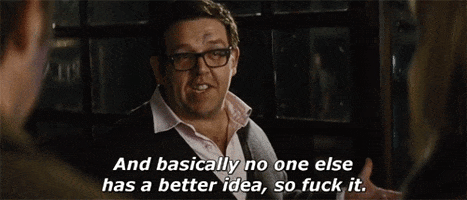
My article The Blind (Drunk) Leading the Blind (Drunk): Masculinities and Friendship in Edgar Wright’s Three Flavours Cornetto Trilogy is up on BitchFlicks as part of their theme week on masculinity.  The Cornetto Trilogy are three of my favorite films, and Andy Knightley (Nick Frost) in The World’s End is one of my favorite fat characters, a topic I hope to explore more in depth on here in the future. I had a lot of fun writing it.  Please check it out, as well as the other articles about masculinities in film and television.

Comparing Spy (2015, dir. Paul Feig) with Tammy (2014, dir. Ben Falcone)

I was skeptical of at first, due to Melissa McCarthy’s last few films receiving mediocre ratings, but I’m happy to report that Spy gloriously exceeded my expectations.  Susan Cooper (Melissa McCarthy) is a smart, capable CIA agent who has spent her career at a computer, doing support work for her suave partner Bradley Fine (Jude Law), who goes around the world on glamorous field assignments.  After she sees villainous Raina (Rose Byrne) kill Bradley and brag that she knows the identity of all of the CIA’s active spies, Susan goes undercover to avenge her fallen partner and prevent Raina from selling a nuclear weapon to terrorists.

melissa mccarthy, spy, spy 2015, paul feig, susan cooper

Spy is a great summer film.  I saw it this afternoon, and my throat is still sore from laughing so hard at the panoply of hilarious performances, with McCarthy as the leader of the pack.  I was notably delighted by Miranda Hart as Susanne’s gawky wingwoman Nancy, and Peter Serafinowicz, whom I recognized from his antagonistic straight man roles in Edgar Wright’s Spaced and Shaun of the Dead, as a relentlessly sleazy Italian agent.  The action scenes are thrilling without being overblown, and the two hour run-time flows by easily with spirited energy.

Spy is a highly entertaining action comedy that knows its limits, but does more than enough within them.  This factor alone makes it a notable improvement over Tammy, last summer’s comedy offering starring McCarthy.  Tammy has plenty of funny moments and empathizes with its fat, ill-mannered, working class protagonist as much as it throws obstacles in her path, but doesn’t do a very graceful job of balancing its goofy, vulgar humor with the more serious aspects of the story, such as Pearl’s (Susan Sarandon) self-destructive behavior, and the moments of emotional honesty and vulnerability do more bogging down than adding depth.  Which sucks, because there is an inherent transgressive joy to see two characters who would be pushed to the sidelines in most films leaving their stagnant lives behind in search of adventure.

melissa mccarthy, susan sarandon, tammy, ben falcone

By virtue of being an action film, as opposed to a road trip film, Spy doesn’t have the expectation of character development or emotionally laden moments.  Even so, Spy doesn’t shy away from the pathos Susan experiences as a fat misfit.  Despite being a multi-talented agent, Susan experiences multiple microaggressions related to her fatness that impact her confidence.  Bradley uses his advantageous position, as her mentor and her crush, to convince her that she isn’t suited for field work.  He treats her with condescension, gifting her a cartoonish cupcake pendant to thank her for her help.  There is no way a sophisticated globetrotter would think of something so tacky as an appropriate gift for someone he respected as a peer, whether or not he had romantic feelings for her.  She is only inspired to volunteer for a field assignment when her boss (Allison Janney) says that they need an operative who is invisible.  Susan is invisible, as she works in a world where anyone who matters, especially any woman who matters, is thin and chic.  Insulting banter is a large chunk of the film’s humor, and there is a recurring theme of characters criticizing each others’ style choices.  Even though Susan is never directly insulted for being fat, she is at an automatic vulnerability for the contempt of her peers and antagonists because her size prohibits her from dressing fashionably.  In the beginning of the film, she puts Bradley on a pedestal, admiring his tailored suits.  “This shirt doesn’t even have a label,” she says of her own blouse, in self-deprecating comparison.  The false identities she is given speak to how her appearance deems her to have a boring, pedestrian life: a single woman with 10 cats, a divorced mom of 4.  Even her fancy spy gadgets are stripped of any glamorous aspects that would accessorize her thinner colleagues, such as an all-purpose antidote disguised as a bottle of stool softeners.

Compared to Tammy, the audience has less of a challenge in sympathizing with Susan.  Susan is impressive.  She holds her own in a field that demands over-achievement: she is a skilled fighter, focused under pressure, and has incredible attention to detail and analytical ability.  Tammy can’t haul herself over a low fast-food restaurant counter, has a hair-trigger temper, and doesn’t know who Mark Twain is.  Like Susan, Tammy struggles with a lack of regard from other people, but this is shown to be partly due to her abrasiveness (which she readily admits).  It would be easy to dismiss Tammy as a fat stereotype engineered for crude laughs, but we could just as easily criticize how Susan is written as overly idealized, as her flaws-that-aren’t-really-flaws (she doesn’t know how to act in a fancy restaurant, just like you in the audience!  She struggles with a lack of confidence that she quickly finds via a sexy international espionage adventure!) pale in comparison to how kickass she is.  However, both characters offer different ways of depicting how fat woman are marginalized.  We witnesses that marginalization on-screen in Spy, as Susan is belittled even though she does everything right.  However, when confronted with Tammy, we struggle with that marginalization in our own reactions to its titular protagonist.

The Story of Self-Improvement: Results (2015, dir. Andrew Bujalski) and Welcome to Me (2015, dir. Shira Piven)

Fatphobia is a complicated beast both in terms of genesis and expression, but in the USA, it is often partnered with the cultural preoccupation with self-improvement.  This country has a history that pushes to the forefront stories of people who better their lot in life through willpower, gumption, and a maverick spirit: wilderness pioneers, rags-to-riches entrepreneurs, social visionaries.  As inspiring as it can be, this idea of self-improvement often intersects with problematic ideas, such as the belief that buying the right product will be life-transforming, or improvements that tacitly require groups who have been fucked over by the aforementioned pioneers and entrepreneurs (and who the visionaries died trying to liberate) to assimilate into hegemonic standards.

As self-improvement focuses on an individual, its narrative is often written onto bodies.  Consider the popular and long-lived meme of “before’ and “after” photos in weight loss product advertising.  #notyourbeforephoto has been used by fat activists to rebel against this meme that positions our bodies as in need of fixing.  On the flipside, this article by a woman recovering from anorexia talks about the troubling co-option of photos of thin people living with eating disorders as “after” photos, deconstructing the idea that thinness equals health and happiness.

The diet ad meme is often pathetic in its transparency, ensuring that the subject is more neatly dressed, in better lighting, and wearing a happier expression in the “after.”  Despite the impassioned personal testimonies from activists and cheesy commercials that border on self-satire, the idea that the shape and size of one’s body equates to one’s mental and emotional well-being persists in popular media.  Two indie dramedies currently in theaters serve as criticism of the idea that a thin, athletic body is a sign of emotional and mental wellbeing.

results, colbie smulders, kevin corrigan

Results focuses on gym owner Trevor (Guy Pearce) and personal trainer Kat (Colbie Smulders), a mismatched pair who try to help client Danny (Kevin Corrigan) with his fitness goals.  At first blush, it seems like Trevor and Kat have their lives more together than Danny does.  Trevor is looking to grow his business and bring his fitness philosophy to the world; Kat is his star trainer and isn’t afraid to remind her boss of that fact.  Danny, meanwhile, is a schlemiel dealing with life-changing events that have left him single, alone in a new city, and a millionaire.  He describes himself as “pudgy;” his average body shape and below average grooming habits are more noticeable when compared to the athletic, clean cut gym bunnies who he constantly, if inadvertently, confuses.  Despite joining Trevor’s gym with the stated goal of wanting to be able to take a punch, we quickly discover that Danny’s life is largely empty and directionless.  He is socially awkward and uses his newfound wealth as a blunt tool to fix his problems, like making Craigslist posts offering hundreds of dollars in compensation for people willing to procure a cat for him and show him how to use his new tv.  However, as the film progresses, Trevor and Kat show cracks in their own well-toned walls.  Trevor, too goal-oriented for much self-reflection, makes a long trip to meet his fitness idol Grigory (Anthony Michael Hall), who criticizes his fitness philosophy and has no respect for him.  Kat’s caustic streak widens into near-chaos as she scrambles to figure out the next step in her own life.  Ultimately, none of them are in control of their own lives, and Kat and Trevor’s inability to untangle their feelings for each other shows their internal lives to be as messy as Danny’s.  To Danny’s credit, he is direct and honest, even if he struggles to express himself appropriately.

Welcome to Me follows Alice (Kristin Wiig), a woman who filters her struggles with mental illness through fad diets and the gospel of Oprah.  After winning $86 million in the lottery, she decides to go off her meds in favor of a high-protein diet, move into a casino, and fund her own talk show on an infomercial network.  Alice’s show, entitled Welcome to Me, is an expression of how she sees her world, and her role in it; she is both the brave survivor whose life stories are material for segments and the self-actualized host who dispenses wisdom and motivation.  The segments include dramatized re-enactments.  Some serve as a form of catharsis for Alice, giving her a chance to confront conflicts from her past in an environment that she controls, but others illustrate her belief that she is a role model to her friends and family, much like Oprah is for her.  One scene re-enacts her and her best friend Gina (Linda Cardinelli) shopping for bathing suits.  The actress Alice has cast to depict Gina is significantly larger than real-life Gina, and the scripted conversation filtered through Alice’s memory revolves around Alice coaching Gina to find the self-confidence to wear a two-piece.  This depiction offends Gina, who tells an uncaring Alice that she is comfortable with her body and simply prefers one-piece bathing suits.  The friend’s roles are reversed in their real lives, with Gina having been a steadfast support and guide for Alice since their childhood.  Late in the film, Gina delivers an impassioned monologue to Alice, telling her that her self-absorption and lack of empathy makes her a terrible friend.  Deciding to leave Alice, Gina cries in frustration,  “Fuck you for making me fat on your show!”  On the last episode of Welcome to Me, Alice apologizes to Gina and acknowledges how much she values her as a friend.  The episode includes a re-enactment of Gina being a source of emotional support for Alice during a difficult time in her life; this time, the actress depicting Gina is slender and petite.

welcome to me, alice klieg, kristen wiig

Both Results and Welcome to Me reach ambiguous conclusions: the protagonists grow as people, but still have long ways to go in their quests for happiness. There is a sense of contentment with this ambiguity, however, as the films show the inherent problems with the idea that self-actualization is easily and automatically obtained through a fitness philosophy or a high protein diet.  We’re all struggling, and nobody has a magic bullet to fix that, no matter how low their body fat percentage.

Portraying Strong Female Characters, Except When It Doesn’t: Mad Max: Fury Road (2015, dir. George Miller)

(Just a reminder, all CPBS articles potentially contain spoilers.)

This afternoon, I had the pleasure of engaging in BitchFlicks‘ weekly Twitter discussion, the topic of which was Mad Max: Fury Road.  Fury Road is a decent action film that makes up in style what it lacks in story and character detail, but it’s getting a lot of attention as a potentially feminist action film.  I tend towards skepticism when regarding mainstream media attempts at true progressivism, as I’m more likely to dwell on the problematic stuff that remains a constant.  A lot of the contributors to this afternoon’s discussion were more optimistic in their view of the film, which led me to concede that I was overlooking the positive aspects of Fury Road.  It’s amazing to see a big budget action film that features women defending themselves, standing up to the bad guy, striking out into the unknown, and doing it all because they know they can rely on each other.  Despite being the titular character, Max (Tom Hardy) plays more of a supporting role to Imperator Furiosa (Charlize Theron).  Over the course of their adventure, the two learn to trust each other and work together without resorting to a compulsory romance.  Furiosa’s goal is to liberate the Wives, five women who are sex slaves to Immortan Joe (Hugh Kyes-Byrne), a tyrant who controls a large source of water, and return with them to her matriarchal homeland, the Green Place.

However, Fury Road is a mixed bag with regards to body diversity.  Furiosa is an amputee, which is pretty huge, considering she’s the protagonist.  However, there are other people in the film whose disabilities aren’t quite as cool (Furiosa gets a neat-looking robotic arm), and seem to be present as props to convey how harsh life is in this desert setting.  Fat people are present in the film, but don’t fare very well.  When Joe is introduced, we see him in a room full of fat naked women whose lactating breasts are being pumped by machines.  These women are presumably his wives as well, or at least other women whose bodies are being exploited by him alongside the Wives.  Physical exploitation is a recurring presence in Fury Road.  Max is initially captured and held by Joe’s war boys so that his blood can be harvested.  The Wives are being exploited by Joe for sexual and reproductive purposes; they graffiti the walls of their rooms for Joe to find when he discovers they have escaped, bearing messages that they are not objects, and refuse to give birth to future warlords.  However, Max and the Wives escape from and confront their oppressors, while the nameless, voiceless fat women have no agency in this way.  The fat women’s bodies are in sharp contrast to those of the Wives– all five actresses playing the Wives have careers as models, and they are clothed in gauzy, pure white fabric.  The fat women do re-appear at the end of the film after Joe’s reign of terror has been overcome, giving the thirsty masses full access to Joe’s water reserves.  Although they participate in the liberation of the Citadel, that role reflected their earlier state captivity a little too closely for me to feel that there was true redemption.  They seemed to be stuck in an affliation with nourishing and abundance which made me uncomfortable, given the unsettling imagery of their captivity.

Another problematic fat figure is Joe’s ally, the People Eater (John Howard).  Although not given much in the way of characterization beyond being a Mini Boss, the People Eater’s fatness is linked to a sense of sadomasochistic hedonism, which are intended to inspire disgust in the audience.  The People Eater’s shirt has holes cut in it so that his nipples stick out; he wears clamps and chains on them that he has a habit of playing with.  He also has a metal grating covering his nose, which I interpreted as suggesting syphilis, which can cause the flesh of the nose to rot in advanced stages.  In the days before medical interventions, the decayed nose was a stigmatic mark of immorality.  Apparently, everything old is new again.  He also has exaggeratedly fat feet which eventually lead to his undoing, as Max forces his foot onto the gas pedal that leads him to crash.

There’s a lot about Fury Road that is refreshing in terms of representation, but the fat bodies present in the film get burdened with some tired tropes that detracted from my enjoyment of it.  One of the main ideas that the film presents is that bodies aren’t objects; unfortunately, that message doesn’t extend in practice too far beyond the normatively attractive characters.

The Foxy Merkins (2014, dir. Madeleine Olnek) and the Uncharted Territory of the Fat Lesbian Protagonist

This is super exciting for a few reasons.  A fat, gender nonconforming protagonist!  A film written, directed by, and starring queer women!  A film that passes the Bechdel Test so hard that it would fail the Bechdel Test if applied to its male characters!

And perhaps the most exciting part– at least, for me, but it’s my blog so that means my opinion is basically irrefutable objective fact– is that the awesome feminist film site BitchFlicks published my thoughts on The Foxy Merkins as part of their Theme Week on fatphobia/fat acceptance.

You can read it here!  Eee!

And if you haven’t already seen it, check out The Foxy Merkins on Netflix watch instantly.  It’s a hoot and a half.

I’ll be doing an article roundup of the rest of fat Theme Week in a few days, as well as taking in a few films at the Chicago Critics Film Festival over the next week, so there might be something from that.

The DUFF, or: What Makes a Character Fat?

In wide release as of last week, The DUFF is about Bianca (Mae Whitman), a senior in high school who is told that she is a Designated Ugly Fat Friend, someone whose social value lies in making her friends look more attractive by comparison.  This premise has not gone without critique.  From Genevieve Koski’s review on the Dissolve:

The idea of a “DUFF”—a “designated ugly fat friend,” or the less-attractive person hot people keep around to make them seem more desirable and approachable—is hideous, offensive, and shallow. And to its credit, The DUFF treats it as such. The idea of Arrested Development’s Mae Whitman, a just barely unconventionally attractive, objectively not-fat actor being a DUFF is even more hideous, offensive, and shallow. And to its detriment, The DUFF doesn’t do enough to undermine that idea.

When an actress who is straight-sized (if not willowy) is cast as someone who is devalued because of the size of her body, does that representation highlight the unobtainable exclusivity of  beauty standards, or uphold them by eclipsing the potential for featuring an actress whose body deviates even further from those standards?  According to its defenders, The DUFF concludes that it’s best to embrace who you are, but is that necessarily synonymous with critiquing culturally established beauty standards?  Frankly, I don’t want to schlep downtown in the cold and pay $11 to find out for myself, but the DUFF kerfuffle did bring to light something I’ve been wondering for a while:  what establishes a character as fat?

Spot the ugly fat person, win a prize!

In our day-to-day lives, we have indicators from various institutions as to whether or not we are fat.  The body mass index (BMI) is a commonly used, if flawed, tool in the medical field.  Mass-produced goods like clothing give us indication about what bodies are supposed to look like.  However, it’s unusual for a film to explicitly state a character’s height and weight, or their clothing size.  Of the films that I’ve reviewed on this blog so far, the closest that we’ve come to information about a character’s height/weight or clothing size is In & Out, where Emily reveals that she used to be 75 pounds heavier.

“Fat” as a descriptor goes beyond quantifiable data.  Mae Whitman obviously isn’t fat by clothing size or BMI standards, but she was cast as a “fat” character.  Even if she can buy clothing in the same store as her peers and her doctor doesn’t tell her to lose weight, Whitman’s body is further than co-star Bella Thorne’s from the established Hollywood ideal.  The measurement that The DUFF uses to consider someone beautiful and thin is objectionable, but it is hardly unprecedented, even in Whitman’s own career.  Her previous roles include characters whose function in the story is to be undesirable in comparison to someone else.  These roles include Mary Elizabeth in Perks of Being a Wallflower, who is less desirable as a girlfriend than Sam (Emma Watson); Roxy in Scott Pilgrim vs. the World, where her relationship with Ramona (Mary Elizabeth Winstead) is dismissed as a “bicurious” phase;  and her arguably best-known role as as Ann Veal in Arrested Development.  Ann has many qualities that make the Bluths question her suitability as a girlfriend for George Michael (Michael Cera), such as her far-right Christian beliefs and her predilection for mayoneggs, but her appearance is an undeniable factor. His father Michael’s (Jason Bateman) numerous Freudian slips when referring to her include “Ann-Hog,” and when George Michael points her out to Uncle Gob (Will Arnett), he puzzledly responds, “What, is she funny or something?”  Ann is the butt of these jokes, but so are the Bluths themselves, as the series’ humor is often driven by characterizing them as shallow California elitists.  So no, the common person on the street would probably not characterize Mae Whitman as fat or ugly, but that’s the point: the viewpoint that’s being presented is not the common person’s, it’s a viewpoint coming from the apex of cultural power and privilege.

Even if it’s positioned in different places based on the context, there exists a boundary that divides bodies with an acceptable amount of fat tissue and bodies with an excessive amount.  Fat bodies.  Marilyn Wann offers a thought-provoking meta-description of fat, saying that it “functions as a floating signifier, attaching to individuals based on a power relationship, not a physical measurement.”  (“Forward,” The Fat Studies Reader)

One of the reasons that fat has become one of my main intellectual preoccupations is because of my own disorienting experiences being a fat character in other people’s lives.  According to the BMI, I am obese.  Most clothing lines don’t make clothes in my size.  However, my body is usually accommodated in public spaces (e.g. I’ve not yet had to pay for a second seat on an airplane), and I don’t suffer a tenth of the harassment that some of my larger friends do.  So while I’m fat, I occupy a weird in-between social space where thin(ner) people have no qualms about saying horrible things about Fat People to me, or express disgust at how fat they themselves are.  At least once, the average-height adult making the latter observation weighed half as much as I did.  I don’t think someone larger than me has ever complained to me about their weight in that way. “Ugh, I’m so fat, I’m so disgusting.”  And what, I wonder, does that make me?  Hearing virulent rants about Fat People is equally confusing for me.  Am I the Ambassador of Fat, tasked with the diplomatic mission of returning to my people with the message to stop ruining society and being so gross?

I’ve never had the nerve to ask a thinner person to tease out the meaning behind their statement, or even why they felt it appropriate to say.  There have been a handful of times when these comments have felt like a passive-aggressive attempt to shame or scold me, but I can extrapolate from 30 years of being around humans that the majority aren’t intentionally including me, even if they inherently are.  People often describe themselves as “fat” as shorthand for feeling unattractive or unhealthy.  Applying Wann’s quote, “fat” is used in this context to express how someone feels their own body devalued– disempowered– in comparison to the thin ideal.  I’ve been on friendly terms with most of the people who have made disparaging comments to me about Fat People, the disempowered Other who should be ashamed of themselves for not being Us, without realising that I can’t/won’t detach myself from that Other.

But let’s return to the original question: what makes a film character fat?  When choosing characters to discuss for CPBS, the most obvious guideline I use is whether the movie explicitly labels them as fat.  Some characters conveniently describe their own bodies as fat, like Louis in True Stories or Pagliacci in Shock Corridor.  Some are labeled fat through another character’s observation, like Bianca in The DUFF. But a fair number of characters aren’t explicitly assessed in these terms.  Stereotypes can draw attention to a character’s fatness, like Sgt. Powell’s Twinkie habit in Die Hard, or Dale’s lack of confidence in Tucker and Dale vs. Evil.  But as I talked about with regards to Emma Levie’s role in Snowpiercerit can be impossible to discern if a fat actor is in a role because they were the best person for the job regardless, or if their body is intended to symbolize a concept or visually reinforce a character trait or interpersonal dynamic (e.g. that timeless dramatic pairing, hottie/DUFF).

The former situation even raises further considerations about a character who is written as fat versus a character who is played by a fat person.  Would The DUFF be given more credit for exploring its subject matter if Sharon Rooney had been cast as Bianca?  No offense to Mae Whitman, but that would make me more willing to see it in theaters.  It would be a more sincere approach to feature an actress who could realistically be the fattest person in the room outside of a casting call for a Hollywood-made teen movie.  As with In & Out, if a film wants to make a point about fat people accepting their bodies, the actor in that role should be someone whose body actively challenges the audience’s expectations about what acceptable bodies look like.  But of course, not every fat character in a film is intended to carry a message about self-acceptance.  Individual films vary greatly in their agendas, cultural milieus, and viewpoints.

After 1400 words of thinkpiecing, I find myself no closer to universally applicable guidelines for who a fat character is, but I feel like ambiguity is the only thing that could accurately reflect the mutable nature of socially constructed power dynamics.  Leaving that process of discernment (especially when looking for topics for this blog) should probably remain in the intuitive realm, because the one common thread that I have found in the characters that I’ve written about thus far is that I find myself able to compare and contrast them to my own real-life experiences of being a fat person.  From my perspective, that’s enough to make them a member of the club.

Year in Review: 2014

Hopefully you’re not too sick of year-end lists; I decided to give myself until the end of the week so I could get in A Girl Walks Home Alone at Night. (No jury in the world would convict me.) Here’s a list of all the movies I saw this year that had their USA release date in 2014, ordered from most-liked to least. However, I’m keeping my comments to if/how fat people are present in the films; of the 52 films I saw, 15 had characters worthy of discussion. Body size in the documentaries I saw were incidental, so I don’t talk about them. Commentary includes spoilers.

Links are to anything I’ve already written about them. Film details may be inaccurate. I’m going off what my impressions of these films were after the fact; for some of these, I’m remembering a movie that I saw roughly a year ago.

My top ten:

Under the Skin (Jonathan Glazer)/Boyhood (Richard Linklater)

Tied for favorite film of the year. No fat characters in either, but I had Thoughts.

We Are the Best! (Lukas Moodysson)
Whiplash (Damien Chazelle)

My anticipation for Whiplash was piqued early in the year, when I saw the original 2013 short that the feature-length film expanded on (and admirably so). The short is left intact within the longer version: Andrew’s (Miles Teller) introduction to Fletcher’s (JK Simmons) band and, erm, teaching methods. The initial illustration of Fletcher’s aggression comes when a chubby trumpeter doesn’t know whether or not he is out of tune. The hapless student is terrified; Fletcher’s tirade is laced with fat insults, and ends with him expelling the trumpeter. After, Fletcher calmly informs a thinner student that his was the out of tune horn. “But [he] didn’t know, and that’s just as bad,” Fletcher justifies, and the punitive moment passes.

Grand Budapest Hotel (Wes Anderson)
Snowpiercer (Bong Joon Ho)

In the above piece, I focused on Claude (Emma Levie), but the discussion of the film is not complete without Tanya (Octavia Spencer). Snowpiercer is high-concept, politicized science fiction with a largeish cast, so it is unsurprising that the characters are closer to allegorical sketches than complex, realistic people. Tanya is brave, strong– stronger than the skinny men Curtis [Chris Evans] is taking with him on his fight through the train, she tells him– and devoted to her son. These traits are admirable, but also characteristic of the strong black woman trope. After I wrote the original piece, which I banged out pretty quickly because I wanted to capture my gut reaction as accurately as possible, I kept thinking about why I didn’t talk more about Tanya, who has more screen time than Claude. The shitty truth is that, an audience member, when I see a fat black woman playing a character whose story is one of resistance in the face of hardship and oppression, I don’t wonder why that casting choice was made. That reaction speaks to a need for me to continue dismantling and unlearning racism, but also the dire need for films with more varied roles for women of color.

octavia spencer, tanya, snowpiercer, bong joon ho

Coherence (James Ward Byrkit)
12 O’Clock Boys (Lotfy Nathan)
Cheap Thrills (E.L. Katz)
The Babadook (Jennifer Kent)

The following films didn’t make my top ten, but I enjoyed and would recommend them:

The Wind Rises (Hayao Miyazaki)
Listen Up Phillip (Alex Ross Perry)
Obvious Child (Gillian Robespierre)
The One I Love (Charlie McDowell)
The Double (Richard Ayoade)
Only Lovers Left Alive (Jim Jarmusch)
The Immigrant (James Gray)

The main thing that I admire about this film is how it presents its characters and situations with empathy and complexity, to a degree that would take a much longer piece to explore. Rosie (Elena Solovay), the stout owner of the bar that Bruno’s (Joaquin Phoenix) cabaret calls home, is a smart, savvy businesswoman. Do I want to say that I like her for those reasons? Yes. Do I find myself unable to do so without reservation, because she is party to forced prostitution? Yes. Similarly, there is a part of me that liked this film for having women who have sagging breasts and fleshy arms but are still read as sexy. However, another part of me can’t give that reaction a pass, partially because seeing more voluptuous women in historical films can be as much a sign of the times as the costumes, but mostly because these women may have been forced into sex work, and are an ultimately disposable part of the story that is ultimately concerned with slender Ewa (Marion Cotillard).

Ernest and Celestine (Stephane Aubier, Benjamin Renner, Vincent Patar)

Some bears are bigger than others. (Some bears’ mothers are bigger– no, stop, this is serious blog business.) It’s not as easy to talk about body size when looking at a species that is pretty uniformly big, especially when they’re anthropomorphic cartoons, but the characters are drawn in a range of shapes and sizes. I think Ernest is supposed to be read as fat. At the very least, his appetite gets him into trouble, a trait that is easily associated with a fat character, even if the one in question is living paw-to-mouth.

Force Majeure (Ruben Östlund)
Alan Partridge: Alpha Papa (Declan Lowney)

As I mentioned regarding Ernest & Celestine, there’s a lot of grey area when figuring out if a character is fat or not. I was on the fence about Pat (Colm Meany), but during a rewatch, Patrick helpfully pointed out a demonstrator holding a sign reading “Pat Farrell the Fat Barrel.” You can’t argue with objective evidence like that. Pat is a victim of corporate downsizing who snaps and takes hostages in the radio station where he and Alan deejay. Meany’s portrayal is sensitive and low-key enough to gain audience sympathy, but not that of his coworkers, especially egomaniacal Alan (Steve Coogan) who uses the seige to advance his career. He ultimately comes across as a pathetic figure. The other fat character in the film parallels Pat’s social awkwardness and inappropriate relationship with violence: a cop who comes across as gun-obsessed and somewhat incompetent, in a scene where he and Alan geek out about historical hostage situations.

fat barrel

Night Moves (Kelly Reichardt)
Willow Creek (Bobcat Goldthwait) Includes a major spoiler

This was an unexpected one. Fat people are the sole visual source of threat in the film. A Hollywood-handsome couple making an amateur documentary about the Patterson-Gimlin footage of Bigfoot is threatened by a fat man at the edge of the forest that is purportedly home to the elusive creature. After one of the skin-crawlingly tensest builds I’ve ever seen, that doubles as one of the best reasons to make a horror film found-footage, the two main characters are hopelessly lost in the woods, being stalked by either a Bigfoot, said fat man, or their own imaginations. Or a mountain lion. The climactic scare before they’re taken out of commission? They stumble across a naked fat woman standing alone in the darkness.

Blue Ruin (Jeremy Saulnier)

Ben (Devin Ratray) is a great example of the fat best friend. His disappeared best friend Dwight (Macon Blair) turns back up in his life, seeking revenge for his murdered parents.  Ben doesn’t hesitate to help him, in the form of an extensive gun collection and expertise. Ben doesn’t ask questions, which both warms the viewer as a sign of his trust in Dwight and disturbs the viewer with regards to his willingness to kill someone to protect his friend. As with many other fat friends, he is lead by his emotions, sometimes towards inappropriate choices: Dwight realizes that Ben’s loyalty to him could have deadly results, and disables his truck so that Ben won’t join him in his act of vengeance.

Like Father, Like Son (Hirozaku Koreeda)
Nymphomaniac (Lars von Trier)
A Girl Walks Home Alone at Night (Ana Lily Amirpour)

The film’s sparse story depicts different examples of vampirism, beyond the literal example embodied by the titular character. Hossein (Marshall Manesh), the human protagonist Arash’s (Arash Marandi) father and largest character in the film, is paradoxically both victim and vampire: in thrall to heroin, and unrepentantly leeching off his son.

Joe (David Gordon Green)
Birdman (Alejandro Gonzalez Iñarritu)
Dead Snow 2: Red vs. Dead (Tommy Wirkola)
Guardians of the Galaxy (James Gunn)
Housebound (Gerard Johnstone)

One of the most delightfully unexpected aspects of this film was Amos (Glen-Paul Waru), parole officer to main character Kylie (Morgana O’Reilly), who is under house arrest. When she tells him that her house is haunted, I assumed that he would be the tightening noose of social services and put her under psychiatric care or something like that– not that he would reveal himself to be an amateur paranormal investigator.

Ida (Pawel Pawlikowski)
Neighbors (Nicholas Stoller)

Besides a fat pledge who I don’t remember as having any lines, we have Seth Rogen, who is not shy about referencing his chub. One notable scene is when new dad Mac (Rogen) meets frat president Teddy (Zac Efron), working as a shirtless welcomer at an Abercrombie & Fitch. Mac decides to show a little solidarity and takes his own shirt off, posing and greeting shoppers. The two guys get a kick out of the difference in their bodies, and the scene highlights the weird nature of Teddy’s job.

The Trip to Italy (Michael Winterbottom)
Big Hero 6 (Don Hall, Chris Williams)
The Lego Movie (Phil Lord, Christopher Miller)
Gideon’s Army (Dawn Porter)
The Alley Cat (Marie Ullrich)

No fat characters to my recollection, but the screening of this film that I attended at the Chicago International Film Festival was followed by a q&a with director Marie Ullrich, who I would categorize as a person of size. The Alley Cat makes Chicago look dreamy and beautiful, and was a promising feature length debut.  I hope to see more from Ullrich in the future.

They Came Together (David Wain)
Afflicted (Derek Lee, Clif Prowse)

The next group of films were ones I thought were average:

Le Week-End (Roger Michell)
Paranormal Activity: the Marked Ones (Christopher Landon)
Enemy (Denis Villenueve)
Happy Christmas (Joe Swanberg)

Lena Dunham’s in it.

Captain America: the Winter Soldier (Anthony Russo, Joe Russo)
God’s Pocket (John Slattery)

One of Phillip Seymour Hoffman’s final roles, he plays Mickey, a petty criminal dealing with the sudden death of his stepson. The characters are broad and somewhat cliche; Mickey is a pretty typical blue-collar schlub who would have a scene or two in a more epic crime film like Goodfellas, but happens to be the protagonist of this particular story. I’m considering doing a series on PSH this year, in which case I’d look at this film more closely, but I feel that it will ultimately be a minor work in his oeuvre.

And finally, if you’re still reading after discovering that I was cool on both Enemy and CAtWS, the films I would actively discourage people from watching:

Life After Beth (Jeff Baena)
The Skeleton Twins (Craig Johnson)
Altman (Ron Mann)
Cabin Fever: Patient Zero (Kaare Andrews)
That Guy Dick Miller (Elijah Drenner)
Devil’s Due (Tyler Gillett, Matt Bettinelli-Olpin)

So there you have it, my first of hopefully many year-end reviews on this blog.  I’ve gotten a lot out of the past 6 months of writing, and I hope it’s been worth your time to read.  Have a great 2015.

The Power of Fatness: Big Hero 6 (2014, dir. Don Hall, Chris Williams)

We have a fat superhero! (Kind of!)

I just came back from seeing Big Hero 6, Disney’s latest offering loosely based on a Marvel series of the same name.  Taking place in the San Fransokyo megalopolis and featuring technology not far off from Popular Science concept art, the story follows young technology whiz Hiro Hamada (Ryan Potter) in his quest to avenge his brother Tadashi’s (Daniel Henney) death with the help of Baymax (Scott Adsit), a “healthcare companion” robot invented by his late brother.  In contrast with the rest of the world’s technology, which is sleek, fast, and colorful, Baymax is fat and white– his inflatable vinyl body was designed by Tadashi specifically to be huggable and comforting– and moves at a gentle, deliberate pace.

Big+Hero+6+video+still

Big Hero 6‘s story and themes hit familiar beats for a family-focused animation, but one thing that impressed me about the film was how it deals with grief.  It’s certainly common for a Disney/Pixar/Dreamworks/etc. protagonist to have lost a family member or significant other, but Big Hero 6 deals with the grieving process more explicitly and realistically than most I’ve seen.  The emotional process is comparable to my favorite Disney film, Lilo and Stitch: Lilo and her older sister Nani are struggling to reach a new normal after the loss of their parents, which is catalyzed with the arrival of Stitch in their lives (who is, coincidentally, also an adorable sci-fi creation).  Where a lot of the grief and healing in Lilo and Stitch is refocused on the process of Stitch being taught empathy and accepted as part of the family, Big Hero 6 focuses explicitly on Hiro’s bereavement process, which is largely verbalized by Baymax.  Since his prime directive is to heal people, Baymax makes decisions based on wanting to help Hiro recover from the loss of Tadashi, and scans Hiro’s brain activity to determine his mood.  Baymax wants to heal Hiro by connecting him with social supports, namely Tadashi’s colleagues.  Hiro, however, is convinced that finding and exacting revenge on the person responsible for Tadashi’s death will make him feel better, and enlists Baymax and his friends to join him in a hi-tech superhero team for this purpose.  Hiro, who heretofore has channeled his genius into building battle bots, creates a warrior exoskeleton for Baymax.  Baymax’s fat body, built with emotional support in mind, is hidden under an athletic body designed for conflict:

Baymax’s body, his true self hidden under the armor and intent that Hiro creates for him, is an anomaly among fat film characters.  Baymax is fat for a reason.  I don’t mean that he was drawn fat as shorthand for a characteristic such as hedonism or sloth.  As previously mentioned, his creator specifically designed Baymax to be cuddly as part of his role as a healer, but he also saves Hiro’s life by cushioning his fall.  Later in the film, Baymax saves the entire team by acting as a flotation device, abandoning his heavy battle armor to do so.  Bear in mind, this film highlights how bodies and their augmentations act as instruments to achieve goals; even ingenuity, one of the main values that the protagonists must embody to win the day, is referred to as “using [one’s] big brain.”  And in this context, a fat body is shown as having unique and valuable attributes to contribute.

That’s huge.  (Pun partially intended.)  However, Baymax is– with the exception of a minor antagonist at the beginning of the film– the only fat character in the movie.  His fat body is manufactured, and given an unrealistic dimension by being inflatable.  Baymax’s body is outside of factors that fat human bodies are judged by, such as perceived health and measurement against normative standards of attractiveness.  An inflatable robot is a much safer choice for a fat hero than a fat human, but having a film where a fat character’s body is validated is a significant paradigm shift, even if that shift requires futuristic technology to happen.

Fat Guys Trying to Survive Horror Films: Abbott & Costello Meet Frankenstein (1948, dir. Charles T. Barton); Tucker & Dale vs. Evil (2010, dir. Eli Craig)

“I shoulda known if a guy like me talked to a girl like you, somebody’d end up dead.”  –Dale, Tucker & Dale vs. Evil

“It’s a little past sunset. And if Dracula’s here, he’s gonna want breakfast. And I’m fatter than you, and it ain’t gonna be me.”  –Wilbur, Abbott & Costello Meet Frankenstein

The comic duo composed of a fat and thin character is a common trope in Western cinema, and has been for a long time.  The thin character is usually smart and quick-tempered; the fat character tends to be meek and simple-minded (either unintelligent, naive, or both), but also tends to be the source of humor, whether through a savant sense for one-liners, propensity for pratfalls, or outlandish eccentricities.  One of the most famous and most illustrative pairs of this kind is Abbott and Costello, who started out as a Vaudeville act and went on to star in more than 30 films together.  Several of their films are horror-comedy, the first of which is Abbott & Costello Meet Frankenstein, putting the hapless duo in a story filled with supernatural threats.  Most of the fun comes from seeing them in way over their heads, coming to the realization that something is up and trying to figure out what’s going on.  62 years later, the same basic dynamic of two disparately-sized Joe Six Packs inadvertently stumbling into a horror film scenario plays out in Tucker & Dale Versus Evil.  Although both horror and comedy have changed enough in the intervening years to make some significant differences in the dynamic between the characters, there’s also a lot that hasn’t changed for respective fat guys Wilbur Gray (Lou Costello) and Dale Dobson (Tyler Labine).

Dale and Wilbur are both the sole fat characters in their respective films.  Wilbur is directly labeled as the fat guy: his size is directly mentioned in several jokes (e.g. Wilbur says he’s “floating in love,” Chick responds by calling him a “blimp”).  Dale’s size is not directly referenced, but is part of a few typical fat-person sight gags (e.g. inappropriately-timed nudity, falling on his friend) and is arguably a part of his insecurities.  Chad, his main college kid nemesis, has an athletic physique.  Tucker tells his friend to have more confidence, but Dale responds that he’s always had an easier time with the ladies.  (It’s never stated directly that Dale is referencing Tucker’s physique, but they did cast Alan Tudyk…)

The dynamic between the two friends at the center of each movie is very similar. Chick Young (Bud Abbott) and Tucker– the thin friends– are both more practical and strong-willed than Wilbur or Dale, and often take the role of leader.  Both Dale and Wilbur are more passive, but the films interpret that in different ways.  Dale’s lack of assertiveness is due to an “inferiority complex,” as Tucker describes it:  if Dale gains confidence, then he will be able to stand up for himself and flirt with women.  Tucker acts like an older brother to Dale, giving him advice and emotional support when he feels bad about himself, such as his initial failure to talk to beautiful college student Allison (Katrina Bowden).  Dale privileges Tucker over his own interests, such as pretending to like fishing because it allows him to spend time with his friend.

Wilbur’s weakness, on the other hand, is an immutable personality flaw, something that is practically part of his biology.  Dracula (Bela Lugosi) is plotting to put a fresh brain in Frankenstein’s Monster (Glenn Strange) in order to make him a compliant servant; Wilbur is being targeted as the donor because he has an “obedient” brain with “no will of his own, no fiendish intellect to oppose his master.”  Chick acts more like a boss, ordering Wilbur around and trying to rein in his unruly behavior.  Wilbur relies on Chick for physical protection, wailing his friend’s name whenever he’s frightened (of course, this results in the monsters removing themselves from the scene by the time Chick arrives).

Dale’s and Wilbur’s love interests are essential to the plots of both films, and both involve them mooning over women who are intelligent and conventionally beautiful, but again we see the similarities end there.  At the beginning of Tucker & Dale vs. Evil, the differences between Allison and Dale are highlighted.  College students like Allison “grew up with vacation homes and guys like me fixing their toilets,” Dale argues early in movie, explaining why he won’t approach her.  But just as Allison is convinced by her friends that Tucker and Dale are evil sadists because they look like villains from movies like Deliverance, Dale’s first impression of her is also a stereotype, and he discovers that she is a tomboy who grew up on a farm and likes bowling. Both Dale and Allison are the moral centers of their respective groups; Allison encourages her friends not to judge the locals of the rural area they’re camping in, while Tucker complains that Dale led them into a fiasco by being “a good Samaritan.”  The growth of their relationship, as much as the string of mishaps and misconceptions that make the titular characters look like serial killers, are the film’s evidence against judging a book by its cover.

tyler labine, tucker and dale vs evil

Wilbur’s love life is the inverse.  In the beginning of the film, Wilbur is dating the beautiful Sandra (Lenore Aubert).  The audience soon discovers that her affection is too good to be true: Sandra is working with Dracula to revive the Monster, and wants to use Wilbur in their experiment.  Later in the film, another beautiful woman, Joan (Jane Randolph), also professes love for Wilbur.  Without pausing to question her motives, Wilbur blithely tries to juggle relationships with both women, even bringing them to the same costume ball.  Joan, however, is also using Wilbur in an attempt to discover Dracula and the Monster’s whereabouts. While revisiting these films to write this piece, I imagined a young Dale watching Abbott & Costello Meet Frankenstein and internalizing that it is foolish for a fat person like himself to consider a viable relationship with someone “out of their league.”

lou costello, abbott and costello meet frankenstein

The differing dynamics between friends is also reflected in how the thin friend reacts to their fat friend’s romantic inclinations.  Chick repeatedly expresses skepticism that women like Joan and Sandra could be attracted to a guy like Wilbur, and tries to talk Wilbur into “sharing,” despite the fact that both women are disinterested in him. Tucker is occasionally frustrated that his friend chooses to woo Allison instead of help with renovations to their cabin, but ultimately he supports and encourages his friend.

Chick and Wilbur find themselves the victims of an objective threat– Dracula, Frankenstein, and the Wolfman (Lon Chaney Jr.) are all very real in their world– while Tucker and Dale are largely threatened due to subjective interpretation: the college kids see a scenario they and the audience associate with horror films and map their ghoulish expectations onto it, fueled by Chad’s prejudice against hillbillies and forceful positioning of himself as an anti-hero.  For much of Abbott & Costello Meet Frankenstein, Wilbur sees the monsters in their supernatural form and tries to convince skeptical Chick that they are real.  Lawrence Talbot (aka the Wolfman) warns Chick and Wilbur of the oncoming supernatural threat, but Wilbur is the one who sees him first in his werewolf form.  Wilbur also resists becoming part of Team Dracula, as he twice averts his gaze from a hypnotizing vampiric gaze and narrowly misses becoming part of the Monster when he is saved by Chick and Talbot.  Dale, on the other hand, tries for much of the film to be seen as benign when he is misjudged as a threat, even going so far as to sit down for a mediated discussion over tea with Chad to hash out their differences.  Eventually, though, he must conform to the college kids’ perception of him as a “psycho hillbilly” in order to save his friends and defeat Chad, who is the real source of danger to the other characters.

Seen in conversation with each other, Abbott & Costello Meet Frankenstein and Tucker & Dale vs. Evil show a progression of attitudes with regards to their fat protagonists.  Wilbur is static, as foolish at the end of the movie as he is in the beginning.  His body is a marker of his personality traits, marking him as objectively unattractive and inherently less dignified than the other characters.  At the beginning of Dale’s story, he perceives himself as the audience perceives Wilbur.  However, Dale lives in a world where perception can be changed and corrected.  His body and appearance never change, but he is able to change his persona through how he presents himself and how others see him, going from diffident fat friend to “killer hillbilly” warrior to romantic hero.