Footage of the original voiceover work and matching storyboards for Shrek, with Chris Farley as the title character, was recently leaked. This coincides with the premiere of biographical documentary I Am Chris Farley, which will be available on VOD on Tuesday. Word from the limited theatrical release is that I Am Chris Farley is a touching tribute to a sweet, insecure, funny guy who died way too young.
fat men
The Heart of a Champion: Chubby (2015, dir. Bruno Deville)
(CN: Eating disorders, suicide)
Fatness exists on a spectrum that is important to look at (but difficult to do in a way that isn’t objectifying or disrespectful). Chubby’s protagonist, Kevin (David Thielemans), is on different place on this spectrum than many fat characters we’re used to seeing in film, especially fat children. Gerry from Heavyweights is fat, but not to the same degree that Kevin is. Both characters, roughly the same age, are weighed in their respective films; Kevin has 100 lbs on Gerry. But it’s more than a number: after an opening shot of his doctor (Stefan Liberski) measuring him with a caliper and making a noise of disgust, the title card puts the word CHUBBY in bold letters over a closeup of his torso. The outline of his nipples and bellybutton can frequently be seen through the fabric of his shirts. A few scenes of him on a bicycle feature the sound of his heavy breathing. Watching as someone from the United States, Kevin appears to have stepped out of a newsmagazine piece worrying over The Health of Our Children. Kevin’s body is depicted in a confrontational manner.
A significant portion of the film is spent on the medical panic over Kevin’s body. The opening scene of his physical exam culminates with his doctor telling him that his heart is like a vespa engine trying to power a truck, accompanied by the sound effect of a struggling motor over a closeup of Kevin’s chest. This threat of cardiac trouble hangs over Kevin for the rest of the film and is fueled by other characters, like when his sister Océane (Themis Pauwels) says that he’s “committing suicide with creme brulee.” His aquafit instructor (Francoise Bolliat) parallels his doctor, lecturing her class of overweight kids on the potential for overweight children to suffer heart attacks. She also introduces an assistant instructor (Mehdi Douib), an amputee who is meant to “inspire” the children to lose weight by being athletic despite his disability.
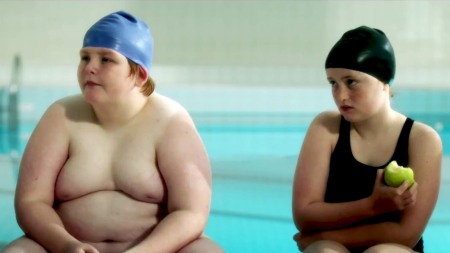
Kevin doesn’t respond directly to these barbs; rather, we see their effect more dramatically on his aquafit classmate, Alice (Lisa Harder). Although not as fat as Kevin, she seems to have absorbed more of the devaluing messages levied at her. She shows Kevin how to self-induce vomiting after their class, revealing that her mother taught her how. She also brings Kevin up to the top of a tall building and tries to convince him to jump off with her. Kevin is resistant to both the purging and suicide, which Alice sees as ways to solve her problems. She tells him that she wants to kill herself because she believes that the afterlife has to be an improvement over her life. Alice wants out of her body. Indeed, she disappears for a significant portion of the film, only to reappear late in the third act with bandages on her wrists, which she wordlessly displays for Kevin’s benefit. Her self-destructive behavior does seem like an attempt to get a response from him, but given how her body has been culturally framed both as something that is destroying her and should be destroyed for her own benefit, it’s not surprising that she would use self-harm to broadcast her presence, to try to inspire feelings of care in others. Although Kevin does not attempt to harm himself, he does absorb the view of his body as in danger of being destroyed, when he assumes that an episode of hyperventilation during a stressful event is a heart attack.
Kevin’s personal development over the course of Chubby occurs at the intersection of fatness and masculinity, at turns both liberatory and problematic. Kevin’s size is initially shown both as emasculating– his aquafit class shows him surrounded by girls, two bullies make comments about his breasts– and as a symptom of emasculation. His father is absent, he lives with his two sisters and mother (Julie Ferrier), who is characterized as overbearing, if well-meaning. (Moms are the worst, aren’t they? In, like, every film, book, and tv show ever?) She calls him “my little chick” and– in one creepy moment that I sincerely hope is just an innocent cultural norm that didn’t translate well– gropes his breast while cuddling him. His doctor straight up tells his mother than Kevin needs a male role model in his life.
Kevin finds this role model in Patrick (Swann Arlaud), a gruff security guard and military commando. Patrick is humorless and intense, reminiscent of Dwight Schrute from the Office, and rigidly conforms to a hyper-masculine ideal. His trained attack dog is named for porn star Rocco Siffredi, and his life revolves around living up to his military ideal. Kevin reveres him, following him around and becoming similarly obsessed with the commando lifestyle. He exercises more vigorously under Patrick’s training than in his doctor-mandated aquafit class (and, to the delight of his doctor, loses 4 kilos) and finds the confidence to stand up to his bullies. Patrick introduces Kevin to the Chief (Francois Hadji-Lazaro), an older fat man who owns the security company Patrick works for. Chief coaches Kevin on how to take pride in his fat body, telling him that fat men inspire a sense of comfort in other people and that he should never let anyone make fun of his breasts. He tells Kevin to eat salmon, as the omega 3 will protect his heart. He also shows Kevin some fighting tactics that rely on having a fat body. It always makes me happy when a fat film character shows a competence or skill unique to the experience of having a fat body, but this feeling was subverted to a degree by the cartoonish nature of Chief’s moves, specifically when he sits on Patrick’s face and farts.

Although their example gives Kevin an identity to try on besides fat kid, neither Patrick nor Chief are well suited to being role models. Kevin starts drinking beer and joins his two heroes in some petty burglary. Late in the film, Chief shatters Kevin’s perception of Patrick by revealing that he was never in the military, citing his slight build and uneven legs as the reason why. Indeed, Patrick visibly reacts whenever Chief makes a comment about his slight build. Like Kevin, Patrick has been deemed inappropriate by a social institution because of his body. He deals with that designation by clinging to military life and culture, and also by trying to assert his control over subjects more vulnerable to domination than himself. Patrick doesn’t seem to like Kevin as much as he likes how Kevin idolizes him, and even seems jealous of the connection that Kevin and Chief share over being fat. He tries to seduce Jennifer (Amelie Peterli), Kevin’s older sister, in an overly assertive manner, publicly giving her the third place medal that he and Rocco win in an obedience competition and asking her to “do the bitch.” (That’s what the subtitles said. I don’t know what “do the bitch” means, but it upsets Jennifer greatly.) He recruits Kevin’s friend Mouk (Dodi Mbemba), a petite African kid whom Patrick refers to as a “terrorist,” into a training exercise for Rocco in which the dog is commanded to track and attack him. Patrick’s treatment of Rocco is the most illustrative of his character, as he uses the dog as an accessory for his masculinity. He doesn’t mistreat Rocco, but has no affection for him. He trains the dog using German commands; for the first few scenes, both Kevin and I thought the dog’s name was “zurück,” the command Patrick uses to call Rocco to his side. Patrick uses Rocco to show his own power, his ability to hurt and dominate someone else through his control of a potentially dangerous animal. When Patrick needs to leave town or face arrest, he plans to sell Rocco to fund his escape.
Kevin’s heart, chest, and breasts are a recurring image in Chubby, symbolic of his physical health, but also his emotional wellbeing. He spends much of the film believing that his heart is sick, and likewise idolizing Patrick, who suppresses his emotions and focuses on his ability to be a dominant masculine figure. A more balanced paternal figure is conspicuously absent, as Kevin’s mother and father are newly separated. Although he learns to be assertive and finds power in his fat body from his time with Patrick and Chief, the spiritual change doesn’t come for Kevin until the two men suddenly leave his life. Passing out due to what he thinks is a heart attack, Kevin has a dream in which the doctors safe him via a transplant of Rocco’s heart, “a champion’s heart,” into his chest. He wakes to find his father (Jean-Benoit Ugeux) by his bedside, a gentler (if flawed) paternal figure better suited for his needs a child. His father gently corrects his assumptions about having a heart attack, telling his son that he has “the heart of a champion.” After spending the film being impassive and making selfish choices, Kevin shows an emotional side, more oriented towards the needs of others. He breaks down crying at the thought of Rocco being left to fend for himself. He begs Mouk to forgive him. He finds and adopts Rocco. The final scene, like the beginning, finds Kevin sitting shirtless, but accompanied by Rocco and Alice instead of his doctor and mother, the sound of a human heart beating instead of an engine. He is neither the failing vehicle his doctor describes, nor the heartless commando Patrick longs to be. He is a human being, both capable and deserving of love.
Roundup: July 2015
Content note: self-harm. A summary of films I saw over the past month featuring fat characters that I didn’t write about.
Chef (2014, dir. John Favreau)
A dramedy focused on a middle-aged man who is stagnating in his professional life and distanced from his family, with the most tantalizing cooking scenes I’ve seen since Eat Drink Man Woman. Ramsey (Oliver Platt), a food blogger, criticizes Chef Carl’s (Jon Favreau) cooking, speculating that he has gained a lot of weight over his career because he “must be eating all the food that gets sent back to the kitchen.” Despite the public dig at his size, everyone agrees that he’s a genius chef, and the front of house manager (Scarlett Johansson) has the hots for him. When it is revealed that his critic is also fat, the dig seems somewhat hypocritical, and is followed by Carl lambasting him for making a living off of being mean. Carl’s former father-in-law also subtly picks on him, remarking that he’s gained weight since they last saw each other. Although there is an implication that Carl’s weight is a symptom of his professional stagnation and unhappy family life, there is no indication that he loses weight as he improves his relationship with his son and goes into business for himself.
Beauty and the Beast (1991, dir. Gary Trousdale, Kirk Wise)
Several fat supporting characters: Belle’s proto-nerd father Maurice, who is considered an oddball by their community and needs to be saved twice; Lefou (literally “the fool” or “the madman”), Gaston’s toadie who worships him despite constant physical abuse and has a more grotesque character design than the other human characters; Cogsworth, the stuffy majordomo; and Mrs. Potts, the motherly cook. Perhaps of note, Disney is producing a live-action reboot, to be released in 2017, with three of these four characters portrayed by thinner actors. Ian McKellen is playing Cogsworth, Emma Thompson is Mrs. Potts, and Kevin Kline is Maurice. Lefou, the one villainous character of this group, will be portrayed by Josh Gad.
Withnail & I (1987, dir. Bruce Robinson)
A character study of two struggling London actors who scrape by on alcohol and bullshit. Withnail (Richard E. Grant) and Marwood (Paul McGann) escape their dismal flat for a trip to the country, staying at a cottage owned by Withnail’s fat uncle Monty (Richard Griffiths). Monty is wealthy and effete, a retired actor whose homosexuality is a defining characteristic (in his introductory scene, he discusses his love of gardening: “There is, you’ll agree, a certain je nais sans quoi, oh so very special, about a firm, young carrot.”) His generosity and kindness are a godsend to the two destitute protagonists, and to an extent, he is an inversion of the trope of the fat incompetent, having his life more in order than the younger men, who can’t manage to clear out their kitchen sink for fear of what lives in it. However, he is also the middle-class fuddy-duddy foil to their edgy, youthful rebel lifestyle, never questioning the lies they feed him. Partially due to a comedy of errors and partially to Withnail’s dishonesty, Monty believes that Marwood is also gay and attempts to seduce him, to the younger man’s abject terror. Monty is overly persistent, forcing his way into Marwood’s bedroom wearing a silk robe and eyeshadow. He tries to force himself on Marwood, although he also pleads with him to not be ashamed of his sexuality, and only stops when Marwood tells him that he and Withnail are a couple, and that he doesn’t want to be untrue. Monty backs off and leaves the cottage before they wake up in the morning, having left a note of apology.

The Tales of Hoffman (1951, dir. Michael Powell, Emeric Pressburger)
As with Beauty and the Beast, there are a handful of fat flunkies in this film that features several stories within stories. Most of the fat characters are thin actors with big prosthetic bellies, including a few villains’ servants and, in one sequence, an ugly clown whose love for a ballerina is unrequited. The one fat character portrayed by a fat actor is Andes (Philip Leaver), who is the servant of Stella (Moira Shearer). Count Lindorf (Robert Helpmann) bribes Andres into allowing him to intercept a message from Stella to Hoffman (Robert Rounseville), which ultimately allows the Count to separate the lovers from each other.
Tangerine (2015, dir. Sean Baker)
There are a few minor fat characters in this film, the most prominent of whom is Jillian (Chelcie Lynn, who is a big deal on Vine), the madam of a “party room” at a sleazy motel that Sin-Dee (Kitana Kiki Rodriguez) breaks into looking for Dinah (Mickey O’Hagan), the girl who’s been sleeping with her boyfriend. It’s not a glamorous role, but none of the roles in this film are. The protagonists aren’t fat, although a few girls make critical comments about Alexandra (Mya Taylor) for not having a flat stomach, but as transgender women of color, they are definitely marginalized based on their physical characteristics. Tangerine is the most vivacious and humanizing portrayal of trans women of color in a film that I’ve seen since Paris Is Burning, and I can’t recommend it enough.
ABCs of Death, “W is for WTF?,” “X is for XXL” (2012, dir. John Schnepp; Xavier Gens)
I didn’t see the whole anthology, so there might be other fat people in the chapters I missed. “W is for WTF?” features two fat men (John Schnepp and someone whose name I couldn’t find on IMDb) as members of a film production team who are struggling with a looming deadline to produce a W segment for ABCs of Death and can only come up with lazy ideas featuring beautiful women in skimpy outfits before the world descends into utter chaos. “X is for XXL” follows a fat woman (actor unknown) who never speaks. She is harassed in public several times due to her weight, and seems to be stalked by an ad campaign for a cereal that claims to have slimming properties. Upon arriving home, she binges on food in a manner that verges on cartoonish (I believe she drinks olive oil straight from the bottle at one point). She then goes into her bathroom with a knife and carves off her flesh, which intersperses with shots of the slim spokesmodel in the cereal commercial.

The Relationship Between Fitness and Self-Respect: Heavyweights (1995, dir. Steven Brill)
(CN: disordered eating and exercise)
I wasn’t a summer camp kid– my one experience was a week at Girl Scout camp between 7th and 8th grade– but I can see why it’s such a popular setting for movies. Camp is removed from civilization, but not to the point where survival is in question. The characters find themselves in a setting outside their normal context (no parents! no bullies!), but still have to function within their temporary community. There are rules, but those rules exist to facilitate having fun; there are authority figures, but they’re often lackadaisical, or at least easily avoided. This anarchic context can be the site of recreation or re-creation, usually some of both. It’s especially potent for adolescents, when summer comes with the hope that some alchemical process will occur over the long, hot days and you will return to school in the fall a better version of yourself. You will have sex. You will grow taller. Your breasts will develop. You will go on adventures. And, of course, you will lose weight.
Heavyweights opens with Gerry (Aaron Schwartz) leaving school on the last day before summer vacation. (The sequence is set to “Closer to Free” by the BoDeans, in case there was any doubt that this film came out in 1995.) He is characterized as a typical sad sack fat kid: he misses his bus and has to walk home; he can’t throw a baseball over a fence; he stops at a lemonade stand and chugs an entire pitcher. Upon arriving home, his parents tell him that he is being sent to Camp Hope. The promotional video sucks him in with the promise of go-karts and the Blob, but he reacts indignantly when he learns that he’s being sent to a fat camp to take care of his ”problem,” as his dad calls it. “I’m not going to camp with a bunch of fat loads!” he protests, separating himself from his peers.
On the plane to camp, Gerry meets Roy (Keenan Thompson), who approaches and asks if he’s going to fat camp. When Gerry defensively retorts that Roy is also fat, assuming that he is being insulted, Roy readily agrees with him. Roy is the first self-accepting fat person we meet. Roy becomes Gerry’s guide to Camp Hope, telling him that it’s a paradise because “nobody picks on you because you’re the fat kid, everybody’s the fat kid.” (Roy is the only black kid in the movie, and becomes an emotionally supportive sidekick for Gerry, not unlike Al is for McClane in Die Hard.) An excited group of campers, including Gerry and Roy, are chaperoned from the airport to Camp Hope by Pat (Tom McGowan), an adult counselor who has spent every summer at Camp Hope since he was 10 years old.

Although ostensibly a place to lose weight, Camp Hope is obviously more of a safe space for fat kids. Tim (Paul Feig), another counselor, “used to be one of us, but then he lost weight,” according to the campers. They tease him about his “chicken legs,” which he responds to with good humor. When Gerry arrives at Chipmunk Cabin, he confesses to slick wiseguy Josh (Shaun Weiss) that he snuck in some Oreos, which prompts his cabin mates to reveal their own contraband, kept in a communal supply under the cabin floorboards. This is followed by a scene of the campers and Pat playing on the Blob. Set to “The Blue Danube Waltz” and filmed in slow motion, the scene both suggests an idyllic transcendence from Gerry’s point of view, and is a reference to the scene in 2001: a Space Odyssey, where the story moves forward from the prehistoric era to the Space Age. Similarly, Gerry finds himself millions of years removed from the brutality of being the picked-on fat kid, and achieves temporary weightlessness playing on the Blob with his new friends. Although Camp Hope is a place where Gerry and his peers don’t have to worry about judgment and ridicule, it’s also not a place where they can push their personal boundaries. Pat, a lifetime member of Camp Hope, is popular with the campers but isn’t confident enough to talk to Julie, the pretty camp nurse (Leah Lail).
The good times end abruptly, however, when the camp owners announce that they have declared bankruptcy and sold Camp Hope to Tony Perkis (Ben Stiller). Tony is a fitness-obsessed motivational speaker who is “looking forward to interacting with children for the first time.” He tells the campers he weighed 319 pounds when he was 12 years old, and had no self-esteem or self-respect. He brings in a new staff of equally athletic, uniformed counselors and tells the campers their summer will be filmed for an infomercial to promote his weight loss regimen, Perkisize. Pat is re-assigned to maintenance duties and replaced by the strict, generically European Lars (Tom Hodges).
Tony creates a strict and overly simplistic binary between healthy and unhealthy, paralleling good and bad. “Anyone who brings candy into camp is not your friend,” he tells Gerry while searching Chipmunk Cabin for contraband snacks, “He is a destroyer.” Perkisize consists of grueling exercise and unsafe levels of food restriction (Tony cancels lunch one day “due to lack of hustle”). He and his staff are in charge because they are athletic, and therefore good, not because they know how to care for children. Their lack of attention to what exercise is appropriate and feasible for their fat, preteen wards creates an immediate threat. Julie says that, as a medical professional, she considers Perkicize dangerous. Lars proves to be a negligent lifeguard with no understanding of how the buddy system works, and Tony punishes campers for gaining weight by taking them on a 20 mile “cleansing” (i.e. without food) hike up a mountain. Pat tries to stop him, fearing for the campers’ safety, but is ignored and ridiculed because of his size. “The fat man is going to tell me what’s healthy!” Tony sneers. “Nobody really cares what you have to say.”

Tony’s binary view puts fat people squarely in the unhealthy/bad category. His regime as camp director begins with Evaluation Day. “The key word is ‘value,’” he explains over the camp loudspeaker. “Do you have any? Not yet! But by the end of the summer this camp is going to be filled with skinny winners!” (“Skinny weiners?” Roy jokes, showing the lack of enthusiasm he has for Tony’s plan.) The kids cling to the old Camp Hope mentality, cheering for Simms when it is announced he is the heaviest boy at camp, but Tony works to break their spirit. Tony expels Josh from camp for talking back to him. He invites “jock camp” Camp MVP to play baseball against Camp Hope. When Tim protests that getting their asses handed to them won’t teach the kids anything about baseball, Tony retorts that it’s meant to teach them about “life.” He doesn’t even stick around to see Camp MVP taunt his campers, nor does he seem to care when Camp MVP vandalizes their dock. Later, he organizes a dance between Camp Hope and the unnamed “girl’s camp,” with the rationalization that making them feel insecure in front of a group of girls (who, of course, would never want to dance with them) will motivate them to lose weight. It takes a lot of time and motivating from Pat, Tim, and Julie, but both sides eventually start dancing enthusiastically. Before long, Tony breaks up the dance mid-song and tells the girls to leave, thanking them for their “efforts” and saying “[he knows] this hasn’t been easy,” despite them having as good a time as the boys– including one young couple sharing a kiss before separating. He wants to instill in them his opinion that they are worthless because they are fat and need to achieve “value” through compliance to the Perkisize program. There is a capitalist motivation behind this, as Tony wants to make his program into a successful business venture by convincing his future fat tv audience that they need his program in order to achieve value for themselves, but it also comes from a place of hatred for fat people. Tony’s “motivation” is psychological abuse.
(Returning to the dance for a moment: it’s worth noting that the presence of female characters in the film is one of Heavyweights’ missteps. Of the few female characters in the film, none are fat. Julie is conventionally attractive, and while she supports the campers by trying to get Child Protective Services to investigate Tony and contributing to the expose video, she largely functions in the film as an object for Pat’s affections, a goal for him to obtain as his self-confidence increases with his ability to stand up to Tony. The girl campers are all thin and conventionally attractive as well. When one of the girl campers asks her friends, “Why don’t they just lose weight?” another girl snaps back, “Why don’t you teach them to throw up after every meal like you do?” The joke makes a point about subverting the notion that thin people are automatically experts on healthy behaviors over fat people. However, I think the more important takeaway is that having zero visibility for girls and women who aren’t thin, and then shaming girls and women for trying to obtain or maintain thinness, is a vicious cycle of sexist bullshit.)
Tony’s treatment of the campers is villainous, but it’s not an unusual attitude towards fat bodies. Consider the martial language employed to advertise diet and exercise products (e.g. fat blasting), motivational workout sayings that portray pain as a desirable outcome, the success of The Biggest Loser. The driving thought that unifies them is that a person’s body must undergo extreme means to meet a certain standard of fitness (although this usually means a certain weight and shape) in order to deserve respect, to have value. Tony believes that by continually punishing the campers– even going so far as to remove the Blob from the lake, despite it being an incentive for them to go swimming– he can get them to lose weight and become people who he deems worthy of respect.
After Tony tells the campers their 20 mile hike has been “extended indefinitely” until they are in good enough shape to beat Camp MVP in a relay race and provide a happy ending for the infomercial, they rebel. They outsmart and imprison Tony and liberate the camp with a bacchanalia of their favorite foods. Even Tim joins in the celebration, ripping his shirt off and covering himself with s’mores. As with the Blob scene earlier in the film, this scene is also slow motion and set to classical music, this time the overture from La Gazza Ladra, which is also featured in scenes of gang violence in A Clockwork Orange. The reference to the droogs’ self-destructive nature is appropriate, as the campers’ unbridled hedonism proves to be almost as painful as Tony’s punishing workouts. The next day the campers are covered in gunk and nursing hangovers. Pat takes the opportunity to present a more moderate course of action.

Although the movie focuses more on the campers’ experience, Pat has been experiencing his fair share of character development, as we see through his interactions with Gerry. Sitting together on the decommissioned go-kart track, Gerry tells Pat that he wants to “go fast” for once in his life, to which Pat responds by playfully pushing him around the track in the go-kart. Later, Pat tells Gerry about his fantasy of being athletic like Camp MVP, and that he’s “tired of being the fat guy.” Gerry tells Pat that he’s “cool, everybody knows that,” but asks him, “When are we gonna start sticking up for ourselves?” Seeing that, although they have defeated Tony and his crew, the kids haven’t learned anything, Pat sees the opportunity for them to start making their wishes into reality.
Pat’s leadership of Camp Hope is different from both Tony’s and the campers’. He talks about restraint and self-respect. He never mentions weight loss in his speech, and speaks about these goals in terms of “we” and “us,” not stationing himself above the campers as Tony did. We see scenes of Julie teaching a nutrition class, and the staff and campers exercising together as a group: some of them are walking briskly, others are running, but everyone is having a good time. When Gerry’s parents come to visit for Parents Day, his father disappointedly remarks that he doesn’t look any different, but Gerry quickly responds that he “feels good,” which his mother admits is “important.”
Having defeated Tony, the remaining challenge for Camp Hope is their annual competition with Camp MVP, the Apache Relay. (As is traditional with many summer camps in the USA, Camp Hope is not above a little tacky cultural appropriation, and the campers are dressed in American Indian costumes for the race.) Camp Hope is used to losing every year, but the self-confidence and teamwork they have learned over the course of the summer pays off. They cheer each other on and use their individual skills to stay in the competition. Gerry is able to “go fast” in the go-kart race and is even able to use his fatness to his advantage, as Pat coaches him to “use [his] weight on the curves.”
As I’ve discussed in previous articles, fat characters often embody lack of moderation. Heavyweights does use this stereotype to a certain extent, such as a scene in which a pack of underfed campers hungrily chase a cow around a field. Heavyweights breaks this mold, though, by making Tony the ultimate figure of excess, culminating in an epic meltdown in front of the campers’ parents in which he tries to prove his physical superiority by walking barefoot on broken glass. The ideal situation through which the campers find their happy ending is in line with real-life wellness philosophies like harm reduction and Health at Every Size: using self-respect as motivation, not a goal. In the end, the campers don’t even place value having won a competition against rival Camp MVP, and Pat throws the Apache Relay trophy in the lake. The campers become different people over the summer, but instead of achieving the change that Tony envisions for them, becoming “skinny weiners” like the Camp MVP kids, they find the ability to stand up for themselves and find confidence in their individual skills and interests. It’s not the happy ending one would expect for fat characters, but it’s arguably the best one for fat kids to have as a cultural reference.
“Straighten, Tighten:” Intersections of Fatness and Queerness in The Birdcage (1996, dir. Mike Nichols)
When I woke up on a Friday morning a few weeks ago to Twitter blowing up about SCOTUS declaring same sex marriage legal in all 50 states, I was happy that my home country was finally moving away from a gender-discriminatory policy. Not deliriously happy, mind you. I feel some kinda way about the political energy and focus poured into marriage equality. But I do have a sentimental side, and I see how much joy getting married has brought to the people in my life who decided to take the plunge. (This post isn’t more timely because I traveled halfway across the country to attend the wedding of one of my oldest friends.) I had a solo mini-celebration for marriage equality that evening with The Birdcage, which I was fond of in high school and had been meaning to revisit. I remembered the excellent comic performances; it’s enjoyable enough to take the film at face value. What surprised me was how deeply I empathized with the character at the epicenter of the film’s tumultuous humor, Albert (Nathan Lane).
The opening scene in which Armand (Robin Williams) and their houseman Agador (Hank Azaria) cajole a hysterical Albert into rallying herself* for a drag performance ushers the audience into a first impression of her that is intertwined with her self-image. She describes herself as “fat and hideous”– a declaration Armand, her director and significant other, knows so well that he mouths the words along with her– and says that she’s “gained and lost over 100 pounds in the past year” in an effort to be thin and beautiful enough to maintain her star status and his love. Although not an extremely large person, she does have a stocky body, where the other performers at the Birdcage (and many of the thong-clad extras in scenes of the public milieu of South Beach) are slender and muscular.

Albert’s sensitivity and flamboyant nature are frequent sources of humor. Armand and his son Val (Dan Futterman) react to Albert’s outbursts with a certain level of weariness that suggests a routine scenario for their family. But even though she is an outlandish character in a farce, her anxieties come from a very real place. The nonplussed reactions she receives from strangers, plus Val’s unwillingness to introduce her to his conservative future in-laws speak to her outsider status in the vast majority of the world. Despite being a headliner who plays to sold-out houses and is more than willing to self-advocate, she lacks necessary social capital to navigate on her own outside her South Beach bubble. In a subplot, she wants Armand to sign a palimony agreement so that she will be provided for in case their relationship ends. Although talented, there is no denying that she is older and fatter than the other performers; who’s to say what her career would look like without Armand and the Birdcage?
The Goldmans’ underlying family tensions are exacerbated when Val declares his intention to marry Barbara (Callista Flockheart), the daughter of staunch conservative Senator Kevin Keely (Gene Hackman) and his wife Louise (Dianne Wiest), who is Barbara Bush by way of Lady Macbeth. Hit with scandal when Kevin’s “common redneck” colleague dies in bed with an underage black prostitute, Louise suggests using the wedding as a distraction technique to symbolize a return to family values. Convinced that the Keelys will never connect themselves to a gay, Jewish** family, Val asks Armand to pretend he’s the father of the heterosexual “Coleman” family. Val initially asks that Albert not be present for the Keelys’ dinner, but Armand insists they compromise and pretend that his companion is heterosexual Uncle Al. Although the Goldmans want their son to be happy, there is ultimately no sugarcoating that Armand is willing to side with Val and pretend Albert isn’t part of their family unit so that Val can access a social institution the two of them can’t by ingratiating himself to a politician who thinks they’re destroying America. Her reactions, oversized in most situations, are appropriate in this case. When she refers to herself as “the monster, the freak,” neither Armand nor Val deny that she is characterized thus by their plans to hide her.
For the Goldmans, achieving normalcy is largely about restraining (“straighten, tighten”). Not only is Val the beneficiary of the charade, he is the main orchestrator, the ambassador of straightness in a queer enclave. He is a man of few words, forever tolerantly waiting for the exuberance around him to die down. “Don’t add, just subtract,” he repeatedly advises the Birdcage staff, who help transform the Goldmans’ colorful home into a “monastery.” The subtraction includes wanting to present Katherine (Christine Baranski), Val’s biological mother, as Armand’s wife. Albert can barely hide her discomfort around reserved, athletic Katherine, who owns and operates a successful gym.

Although Armand is more masculine and paternal than Albert, Val asks him to tone down his stereotypically gay mannerisms (eg. how he walks, talks, and gestures). Armand, in turn, coaches Albert to restrain herself, emotionally and physically, in order to play is straight. “Look at your pinky! Look at your posture!” He tells her to hold her unruly body more firmly and tone down her emotional responses. Dismissing small setbacks (e.g. breaking a piece of toast) seems like a revelation to her: “Of course! There’s no need to get hysterical. All I have to remember is I can always get more toast.” But the couples’ desire to help their child achieve the life he wants comes at the expense of their own. Right before the Keelys’ arrival, the family gathers in the master bedroom, their vivacity stripped away in the pursuit of heteronormativity. Armand remarks that he looks like his grandfather, who “killed himself when he was 30.” Their clothing and demeanors suggest a funeral, Albert the most uncomfortable of all.
The performance of straightness that the Goldmans put on is a wickedly funny inversion of the colorful, campy drag show that is their profession. Agador calls himself “Spartacus” and lowers his voice by an octave or two, Armand is so stiff that Val feels the need to fabricate a football injury for his father, and Albert presents herself as an old-fashioned housewife from Smalltown, USA whose ludicrously conservative political views terrify her family, but manage to charm Kevin. Appropriately, the Keelys themselves are practically drag versions of straight conservatives, wearing clothing so drab as to practically be Orwellian and barely hiding their elitist, repressive viewpoints under jes’ folks rhetoric. One of my favorite moments in the film is after the two families first meet, when Kevin responds to a polite question about his trip to South Beach with a soporific monologue that spins out into a patriotic travelogue gone wrong. Of course, they too look at the dinner party as a path to social legitimacy (or, as Louise puts it, “salvation”) that will hide their own connection to deviance. The Keelys too have a fat skeleton in their closet, as Lousie tries to prevent Kevin from stress-bingeing on candy, and they are stalked by a tabloid journalist (Tom McGowan) who’s “put on so much weight since the Simpson trial.”
As a fat, gender nonconforming person, I deeply felt Albert’s need to be loved and, when people do express love for her, the fragility of her trust. It’s rough living in an environment where people like you are constantly positioned as inherently unworthy of respect. Even in the safety of home, family, and community, it is impossible to completely forget the hostility of the outside world, or how easy it is for that hostility to be present in a loved one. As Albert says, fed up with the emotional burden of being a source of shame for Val, “…everyone laughs at me. I’m quite aware of how ridiculous I am.” She says this as she is leaving for the cemetery, dramatically communicating that she feels she is dead to her family. The scene is not completely serious, as her tone and gestures mimic a diva in a classic melodrama, but it does reflect the real emotional fallout that many LGBTQ people have experienced due to being rejected by their families, including suicide in some instances.
This isn’t the first film I’ve seen with parallels between fatness and queerness, even if fatness is a less explicit factor in The Birdcage than In & Out. They are barriers to achieving a goal (in both cases, a wedding that will provide social legitimacy). Albert’s size doesn’t threaten Val and Barbara’s engagement, but she does worry that Armand isn’t attracted to her any longer and doesn’t want to make their partnership legally binding. Albert’s body, specifically her emotions and mannerisms, is seen as excessive to the point of threatening the family’s social legitimacy. Her queerness is irrepressible, and the men of the family take it upon themselves to orchestrate a solution. However, once her influence is removed from the family, Val and Armand alone are not enough to win Kevin and Louise’s trust. It is only through relying on her “threatening” inclinations to be feminine and maternal (Armand describes her as “practically a breast”), and her skill as a drag queen, that Albert can pass as Mother Coleman. Once seen as a heterosexual, female mother, she becomes a legitimate (and favored) member of the family in the eyes of Kevin, who is the apex of power in the film, both in terms of social capital and allowing Val to marry Barbara. The facade of normativity cannot be maintained for long, but the temporary diversion from her outcast status is enough for Albert to sustain the dinner party longer than Val or Armand could on their own. Her drag skills come in handy again to prevent the Keelys from being spotted by the press, ending the film with a power reversal where the heterosexual elite are sheepishly reliant on the queers for a different kind of salvation than Louise originally anticipated.
Albert and Armand’s happy ending isn’t just because they get to be themselves, but because they triumph due to how their lives have been shaped by being marginalized. It’s not an explicit score for the fat kids, like Hairspray, but it does find power in qualities that get combined with fatness: femininity, sensitivity, and excess.
*Albert identifies as a gay man and is referred to with both masculine and feminine pronouns. There are several points in the movie where Albert shows a preference for feminine pronouns, thus my use of she/her/hers in this article. Apologies if this is confusing.
** Sander Gilman’s Fat Boys: a Slim Book includes an interesting history of the conflation of Jews and fatness in the historical Gentile imagination. Suffice it to say that there are stereotypical characteristics common to Jewishness, fatness, and effeminacy, such as a lack of athleticism and a penchant for heavy foods (“When the schnecken beckons!”).
The Blind (Drunk) Leading the Blind (Drunk): Shaun of the Dead; Hot Fuzz; The World’s End (2004, 2007, 2013; dir. Edgar Wright)
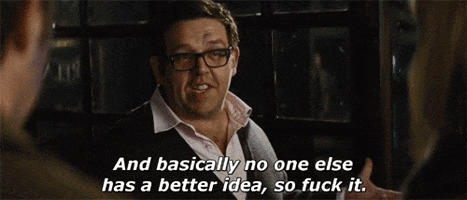
My article The Blind (Drunk) Leading the Blind (Drunk): Masculinities and Friendship in Edgar Wright’s Three Flavours Cornetto Trilogy is up on BitchFlicks as part of their theme week on masculinity. The Cornetto Trilogy are three of my favorite films, and Andy Knightley (Nick Frost) in The World’s End is one of my favorite fat characters, a topic I hope to explore more in depth on here in the future. I had a lot of fun writing it. Please check it out, as well as the other articles about masculinities in film and television.
The Story of Self-Improvement: Results (2015, dir. Andrew Bujalski) and Welcome to Me (2015, dir. Shira Piven)
Fatphobia is a complicated beast both in terms of genesis and expression, but in the USA, it is often partnered with the cultural preoccupation with self-improvement. This country has a history that pushes to the forefront stories of people who better their lot in life through willpower, gumption, and a maverick spirit: wilderness pioneers, rags-to-riches entrepreneurs, social visionaries. As inspiring as it can be, this idea of self-improvement often intersects with problematic ideas, such as the belief that buying the right product will be life-transforming, or improvements that tacitly require groups who have been fucked over by the aforementioned pioneers and entrepreneurs (and who the visionaries died trying to liberate) to assimilate into hegemonic standards.
As self-improvement focuses on an individual, its narrative is often written onto bodies. Consider the popular and long-lived meme of “before’ and “after” photos in weight loss product advertising. #notyourbeforephoto has been used by fat activists to rebel against this meme that positions our bodies as in need of fixing. On the flipside, this article by a woman recovering from anorexia talks about the troubling co-option of photos of thin people living with eating disorders as “after” photos, deconstructing the idea that thinness equals health and happiness.
The diet ad meme is often pathetic in its transparency, ensuring that the subject is more neatly dressed, in better lighting, and wearing a happier expression in the “after.” Despite the impassioned personal testimonies from activists and cheesy commercials that border on self-satire, the idea that the shape and size of one’s body equates to one’s mental and emotional well-being persists in popular media. Two indie dramedies currently in theaters serve as criticism of the idea that a thin, athletic body is a sign of emotional and mental wellbeing.

Results focuses on gym owner Trevor (Guy Pearce) and personal trainer Kat (Colbie Smulders), a mismatched pair who try to help client Danny (Kevin Corrigan) with his fitness goals. At first blush, it seems like Trevor and Kat have their lives more together than Danny does. Trevor is looking to grow his business and bring his fitness philosophy to the world; Kat is his star trainer and isn’t afraid to remind her boss of that fact. Danny, meanwhile, is a schlemiel dealing with life-changing events that have left him single, alone in a new city, and a millionaire. He describes himself as “pudgy;” his average body shape and below average grooming habits are more noticeable when compared to the athletic, clean cut gym bunnies who he constantly, if inadvertently, confuses. Despite joining Trevor’s gym with the stated goal of wanting to be able to take a punch, we quickly discover that Danny’s life is largely empty and directionless. He is socially awkward and uses his newfound wealth as a blunt tool to fix his problems, like making Craigslist posts offering hundreds of dollars in compensation for people willing to procure a cat for him and show him how to use his new tv. However, as the film progresses, Trevor and Kat show cracks in their own well-toned walls. Trevor, too goal-oriented for much self-reflection, makes a long trip to meet his fitness idol Grigory (Anthony Michael Hall), who criticizes his fitness philosophy and has no respect for him. Kat’s caustic streak widens into near-chaos as she scrambles to figure out the next step in her own life. Ultimately, none of them are in control of their own lives, and Kat and Trevor’s inability to untangle their feelings for each other shows their internal lives to be as messy as Danny’s. To Danny’s credit, he is direct and honest, even if he struggles to express himself appropriately.
Welcome to Me follows Alice (Kristin Wiig), a woman who filters her struggles with mental illness through fad diets and the gospel of Oprah. After winning $86 million in the lottery, she decides to go off her meds in favor of a high-protein diet, move into a casino, and fund her own talk show on an infomercial network. Alice’s show, entitled Welcome to Me, is an expression of how she sees her world, and her role in it; she is both the brave survivor whose life stories are material for segments and the self-actualized host who dispenses wisdom and motivation. The segments include dramatized re-enactments. Some serve as a form of catharsis for Alice, giving her a chance to confront conflicts from her past in an environment that she controls, but others illustrate her belief that she is a role model to her friends and family, much like Oprah is for her. One scene re-enacts her and her best friend Gina (Linda Cardinelli) shopping for bathing suits. The actress Alice has cast to depict Gina is significantly larger than real-life Gina, and the scripted conversation filtered through Alice’s memory revolves around Alice coaching Gina to find the self-confidence to wear a two-piece. This depiction offends Gina, who tells an uncaring Alice that she is comfortable with her body and simply prefers one-piece bathing suits. The friend’s roles are reversed in their real lives, with Gina having been a steadfast support and guide for Alice since their childhood. Late in the film, Gina delivers an impassioned monologue to Alice, telling her that her self-absorption and lack of empathy makes her a terrible friend. Deciding to leave Alice, Gina cries in frustration, “Fuck you for making me fat on your show!” On the last episode of Welcome to Me, Alice apologizes to Gina and acknowledges how much she values her as a friend. The episode includes a re-enactment of Gina being a source of emotional support for Alice during a difficult time in her life; this time, the actress depicting Gina is slender and petite.

Both Results and Welcome to Me reach ambiguous conclusions: the protagonists grow as people, but still have long ways to go in their quests for happiness. There is a sense of contentment with this ambiguity, however, as the films show the inherent problems with the idea that self-actualization is easily and automatically obtained through a fitness philosophy or a high protein diet. We’re all struggling, and nobody has a magic bullet to fix that, no matter how low their body fat percentage.
Portraying Strong Female Characters, Except When It Doesn’t: Mad Max: Fury Road (2015, dir. George Miller)
(Just a reminder, all CPBS articles potentially contain spoilers.)
This afternoon, I had the pleasure of engaging in BitchFlicks‘ weekly Twitter discussion, the topic of which was Mad Max: Fury Road. Fury Road is a decent action film that makes up in style what it lacks in story and character detail, but it’s getting a lot of attention as a potentially feminist action film. I tend towards skepticism when regarding mainstream media attempts at true progressivism, as I’m more likely to dwell on the problematic stuff that remains a constant. A lot of the contributors to this afternoon’s discussion were more optimistic in their view of the film, which led me to concede that I was overlooking the positive aspects of Fury Road. It’s amazing to see a big budget action film that features women defending themselves, standing up to the bad guy, striking out into the unknown, and doing it all because they know they can rely on each other. Despite being the titular character, Max (Tom Hardy) plays more of a supporting role to Imperator Furiosa (Charlize Theron). Over the course of their adventure, the two learn to trust each other and work together without resorting to a compulsory romance. Furiosa’s goal is to liberate the Wives, five women who are sex slaves to Immortan Joe (Hugh Kyes-Byrne), a tyrant who controls a large source of water, and return with them to her matriarchal homeland, the Green Place.
However, Fury Road is a mixed bag with regards to body diversity. Furiosa is an amputee, which is pretty huge, considering she’s the protagonist. However, there are other people in the film whose disabilities aren’t quite as cool (Furiosa gets a neat-looking robotic arm), and seem to be present as props to convey how harsh life is in this desert setting. Fat people are present in the film, but don’t fare very well. When Joe is introduced, we see him in a room full of fat naked women whose lactating breasts are being pumped by machines. These women are presumably his wives as well, or at least other women whose bodies are being exploited by him alongside the Wives. Physical exploitation is a recurring presence in Fury Road. Max is initially captured and held by Joe’s war boys so that his blood can be harvested. The Wives are being exploited by Joe for sexual and reproductive purposes; they graffiti the walls of their rooms for Joe to find when he discovers they have escaped, bearing messages that they are not objects, and refuse to give birth to future warlords. However, Max and the Wives escape from and confront their oppressors, while the nameless, voiceless fat women have no agency in this way. The fat women’s bodies are in sharp contrast to those of the Wives– all five actresses playing the Wives have careers as models, and they are clothed in gauzy, pure white fabric. The fat women do re-appear at the end of the film after Joe’s reign of terror has been overcome, giving the thirsty masses full access to Joe’s water reserves. Although they participate in the liberation of the Citadel, that role reflected their earlier state captivity a little too closely for me to feel that there was true redemption. They seemed to be stuck in an affliation with nourishing and abundance which made me uncomfortable, given the unsettling imagery of their captivity.
Another problematic fat figure is Joe’s ally, the People Eater (John Howard). Although not given much in the way of characterization beyond being a Mini Boss, the People Eater’s fatness is linked to a sense of sadomasochistic hedonism, which are intended to inspire disgust in the audience. The People Eater’s shirt has holes cut in it so that his nipples stick out; he wears clamps and chains on them that he has a habit of playing with. He also has a metal grating covering his nose, which I interpreted as suggesting syphilis, which can cause the flesh of the nose to rot in advanced stages. In the days before medical interventions, the decayed nose was a stigmatic mark of immorality. Apparently, everything old is new again. He also has exaggeratedly fat feet which eventually lead to his undoing, as Max forces his foot onto the gas pedal that leads him to crash.
There’s a lot about Fury Road that is refreshing in terms of representation, but the fat bodies present in the film get burdened with some tired tropes that detracted from my enjoyment of it. One of the main ideas that the film presents is that bodies aren’t objects; unfortunately, that message doesn’t extend in practice too far beyond the normatively attractive characters.
Happy 100th birthday, Orson Welles
He was some kind of a man. What does it matter what you say about people?
–Tana (Marlene Dietrich), Touch of Evil
A few months ago, I saw a theater production called Mr. Burns: a Post-Electric Play. Mr. Burns is three snapshots in three acts of life in the United States after a catastrophe that causes the nation’s electric grid to shut down. We see society rebuilding itself from the detritus of our contemporary world through the lens of performance art, specifically the survival and evolution of The Simpsons episode “Cape Feare.” As the timeline progresses two, ten, then eighty years out from the disaster, “Cape Feare” evolves from a Simpsons episode being recounted by two fans to fellow survivors around a campfire, to a highly stylized opera in which characters and stories have synthesized various aspects of culture, such as Mr. Burns in Joker makeup giving a version of Robert Mitchum’s speech about the battle between love and hate from Night of the Hunter.
I bring this up not to brag about the best play I’ve ever seen (okay, maybe a little bragging), but because it’s such a vibrant illustration of how pieces of history and culture survive through being contained within newer works. For instance, I will be watching Cape Fear for the first time this week in preparation for a Director’s Club bonus episode, but I have a basic understanding of the plot and characters thanks to “Cape Feare,” which was probably in turn the most exposure some of my Simpsons-watching peers who didn’t have classical music as a presence in their lives had of Gilbert & Sullivan.
I bring all this up as a precursor to my experience of Orson Welles, who was born May 6, 1915. I was 1 when Welles died, so I have no memories of him as a living person. My first exposure to Welles was caricatures of him in later life, as in 1994-1995’s the Critic:
I knew him as an glowering old man who embodied fat stereotypes. I’m sure a lot of my memories of this images of Welles are mixed up with similar jokes about Marlon Brando. I found out somewhere along the way that he had created the War of the Worlds radio play, but it was difficult enough to wrap my brain around a play that was limited to sound and had the power to drive people to hysteria, let alone the man behind it. (This was before Welcome to Nightvale, kids.)
My image of Orson Welles was changed as a teenager when I saw Cradle Will Rock, featuring Angus MacFayden’s portrayal of Welles as a leonine artistic genius on the vanguard of modern theater, and again as an inspirational vision in Ed Wood (played by Vincent D’Onofrio and voice by Maurice LaMarche, who also provided the voice acting for Welles in The Critic):
Two seemingly disparate images of a dynamo and a has-been, both large but the latter cartoonishly fat, and neither quite adding up to a full, real artist and human being. Welles is, of course, best known for his association with Citizen Kane, usually found at the top of best-of lists. But this often feels perfunctory, especially being so chronologically removed from Citizen Kane that its reputation far proceeded my viewing of it. Welles feels like the cinematic equivalent of Shakespeare in this respect.
I started watching other films that Welles directed about a week ago, hoping to find something to write about for CPBS and not realizing it was almost the 100 year anniversary of his birth. (I like to think this is a sign that I am part of a brilliant fat person hive mind that transcends the limits of death.) I’m not usually automatically enraptured by well-regarded classic films, so hopefully this comes across as more than a cliche reaction: I was completely blown away by Welles’ mastery of the camera in The Lady from Shanghai and Touch of Evil.
Wow.
WOW. (This clip is violent, be forewarned.)
At the end of Touch of Evil, Welles’ character Captain Quinlan is proven to be right in his hunch about the perpetrator of a crime, although the other characters have been disregarding him because of his reputation as a corrupt drunk. It’s nearly impossible to eclipse one’s reputation. It may be foolishly idealistic, but given the sheer brilliance of his work, I hope that Welles’ legacy as a great director and writer will live on at least as much as the fat jokes about him.
Related links:
Pathologized Bodies, Pathologized Minds: Mary and Max (2009, dir. Adam Elliott)
(CW: mental illness, weight loss, ableism)
Mary and Max is one of those films that Netflix has been incessantly recommending to me for years and I kept putting off. I recently ended up watching it (instead of, say, Jiro Dreams of Sushi) because I noticed that the two titular characters are described as “a chubby 8-year-old Australian girl” and “an obese, adult New Yorker.” The description of Max’s body stood out. Other films on Netflix with fat protagonists that I’d come across tended to be more euphemistic. Paradise: Hope is summarized as being about a girl sent to a “diet camp;” the heroine of The Hairdresser is described as having a “plump figure;” and in tv series Drop Dead Diva, she’s “plus-sized.” This could be influenced by gender; Max is a man, and the examples I was able to think of and find on Watch Instantly are about women. However, when I searched “obesity,” the seven “titles related to obesity” that I got as results were all documentaries related to health and medicine, like The Waiting Room and Forks Over Knives. As a claymation drama about friendship, Mary and Max seems to have more in common with the aforementioned female-lead narrative films, where fat characters must navigate a world that ostracizes them. For Max, that ostracization often manifests as pathologization.
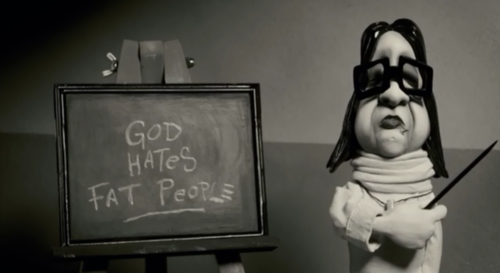
Deviating from my previous observation that films rarely tell us characters’ height and weight, Max (Philip Seymour Hoffman) informs Mary (Bethany Whitmore, later Toni Collette) that he is 6 feet tall and weighs 352 lbs. Max is described as obese in the text of the film, as one of several labels used by institutions to describe him as in need of fixing. These labels mostly hinder him, but also help: Max was called for jury duty (a position he holds in high esteem) but was dismissed because he had been institutionalized, but later in the film criminal charges brought against him are dismissed because the court deems him “mentally deficient.” Likewise, he is able to restore balance to his life through help from his psychiatrist and being institutionalized, but the medical system also limits him by describing him as disabled and in need of curing due to Asperger’s syndrome (as well as diagnosing him with obesity). Max dissents. He feels that living with Asperger’s (or being an “Aspie,” his preferred term) is as much a part of his identity as the color of his eyes. He is an outsider, but he maintains the integrity and independence to see a world he doesn’t fit into as nonsensical because it doesn’t make allowances for him, instead of giving in to how the world has labeled him. Max’s self-loyalty extends to his dietary habits. He attends Overeaters Anonymous at the advice of his psychiatrist, but doesn’t seem to have any personal motivation for losing weight. Rather, he takes pleasure in eating chocolate and creates new dishes that are more driven by taste than nutritional value. Chocolate is important to both Max and Mary as a shared passion, and their correspondences include sending new types of chocolate to each other along with their letters.

Although the film situated Max in a world where he is labeled and ostracized by medical conditions, the film itself does not assign moral judgment to how Max functions or perceives the world. Max’s eccentricities are occasionally a source of humor, such as his invisible friend Mr. Ravioli. His fat body is not romanticized, as we often hear his heavy breathing (especially after he gains a significant amount of weight) and see the repeated image of his plumber’s crack when he sits at his typewriter. But in a departure from how films often depict fat characters’ bodies as grotesque in comparison to thin characters’, the whole cast of Mary and Max is comparably rabelaisian. I’ve never heard so much incidental farting in a film. If nothing else, casting the late, great Philip Seymour Hoffman to voice Max is a strong indication that the creators of the film intend for the audience to respect Max, as fat outsiders portrayed with warmth and humanity comprise Hoffman’s career.
Neurotypical Mary is better equipped to function in society than Max, but is a ultimately a less-fulfilled person than he. She too is an outsider, but her sense of fulfillment is more subject to outside approval than her friend’s. Her body even seems to be a concentration of her homogeneic suburban environment, which is filmed in sepia tint. (Max’s New York is shown in black and white, perhaps a visual pun on how the Asperger’s mind tends to work.) The first lines of the film’s narration describe Mary’s body in unappealing terms that highlight her brown-ness: “Mary Dinkle’s eyes were the color of muddy puddles. She had a birthmark the color of poo.” She too is fat, but fatness is more of a problem for her as garnering social disapproval than pathologization. “I’m sad to hear you’re fat,” she writes to Max in one of their early exchanges, “I’m fat too, and mum says I’m growing up to be a heffer.” When we see her as an adult, she is slimmer. This physical transformation comes at the same time in her life as voluntary surgery to remove her birthmark and a makeover. Unfortunately, when her crush Damian (Eric Bana) sees the “new and improved” Mary for the first time, he only comments on the dog shit stuck to her shoe. Surface physical changes are not enough to free Mary from her indifferent, brown environment, nor from her reliance on Damian’s approval to fuel her self-confidence. She writes to Max that she wasted her savings, and should have used them to fund a trip to New York.

Although adult Mary’s normative body and ability to navigate institutions like university successfully give her a certain amount of privilege over Max, he subverts the trope of fat best friend who exists to support the maturation of a thinner protagonist. In their initial correspondence, the two interact as peers, seeking advice and information from each other. The power dynamic shifts when Mary goes to university and studies psychology. This is hinted at when she is shown on campus reading a book by Oliver Sachs, a neurologist who has been criticized for exploiting his clients in the interest of his literary career. Mary finds a way of succeeding in the world that had previously rejected her, and through assimilating into that world, she adopts its pathologizing view of her friend. When Mary publishes a book about Asperger’s using Max as her case study without his permission, telling him that she hopes to find a “cure,” he reacts in anger. Instead of one of his typical wordy letters, he sends her the M typebar from his typewriter, dramatically cutting her off from receiving any further communication from him. This shifts the power dynamic in their relationship a third time. Max gains power over Mary, as his withdrawal prompts her to pulp every copy of her book before it can be sold and sends her spiralling into depression. She begs his forgiveness by mailing him the last can of her childhood comfort food, sweetened condensed milk, in her pantry. But even if this power dynamic contradicts the expected course of their relationship, it isn’t healthy for either of them. Mary falls deeper into depression and reliance on alcohol, while Max becomes bitter and angry. When Max learns how to forgive, both of them are redeemed. Max separates himself from the supportive outsider archetype not only through his expression of anger and withdrawal of support, but by developing as a character alongside his thinner, neurotypical friend.
A third important factor that suggests the film wants us to empathize with Max instead of pathologize him is how he subverts the easy symbolism of his size. Max is a fat character, but his size is not a physical indicator of greed or insatiability: he is able to achieve satisfaction. He has three life goals, all of which are acquisitions of things outside of himself: he wants a lifetime supply of chocolate, a complete collection of Noblet figurines, and a friend. These goals seem to have foundation in Max’s concrete way of thinking, as opposed to avarice. In fact, when Max is able to achieve the first two goals when he wins the lottery, he gives the rest of the money to his neighbor. Max might not even see his death at the end of the film as tragic. Mary finds him with a contented smile on his face as he gazes at her letters while The Noblets, their shared ideal of friendship, plays on TV. For Max, their long-distance relationship was fulfilling without them ever being in the same room.

Mary and Max presents us with flawed, eccentric characters who struggle to exist in communities that don’t accommodate them. However, by focusing on their inner lives and their own means of communicating their feelings and experiences, the film invites the viewer to empathize with the protagonists instead of agreeing with the labels and judgments they are forced to live with. Despite being lumps of clay, Mary and Max are considerably more human than many of the flesh-and-blood fat characters given to us by cinema.
 Consistent Panda Bear Shape