fat women

Civil Rights, Fat Acceptance, and Protest in Hairspray (1988, dir. John Waters; 2007, dir. Adam Shankman)

[CW: racism. Unless I’m speaking specifically about one of the films, actors are credited thus: (Actor in Original/Actor in Remake). –TR]

I’m sure John Waters has scoffed at people who try to ascribe a specific political angle to his films, but I can’t help myself.  His outsider characters make me feel empowered by their vibrant, unapologetic weirdness.  Hairspray’s Tracy Turnblad (Ricki Lake) is probably the most whitebread example of this character, but also one of the most lovable.  Tracy is a fat white teenage girl growing up in Baltimore in the Civil Rights Era.  Her family is working class, but she dreams of fame.  Her dancing skills lead to her being cast on The Corny Collins Show, an American Bandstand-style pop music and dance show, she becomes an ally to the black cast members who want the show to be de-segregated.  The film was adapted as a Broadway musical in 2002, which was made into a 2007 film starring Nikki Blonsky as Tracy and John Travolta as Edna Turnblad, a role originated by Divine.  Wanting to see how Hairspray’s portrayal of fatness changed after being elevated into the elite subgenre of films based on musicals based on films, I watched the two films back to back.

Ricki Lake as Tracy Turnblad, 1988

I almost put this project aside before it began.  Tracy’s size and indefatigable spirit are essential parts of the story; I couldn’t imagine that much could change.  And yet, here we are.  The characters and story remain intact for the most part, but there is a noticeable change in how both fatness and race are portrayed.  The gains in nuance come with the loss of spirit, unfortunately, making the two Hairsprays into narratives that are complementary in their shortcomings.

Nikki Blonsky as Tracy Turnblad, 2007

Tracy Turnblad is one of my favorite fat film characters.  She doesn’t let anything hold her back or stop her from being “big, blonde, and beautiful.”  Rich snob Amber von Tussle (Colleen Fitzpatrick/Brittany Snow) makes cruel comments about her weight, but Tracy still becomes a wildly popular public figure and wins the love of heartthrob Link Larkin (Michael St. Gerard/Zac Efron).  It’s an idealized situation for a fat woman in the 1960s.  The 2007 remake is more explicit about the effect of sizeism on its characters: Velma (Michelle Pfeiffer) refuses to hire Tracy for The Corny Collins Show because she’s fat, Tracy misunderstands something that Link says as a dig at her size.  Most of the added treatment of characters’ fatness in the remake is attached to Tracy’s mother.  John Travolta’s Edna is very insecure about her weight, to the point where she hasn’t left the house in 10 years because she doesn’t want the neighbors to see the weight she’s gained in that time.

Granted, the remake’s treatment of fatness is more grounded in reality.  Edna’s subplot reflects a tenet of fat acceptance: rejecting the idea that a fat person must put their life on hold until they achieve a certain weight.  It’s important to have narratives that reflect the struggle that many fat people have in accepting themselves and navigating a world that dismisses them based on their size, but that hardly has to be every narrative about fat people.  Fat characters who are doing their thing without angst or apology can be just as powerful; the optimism inspired by an idealized setting can mean as much as a more relatable tale. During her audition for The Corny Collins Show Ricki Lake’s Tracy construes her size as a boon, saying that she would be relatable to home viewers who are “pleasantly plump or chunky.” Divine’s Edna similarly charges into the role of Tracy’s agent with no worry that people might not take a fat housewife seriously.  The closest the remake comes to the original’s gleeful distortion of stereotypical depictions of fat people is Edna’s self-acceptance being conflated with her appetite (“You can’t stop my knife and fork when I see a Christmas ham,” she sings confidently during the finale).  Instead of being completely unapologetic about her deviance from expectations around beauty and propriety and moving forward with the rest of the film, as Divine’s Edna is, Travolta’s Edna starts the film as a sad fat stereotype, gets permission from Tracy, Maybelle, and her husband (Christopher Walken) to accept herself, and blossoms into a more comical fat stereotype.  Considering the amount of time the remake gives to Edna’s transformation, the results are disappointing.

Hairspray lacks much of Waters’ signature filth compared to his other films, but it’s hardly sanitized; this is evident when compared to the remake.  One of my favorite scenes from the original film is the Hefty Hideaway ad spot. Mr. Pinky (Alan J. Wendl), owner of the plus-size boutique, hires Tracy as his spokesperson.  It’s a moment that finds subversive power through the gleeful embracing of stereotypes.  Mr. Pinky keeps his store stocked with pastries.  “Eat up, girls, eat up,” he encourages his customers, “Big is beautiful!”  His commercial spot on The Corny Collins Show features Tracy modelling a chic ensemble, picking up a pink frosted pastry from a display at the end of the runway and taking a bite.  The modified exchange in the remake suggests a more comfortable approach to a fat-safe space for audiences.  The ad spot is gone. During her visit to the Hefty Hideaway, Mr. Pinky (Jerry Stiller) hands Tracy a platter of donuts, which she hands off without taking one, showing that she’s a “good fatty” with self-control.  The underlying current of lasciviousness is redirected into Mr. Pinky trying to guess Edna’s bra size, and his glee when she reveals that she is a few cup sizes larger than he had assumed.  The remake, presumably trying to give respectability to fatness the original does not, ends up repeating a regressive trope of fat women’s desirability being chalked up to larger breasts.

Although Tracy is white, the story’s action is largely propelled by racism.  The main conflict of the film is the struggle to integrate The Corny Collins Show, which has an all-white cast except for the monthly “Negro Day,” hosted by Motormouth Maybelle (Rita Brown/Queen Latifah).  By prioritizing Tracy’s perspective as she stands in solidarity with her black friends, Hairspray inescapably becomes a white savior narrative, which dramatically limits the impact of its critique of the racism it depicts.  The remake tries to compensate by increasing the focus on the black characters’ experiences with racism, but fails to give life to these moments without the original’s unruly, rebellious spirit and ultimately proves an ineffective counterbalance to the original film’s shortcoming.

The remake infuses a Message into the story by equating the struggles of fat people with those of black people.  Tracy supports Maybelle, Seaweed (Elijah Kelley) and Little Inez (Taylor Parks) because she relates to them as someone else who is “different,” and not seen on television.  Tracy’s sense of solidarity being due to ability to connect her personal struggles with those of others is an important element in stories about struggles for justice that isn’t emphasized in the original.  However, the film brings that equation into areas where it doesn’t really work.  In one scene that neatly synthesizes stereotypes about both fat people and black people, Edna is reluctant to allow Tracy to hang out at Maybelle’s record store, but is won over by a spread of fried chicken, cornbread, and collard greens during the sexy “Big, Blonde and Beautiful” number.

As with fatness, the remake sanitizes the original’s treatment of race.  The original seeks to align the audience’s empathy with the black characters and against the racist white grownups.  The satirical depiction of racist attitudes (presumably the ones John Waters heard growing up) doesn’t pull any punches.  Velma (Debbie Harry) and Amber try to discredit Tracy by insisting that she is “mulatto”.  Mrs. Pingleton panics when she has to walk through a black neighborhood, and we are cued in to the degree of her bigotry by a tribal drumming score. These moments are scrubbed out of the remake.   All three antagonists are still assholes, but taking them out of the tasteless, ridiculous light cast by the original only serves to soften the ugliness of their behavior.  Depictions of racism are also far less subtle.  The remake addresses cultural appropriation through a scene where Velma gets angry at the Dynamites for singing a song they wrote on Negro Day because it had previously appeared on a white episode.  This is a far more direct illustration than the original, where Link smarmily informs Tracy, “our souls are black, though our skin is white.”  Having realistic depictions of racism in the film while remaining family friendly creates a problematic need to gloss over certain aspects, such as police brutality.  When Tracy is on the run from the police and seeks shelter at Maybelle’s house, the danger of police backlash Maybelle would risk (to say nothing of her children) is not even a consideration, because they’re so grateful for the allyship Tracy has shown the Negro Day cast for– what?  a week?

Perhaps the most illustrative example of how each film regards outsiders is in the contrast of how the outsiders are portrayed attempting to demonstrate political power.  The protests in the original film are spontaneous, energetic, and disruptive, but their purpose changes from integrating The Corny Collins Show to freeing Tracy when she is sent to reform school.  The remake sees Tracy joining the black community for a somber candlelight march while Maybelle sings the slow, soulful “I Know Where I’ve Been.”  The focus stays on integration, which reduces the problematic aspects of the white savior narrative, but is also devoid of the flamboyant energy that pervades the other scenes.  Abruptly changing the tone of the film to express the black characters’ call for integration feels oddly distancing, as though the scene was added out of a sense of obligatory liberalism, and frames political protest as something that is not only rigidly somber, but embalmed in a specific point in history (i.e. the Sixties, when the Baby Boomers fixed everything before moving on to middle management positions).  A more vivacious protest scene would not only be better suited to a group of teenage dancers demanding their rightful place in rock ‘n roll, but would also be more engaging for the audience.

The moment that best overlaps the spirit of the original Hairspray with the sensibility of the remake is during the climax of the latter, when Inez forces her way onstage during the Miss Hairspray pageant and gains more votes for her dance moves than either Amber or Tracy.  By unapologetically ignoring the arbitrary and stifling rules put in place by white authority figures, Inez expresses herself and achieves her dream of dancing on The Corny Collins Show.  Her victory isn’t hers alone, though:  it is a victory for her marginalized community, and raises the happy ending above individual gain to large-scale progressive change.  But if the remake wants to take the civil rights aspect of the story more seriously, why not step away from the white savior narrative altogether and make Inez the protagonist?  Tracy Turnblad is an amazing fat heroine, but not an appropriate once for a story about racism.

The DUFF, or: What Makes a Character Fat?

In wide release as of last week, The DUFF is about Bianca (Mae Whitman), a senior in high school who is told that she is a Designated Ugly Fat Friend, someone whose social value lies in making her friends look more attractive by comparison.  This premise has not gone without critique.  From Genevieve Koski’s review on the Dissolve:

The idea of a “DUFF”—a “designated ugly fat friend,” or the less-attractive person hot people keep around to make them seem more desirable and approachable—is hideous, offensive, and shallow. And to its credit, The DUFF treats it as such. The idea of Arrested Development’s Mae Whitman, a just barely unconventionally attractive, objectively not-fat actor being a DUFF is even more hideous, offensive, and shallow. And to its detriment, The DUFF doesn’t do enough to undermine that idea.

When an actress who is straight-sized (if not willowy) is cast as someone who is devalued because of the size of her body, does that representation highlight the unobtainable exclusivity of  beauty standards, or uphold them by eclipsing the potential for featuring an actress whose body deviates even further from those standards?  According to its defenders, The DUFF concludes that it’s best to embrace who you are, but is that necessarily synonymous with critiquing culturally established beauty standards?  Frankly, I don’t want to schlep downtown in the cold and pay $11 to find out for myself, but the DUFF kerfuffle did bring to light something I’ve been wondering for a while:  what establishes a character as fat?

Spot the ugly fat person, win a prize!

In our day-to-day lives, we have indicators from various institutions as to whether or not we are fat.  The body mass index (BMI) is a commonly used, if flawed, tool in the medical field.  Mass-produced goods like clothing give us indication about what bodies are supposed to look like.  However, it’s unusual for a film to explicitly state a character’s height and weight, or their clothing size.  Of the films that I’ve reviewed on this blog so far, the closest that we’ve come to information about a character’s height/weight or clothing size is In & Out, where Emily reveals that she used to be 75 pounds heavier.

“Fat” as a descriptor goes beyond quantifiable data.  Mae Whitman obviously isn’t fat by clothing size or BMI standards, but she was cast as a “fat” character.  Even if she can buy clothing in the same store as her peers and her doctor doesn’t tell her to lose weight, Whitman’s body is further than co-star Bella Thorne’s from the established Hollywood ideal.  The measurement that The DUFF uses to consider someone beautiful and thin is objectionable, but it is hardly unprecedented, even in Whitman’s own career.  Her previous roles include characters whose function in the story is to be undesirable in comparison to someone else.  These roles include Mary Elizabeth in Perks of Being a Wallflower, who is less desirable as a girlfriend than Sam (Emma Watson); Roxy in Scott Pilgrim vs. the World, where her relationship with Ramona (Mary Elizabeth Winstead) is dismissed as a “bicurious” phase;  and her arguably best-known role as as Ann Veal in Arrested Development.  Ann has many qualities that make the Bluths question her suitability as a girlfriend for George Michael (Michael Cera), such as her far-right Christian beliefs and her predilection for mayoneggs, but her appearance is an undeniable factor. His father Michael’s (Jason Bateman) numerous Freudian slips when referring to her include “Ann-Hog,” and when George Michael points her out to Uncle Gob (Will Arnett), he puzzledly responds, “What, is she funny or something?”  Ann is the butt of these jokes, but so are the Bluths themselves, as the series’ humor is often driven by characterizing them as shallow California elitists.  So no, the common person on the street would probably not characterize Mae Whitman as fat or ugly, but that’s the point: the viewpoint that’s being presented is not the common person’s, it’s a viewpoint coming from the apex of cultural power and privilege.

Even if it’s positioned in different places based on the context, there exists a boundary that divides bodies with an acceptable amount of fat tissue and bodies with an excessive amount.  Fat bodies.  Marilyn Wann offers a thought-provoking meta-description of fat, saying that it “functions as a floating signifier, attaching to individuals based on a power relationship, not a physical measurement.”  (“Forward,” The Fat Studies Reader)

One of the reasons that fat has become one of my main intellectual preoccupations is because of my own disorienting experiences being a fat character in other people’s lives.  According to the BMI, I am obese.  Most clothing lines don’t make clothes in my size.  However, my body is usually accommodated in public spaces (e.g. I’ve not yet had to pay for a second seat on an airplane), and I don’t suffer a tenth of the harassment that some of my larger friends do.  So while I’m fat, I occupy a weird in-between social space where thin(ner) people have no qualms about saying horrible things about Fat People to me, or express disgust at how fat they themselves are.  At least once, the average-height adult making the latter observation weighed half as much as I did.  I don’t think someone larger than me has ever complained to me about their weight in that way. “Ugh, I’m so fat, I’m so disgusting.”  And what, I wonder, does that make me?  Hearing virulent rants about Fat People is equally confusing for me.  Am I the Ambassador of Fat, tasked with the diplomatic mission of returning to my people with the message to stop ruining society and being so gross?

I’ve never had the nerve to ask a thinner person to tease out the meaning behind their statement, or even why they felt it appropriate to say.  There have been a handful of times when these comments have felt like a passive-aggressive attempt to shame or scold me, but I can extrapolate from 30 years of being around humans that the majority aren’t intentionally including me, even if they inherently are.  People often describe themselves as “fat” as shorthand for feeling unattractive or unhealthy.  Applying Wann’s quote, “fat” is used in this context to express how someone feels their own body devalued– disempowered– in comparison to the thin ideal.  I’ve been on friendly terms with most of the people who have made disparaging comments to me about Fat People, the disempowered Other who should be ashamed of themselves for not being Us, without realising that I can’t/won’t detach myself from that Other.

But let’s return to the original question: what makes a film character fat?  When choosing characters to discuss for CPBS, the most obvious guideline I use is whether the movie explicitly labels them as fat.  Some characters conveniently describe their own bodies as fat, like Louis in True Stories or Pagliacci in Shock Corridor.  Some are labeled fat through another character’s observation, like Bianca in The DUFF. But a fair number of characters aren’t explicitly assessed in these terms.  Stereotypes can draw attention to a character’s fatness, like Sgt. Powell’s Twinkie habit in Die Hard, or Dale’s lack of confidence in Tucker and Dale vs. Evil.  But as I talked about with regards to Emma Levie’s role in Snowpiercerit can be impossible to discern if a fat actor is in a role because they were the best person for the job regardless, or if their body is intended to symbolize a concept or visually reinforce a character trait or interpersonal dynamic (e.g. that timeless dramatic pairing, hottie/DUFF).

The former situation even raises further considerations about a character who is written as fat versus a character who is played by a fat person.  Would The DUFF be given more credit for exploring its subject matter if Sharon Rooney had been cast as Bianca?  No offense to Mae Whitman, but that would make me more willing to see it in theaters.  It would be a more sincere approach to feature an actress who could realistically be the fattest person in the room outside of a casting call for a Hollywood-made teen movie.  As with In & Out, if a film wants to make a point about fat people accepting their bodies, the actor in that role should be someone whose body actively challenges the audience’s expectations about what acceptable bodies look like.  But of course, not every fat character in a film is intended to carry a message about self-acceptance.  Individual films vary greatly in their agendas, cultural milieus, and viewpoints.

After 1400 words of thinkpiecing, I find myself no closer to universally applicable guidelines for who a fat character is, but I feel like ambiguity is the only thing that could accurately reflect the mutable nature of socially constructed power dynamics.  Leaving that process of discernment (especially when looking for topics for this blog) should probably remain in the intuitive realm, because the one common thread that I have found in the characters that I’ve written about thus far is that I find myself able to compare and contrast them to my own real-life experiences of being a fat person.  From my perspective, that’s enough to make them a member of the club.

The Irrepressible Body: In & Out (1997, dir. Frank Oz)

(CW weight loss)

Maybe after this blog becomes wildly successful and they make the Tessa Racked biopic, the opening scene summarizing my childhood and heralding my adult preoccupation with queer liberation and fat people in movies could very well when I was 12 years old and saw In & Out in theaters. At the time, however, it had two main draws. It was rated PG-13, and some scenes had been filmed a town over from where I lived. If you haven’t seen this film and are so inspired, I urge you to spend some of it admiring the background. I had positive memories of it and wanted to see how it held up over time.

Summary of the plot: a rural town in Indiana is sent into upheaval when high school English teacher Howard (Kevin Kline) is outed by former student turned celebrity Cameron (Matt Dillon) during an Oscar acceptance speech. Howard is surprised that Cameron perceives him as gay, as he is marrying Emily (Joan Cusack) in a week’s time. Emily has more than the desire for a lifetime commitment invested in their wedding: not only has their engagement lasted 3 years, but Emily has lost 75 pounds in order to be a thin bride.

in & out, kevin kline, howard brackett, joan cusack, emily montgomery

In & Out uses topical humor liberally, but two unutilized mid-nineties news stories actually fit in neatly with the film’s subject matter: the supposed discoveries of a “gay gene” and a “fat gene.” Biological determination is often used as an excuse for fatness or queerness to exist within a culture where “normal” people are straight and thin. We aren’t unnatural, we’re born that way. However, as Kathleen LeBesco points out: “This form of narration is particularly dangerous, however, in that the uses of biological research can cut both ways: science might be used as the basis for legal protection and moral respectability just as easily as it might be used as the proof of pathology and justification for eradication” (Rothblum and Solovay 77).

In & Out takes the optimistic approach to biological determinism. The film speaks not only to the virtue of acceptance, but also the folly of suppression. Emily’s and Howard’s bodies betray the false selves they have created in the interest of fitting into a heteronormative ideal, the achievement of which is in service to unobtainable cultural ideals and in conflict with their true natures. She is not a thin bride, he is not a groom who wants to have sex with a thin bride, “Macho Man” plays over the end credits. However, In & Out doesn’t fully deconstruct the conventional understandings of acceptability that constrict its characters.

Kline gracefully portrays Howard’s ambiguity with an undertone of innocence. In the beginning of the film, he doesn’t seem to be actively denying his sexuality as much as he’s lived his life in a completely heterocentric world without any cause to question his straight identity. Howard’s straightness becomes less and less viable as the film begins to question the omnipresence of heterosexuality, and characterizes it as a bundle of compulsory, restrictive gendered stereotypes. “At all costs, avoid rhythm, grace, and pleasure,” he is instructed by a self-help tape during an attempt to unlock his machismo; the audience immediately knows that musical-loving Howard will not be able to maintain this abstinence for long. But even when he isn’t consciously embracing it, his gayness is constructed in the film as an innate physical aspect. Even a casting choice suggests that Howard’s sexual orientation is a genetic trait: Howard’s mother is played by Debbie Reynolds, a gay icon who is best known for her roles in studio musicals like Singing in the Rain. His body is constantly betraying him, even as he tries to assert his straightness (as it is conflated in the film with manliness). When Cameron “outs” him at the Oscars, Howard’s shocked reaction includes letting his wrist go limp. In the best scene in the film, Howard tests his masculinity by trying not to dance to “I Will Survive,” but cannot prevent his body’s reaction to the disco beat.

in & out, debbie reynolds, kevin kline, joan cusack, wilford brimley, frank oz

Emily’s repeated sentiment is that she can’t believe that she is a thin bride; this not only conveys her happiness, but foreshadows that her current state is a fleeting fantasy. Of course, the fantasy alluded to is her and Howard’s romance, but her thin body is intrinsic. Even if Emily and Howard did get married, it’s not likely that she would be able to maintain a 75 pound weight loss in the long run, if multiple studies are to be believed. Even the threat that she will return to her original weight is verbalized as a threat that she will “start eating again,” a hyperbole that characterizes her goal as requiring the impossible denial of something essential, but also characterizes her as being a typical food-obsessed fat girl just underneath her controlled, trim surface. Emily’s quest to regulate her body is paralleled with Cameron’s supermodel girlfriend Sonya (Shalom Harlow), who includes vomiting as part of her daily agenda and is insulted by the suggestion that she eat a meal after a long trip. Thinness, like straightness, can only be achieved through hypervigilance and self-denial. As soon as the wedding is called off and Howard’s illusion of straightness has dissipated, Emily too begins to drop her illusion and seeks food to binge on. Her fantasy of being a thin bride leaves her collapsed in a heap in her wedding dress, wailing, “I’m starving!”

The least explicit but most present pressure on Howard and Emily to marry is the threat of being categorized as unmarriageable. When Emily blows up at Howard after he comes out during their wedding ceremony, she cries, “I base my entire concept of self-esteem on the fact that you’re willing to marry me!” For Emily, validation comes through marriage, which she sees as evidence that she is worth of love and desire. Deeper into her meltdown, she runs along the side of the road in her wedding dress, begging passing cars to marry her. Being a bride hinges on being thin. Emily describes herself as having been fat her whole life, but that she “didn’t want to waddle down the aisle.” She says that her deceased parents never thought she would get married; her fatness is the only given possibility as to why they would think that. But her achievement of this goal also depends on Howard’s heterosexuality. “You still want to [get married], right?” she asks him. “That’s why I transformed myself, isn’t it? Do you want me to start eating again? …I can, Howard! I’m very fragile!”

But Howard is also using Emily as a means of validating his own normalcy, as cancelling the wedding would mean disappointing his community’s expectations. Howard’s mother tells him immediately after suspecting he might be gay that she loves him no matter what, but forces him to marry so that she can have some excitement in her life through planning the wedding. The pressure to be regain his straight identity through getting married is most poignant at his school, as his beloved students suddenly become uncomfortable around him and Principal Halliwell (Bob Newhart) suggests that he could lose his job.

Although his friends and family all want to believe that he is straight, openly gay TV journalist Peter (Tom Selleck) thinks Howard is gay and calls him out on marrying Emily for the wrong reason. Peter encourages Howard to trust his friends and family will support him. His advice proves to be wise, as the town rallies around Howard in a Spartacus-esque show of solidarity at his school’s graduation ceremony, everyone declaring themselves to be gay as well. Howard maintains his place in his various social units, and the film ends with him attending his parents’ wedding vow renewal ceremony.

Emily’s victory comes when Cameron shows up to replace (and supersede) Howard as the desirer of her as an object. The handsome, successful actor confesses that he fell in love with her when she was a fatter student teacher who tutored him, and chooses her over his supermodel girlfriend (who he says “looks like a swizzle stick”).

Although given more license to exist, presumably her confidence and happiness still depend on being physically attractive. Cameron and Emily express their feelings for each other by reciting lines from Romeo and Juliet, using a literal performance of heterosexuality as a means of connecting to each other. Even if Howard and Emily end the film with more freedom to be themselves, this freedom was given to them by members of the entertainment industry. They are still bound by the somewhat modified cultural norms that initially pressured them into adopting false identities in the first place.

Ironically, it is the film itself that ultimately restricts Howard’s queerness and Emily’s fatness, as these traits are only present in the film in their lack. Howard’s sexual orientation is expressed solely as effete traits, the only erotic exchange with another man is a kiss that is performed as an experimentation (and didn’t even involve tongue). In an odd mirror image, Emily’s happy ending is solely behavioral– during the denouement dance party we see her eating cheese puffs– but we never see her as a fat person. Therein lies the discrepancy of the film’s message: are we truly accepting of something that we can’t bring ourselves to actually look at?

The Problem with Acceptance: The Ox-Bow Incident (1943, dir. William A. Wellman)

The Ox-Bow Incident is a Western with a simple plot that takes a critical look at capital punishment, following a posse from a backwater town in Nevada who are hellbent on seeking vengeance for the murder of a local rancher.  Our hero is Gil (Henry Fonda), a cowboy who is ambivalent about the ethics of the posse’s brand of justice.  The posse forms a motley crew, one of whom is Jenny “Ma” Grier (Jane Darwell), a fat women who is well-liked by the others.

jenny grier, ma grier, ox bow incident, jane darwell

She is outside binary gender categories.  The town is characterized in the first scene as lacking women; which is both denied and reinforced by her presence and appearance.  Her nickname ties her to womanhood, but when the judge balks at her wanting to be part of the posse because of her gender, she and the others laugh at him.  She is asked to cook for the men on the trail– despite the fact that most, if not all, of the men in the posse are able to cook a meal over an open campfire– but also volunteers to take an active part in the hanging of the posse’s suspects, “if no one else will.”  As she says this, she looks around at the others in the group, wordlessly accusing them of being sissies.  In stark contrast to Ma is Gerald (William Eythe).  Gerald is coded as queer; his father Major Tetley (Frank Conroy), formerly of the Confederate Army, is the sternly vicious leader of the posse, and demands that Gerald come along in an attempt to “make a man of [him].”  Gerald is sickened at the sight of blood, and tries to oppose hanging the suspects without a fair trial.

Ma is a great example of the layered politics of representation.  She’s a fat, gender nonconforming woman who is respected by the other townspeople, speaks her mind with confidence, and effortlessly laughs off sexist comments.  It would be easy enough to join Team Ma based on these components, but paradoxically, the degree to which she blends in with the majority of the posse makes it impossible to admire her.  Her seeming ability to overcome marginalization doesn’t excuse the unethical nature of her choices in the film.  I saw this film pretty soon after reading Tasha Fierce’s great essay The Revolution Will Not Be Plus-Sized, which describes a real-world parallel: by demanding that mainstream clothing lines offer a greater range of clothing sizes, fat people are making a political goal of (further) assimilation into an industry that thrives on exploitative labor practices and “the cultural push to appear normative.”  When we demand respect and representation, does that mean we have to compromise ethical stances in deference to the status quo of the oppressive group in order to get what we need?

Fat at a Movie Marathon

[CW: discussions of violence and sexual assault]

There are a fair amount of spoilers in this post; if that’s a concern, click on the provided link to see what films I’ll be talking about.

This weekend I attended [most of] the 10th annual Music Box of Horrors, a 24-hour marathon of horror films from across the world and history of film.  It’s only my second time attending, and it’s been great fun both times.  Instead of doing a separate post for each movie– which would take a long time and I am so very, very tired– I’m opting to give a brief rundown of fat representation in this year’s lineup, to document my experience as a fat audience member.  For extra fun, I’ll include my favorite moments of misandry, as I was pleased to note that a good number of the movies in this year’s lineup had interesting and kickass female characters.

The Phantom Carriage (1921, dir. Victor Sjöström): no fat characters.

The Man They Could Not Hang (1939, dir. Nick Grinde): we skipped all but the last 15 minutes in the interest of getting lunch, but no fat people in the part I did see.

Cat People (1942, dir. Jacques Tourneur) no fat characters.
Misandry Moment: slimy psychiatrist refuses to stay friendzoned by his patient (ick), she turns into a panther and mauls the crap out of him.

The Curse of the Werewolf (1961, dir. Terence Fischer) Leon, the main character, has a fat best friend.  Jose is his cheerful, hedonistic coworker; he suggests that the two of them spend their wages at a brothel.  Unfortunately, Leon turns into a werewolf and mauls the crap out of him.

The Borrower (1991, dir. John McNaughton) in a group of potentially victimizable young people:  a heavy metal (I guess) band is shown filming a music video of a song about how they want to kill their parents.  The fat lead singer is an egomaniacal bully; when they hear the neighbor’s dog barking, he goes out to the backyard and sprays it down with the garden hose, laughing all the while.  However, the neighbor’s dog is actually the titular serial killer alien, who kills the fat lead singer.  (This was a weird one.)  His bandmates survive unharmed, while…
Misandry Moment: …the young person who has their shit together enough to load a gun and blast a hole in the baddie is the band’s camerawoman.  Also at least three scenes of a female cop shooting and beating up a rapist.

Nosferatu the Vampyre (1979, dir. Werner Herzog) no fat people.
Misandry Moment: this film follows the classic Dracula story, except that Lucy is the one who is solely responsible for killing the vampire, while Dr. Van Helsing is a skeptical milquetoast.

Dead Snow 2: Red vs. Dead (2014, dir. Tommy Wirkola) no fat people.
Misandry Moment: a professional zombie killing team that is two-thirds women, raising the film’s undead Nazi body count with shovels, shears, and homemade fertilizer bombs.

I went home for a few hours’s sleep, but stalwart Patrick stayed the whole night.  His not-entirely-awake testimony is as follows:

Nightmare, aka Nightmares in a Damaged Brain (1981, dir. Romano Scavolini) no fat people.

Shakma (1990, dir. Tom Logan) no fat people.

Don’t Look in the Basement (1973, dir. S.F. Brownrigg) Takes place in a psychiatric hospital; some of the patients are fat.

The marathon also plays shorter pieces in between the features; a short at one point overnight there was a screening of “Space Werewolf”, which features a fat protagonist.

I returned for the last two features:

Just Before Dawn (1981, dir. Jeff Lieberman)  My cup runneth over.  The bad guys are fat psycho hillbilly twins, terrorizing and murdering a group of sexy young campers.  The sexy young campers are given harbingers in the form of a large-bodied park ranger (George Kennedy) who eventually comes to their rescue, and a hillbilly family comprised of a friendly but shy waif daughter, a hostile old dad, and a fat mom in an ill-fitting dress who isn’t given much to do except remind the audience that hillbillies are grotesque, I guess?  The first killer twin to die is shot by Ranger Kennedy and falls on top of the Final Girl who he is attacking, leading some of the audience to vocalize disgust.  It’s pretty gross to have a bloody corpse fall on you, but I feel like the disgust factor was heightened by the fact that the corpse in question is a fat man who looks like he hasn’t bathed in a while.
Misandry Moment: the Final Girl rams her fist down the second killer twin’s throat and chokes him to death while her traumatized boyfriend cowers in the background.  One of the campers is murdered after he mansplains a rope bridge in the forest to the girl who lives in the forest and has presumably had her entire life to figure out the rope bridge.

Audition (1999, dir. Takashi Miike)  no fat people.
Misandry Moment: it’s Audition.

There weren’t any surprises as far as representation of fat people goes.  While nothing was grossly fatphobic, most of the films didn’t incorporate fat characters, and the fat characters that did appear were pretty typical, and in small supporting roles.  Hopefully I’ll end up seeing a horror film with a meatier (ha) role for a fat person that I can write about before Halloween; if I have to resort to writing about Tucker and Dale vs. Evil, one of my favorite horror films, so be it.

Fat Fuck: Nymphomaniac (2014, dir. Lars von Trier) and Concussion (2013, dir. Stacie Passon)

[CW diet talk, discussion of consensual sex]

Two recent films, Nymphomaniac and Concussion, spend ample time exploring the marginalized sexualities of their (thin) female protagonists. Joe (Charlotte Gainsboug/Stacy Martin), the titular character of von Trier’s epic, labels herself as a nymphomaniac and constructs her life around her insatiable libido; Abby (Robin Weigert), the heroine of Passon’s directorial debut, is a lesbian who subverts her life as a mainstream upper middle-class homemaker by involving herself in sex work. Both women have fat sex partners over the course of their respective stories, neither of whom function as a source of comedy or disgust.

A common observation of fat characters is that they possess an inappropriate sexuality relative to thin characters in the same film, either lacking in sexual desire or experience (based on the assumption that nobody wants to have sex with fat people) or being too assertive or indulgent with regards to their sexuality (based on the assumption that fat people desire more and control themselves less than thin people). Fat people in movies are often treated as de facto repugnant or pathetic, but even more so when they are seen as sexual beings. A portrayal of fat people experiencing lust the same as thin people, even being accepted as a thin person’s lover, is enough to make these movies stand out as unusually fair-minded with regards to body diversity. However, both F and Woman #1 are portrayed as less exciting than their thin counterparts, and evoke a sense of family and domesticity, elements which the protagonists of both films are trying to avoid or escape.

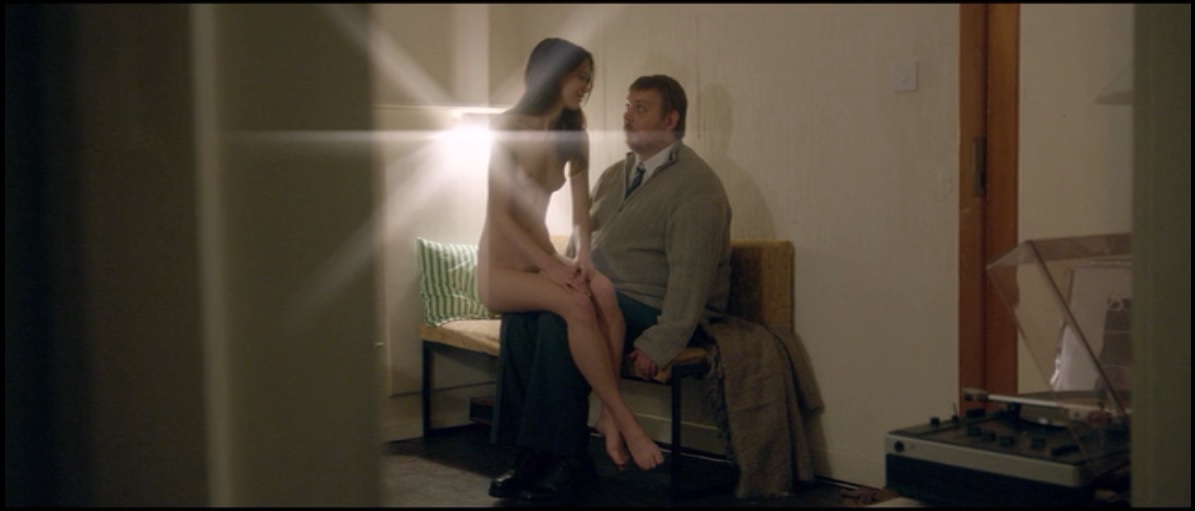
Nymphomaniac presents a series of flashbacks, where Joe relates her story Seligman (Stellan Skaarsgard), an asexual bookworm who compares the details of her life to his various intellectual pursuits. As the title suggests, a large portion of these flashbacks deal with Joe’s sex life. Nearing the end of Volume 1, almost 2 hours in, I found myself getting bored with scene after scene of Joe having rather vanilla sex with male partners, mostly young and thin. F’s arrival was perfectly timed. Joe describes a time when her sex life was a perfect balance of harmonizing elements, like a polyphonic organ piece, with F (Nicolas Bro) as the bass voice. If memory serves, this is the first time we see someone go down on Joe, shown in extreme closeup. F focuses on Joe and her satisfaction. “Without words, he knew exactly what I wanted, where he should touch me and what he should do. The most sacred goal for F was my orgasm.” Because he is so trustworthy and stable, Joe privileges him with activities she does not her other sexual partners. While she explains this in voice over, we see him gently washing her in a bathtub.

nicolas bro, nymphomaniac, stacy martin

The entire time we see Joe and F together, he is clothed and she is naked, heightening the contrast between their ages and body sizes. F is not Joe’s only extragenerational partner, but he is certainly the most paternal. Immediately after seeing them have sex, we cut to an image of Joe sitting on F’s lap, giggling as he tells her a fairytale. F’s arrival in Joe’s story immediately follows the death of her father (Christian Slater); perhaps it is not coincidental that she would so fondly remember a lover who would be “reassuring” and a “foundation,” while so strongly feeling the absence in her life of her dad, who provided her with a sense of security and consistency. F also contrasts with H, a previous lover of Joe’s who leaves his wife and children– his role as a father– to be with her. We have no information of who F is outside of his relationship with Joe, but if he is a father (or some other form of caregiver), he manages to merge the elements of that identity with being Joe’s lover.

F is accepting of Joe’s multiple partners and is actively in deference to her lifestyle, as he often arrives early and patiently waits for her in his car (which was bought used, she points out) with a bouquet of flowers, or in Joe’s living room while she has sex with someone else in the bedroom. F’s patience an example of one of Nymphomaniac‘s strong points: the refreshingly personal and straightforward portrayal of deviations (so to speak) from normative sexuality: monogamous, possessive, not extractable from idealized romantic love. However, F seems emasculated and powerless when Joe compares him to the other members of Joe’s sexual polyphony– and this comparison is explicitly illustrated, in split screen. G (Christian Gade Bjerrum), designated the second voice, is “the only one [Joe] had to and wanted to wait for.” Instead of arriving early, G stands on her threshold when she invites him in, entering as he pleases. Joe finds this exciting because it takes away her control of the situation; she compares G to a predatory wild cat. The sex that she has with G is rough and feral, polarized from F’s “predictable” lovemaking. The two create a spectrum of sexual experience that is beyond limited descriptions of a binary of straight/gay (sometimes expanding to dominant/submissive). As we see an image of a leopard killing a deer, representing G, we also see F waiting in his car for Joe to see him. In between these two is the cantus firmus, Jerome, the closest character to a typical One True Love a viewer might expect to see in a film that focuses on a woman’s love life. These series of images also show Joe’s face while she has sex with them. With G she is wantonly excited; with Jerome she seems transported by the intimacy and soulfulness of their lovemaking; but with F she appears placid and peaceful.

nymphomaniac, lars von trier, stacy martin, shia la boeuf, nicolas bro

Joe describes F as essential to her happiness, but ultimately unsatisfying on his own; Jerome, however, she entreats to “fill all [her] holes,” to complete her, and the fate of the film brings them back together again and again. Even if F displays generosity beyond her other lovers and is seemingly supernatural in his ability to anticipate her desires, what he offers is ultimately incomplete on its own.

Concussion‘s opening sequence is composed of voice overs of women talking about maintaining their aging bodies and images of a gym, showing a spin class of fit women in slow motion, sneaking competitive glances at each other. The film is about a lot of things– queer assimilation, aging– but the body is a prominent and recurring theme. Abby’s dissatisfaction with her life as a stay-at-home is brought to a head by a concussion she suffers accidentally at the hands of her son; there is an early scene of her running on a treadmill until she vomits. She deals with the dissatisfaction by going back to work in New York City, then patronizing sex workers, then finally becoming a sex worker herself, seeing women clients at the condo she is renovating. Like her protagonist, director Stacie Passon is a lesbian, and Concussion does step away from the normative male gaze in some significant ways, including showing sex between women who do not have all the characteristics required to be a woman with a sex life by most films. Some of the women Abby has sex with are older, some have extensive tattoos, one client has a mastectomy scar, and– in case you haven’t guessed where I’m going with this– another is fat.

Abby’s fat client (Daria Rae Feneis) is only known as Woman #1, all clients of Abby’s only being referred to by numbers. It would be easy to see someone patronizing a sex worker as a sign of their inability to attract a partner without the exchange of money, and that sex workers will do anything (or anyone) as long as they’re paid. However, the film makes clear that Abby wants to have sex with Woman #1. Abby is very particular about her clients: she is not willing to go to their homes, and she insists on having coffee with them first, even though The Girl (Emily Kinney), her manager, screens them. Abby even rejects her first potential client for doing homework while she waits for their rendezvous. Abby wants to have sex with Woman #1 as an individual, not solely because she wants (or needs) the money.

daria feneis, concussion

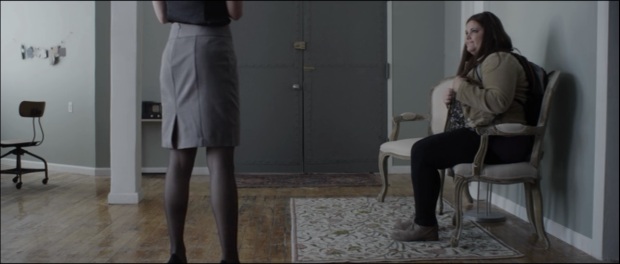
Woman #1 embodies some characteristics often seen in fat film characters. She initiates the conversation awkwardly, talking about a Women’s Studies class she is taking where she has to draw her vulva and talk about her drawing in every class. She even brings a folder of these drawings to show Abby, who politely declines, recreating a common dynamic in films where a fat person’s social inappropriateness is highlighted or regulated by a thinner person. (Slight tangent: as someone who has taken over a dozen Women’s and Gender Studies courses– none at NYU, granted– this class exercise strikes me as absurd.) Women #1 describes drawing her vulva as having a force field around it, because she is 23 and has never had sex or even been kissed. The character comes across as shy and awkward (although she is very pretty), and her lack of experience is never explicitly linked to her weight, but given the setting and sexual/relational experience of the other characters, her late-bloomer status sticks out like a sore thumb. Women #1’s appointment with Abby– a first time for both of them– is quietly drawn out with tension and tenderness. Abby reassures her that she doesn’t have to do anything, can stop at any time, and Abby will do things that she wants to do. Woman #1 is still awkward, however; she neglects to take off her backpack, and after their kiss, she remarks that Abby “smells like oranges.”

During a subsequent visit, Abby finds the ingredients for a Master Cleanse in Woman #1’s bag, which her mother has given her to “start [her] off.” Abby assumes a maternal role in this scene, overriding Woman #1’s mother’s influence by giving her three books to read: Simone de Beauvoir’s feminist classic The Second Sex (“the Bible”), a book on vegetarianism, and a collection of Gandhi’s writings, which Abby describes as “an excellent book for weight loss.” (Another slight tangent. Overall I liked this movie, but the script rubbed me the wrong way at times, this line possibly being the worst example. I trust, reader, that I don’t have to go in-depth as to why it’s hugely problematic for rich white Americans to appropriate aspects of anti-colonial resistance to support their own assimilation into a beauty standard. I confess I’ve never read Gandhi’s writings, what about them makes them excellent for weight loss? Is Woman #1 supposed to fast? Because that slows your metabolism down. Is she supposed to use white guilt as an inspiration to be self-denying in her food choices? Does Gandhi talk about tips for cutting carbs at some point?) She then encourages Woman #1 to throw away her cleanse materials, “because that shit will kill you.” Woman #1 glows as she looks at Abby, who is treating her as a human being whose health needs to be prioritized, not a fatty problem to be eradicated using any means possible. I’m guessing that she experiences the latter attitude from the other people in her life more frequently than the former. We never find out if she herself wants to lose weight, though.

The third and final session we see between Abby and Woman #1 shows a progress in both of their explorations of sexuality. Their attitude with each other is relaxed and intimate; the camera is closer to them than ever. Woman #1 says that she read the books Abby loaned her, but didn’t lose any weight. This scene subverts the expected story beats that Woman #1 would have lost weight, or that a dramatic moment would occur between them (Abby giving some inspirational speech, Woman #1 revealing a dark secret), as the two laugh over this fact and move on with their conversation, as Abby strokes her hair affectionately. Woman #1 also says that she wants to move on from their arrangement and “try something new, like, maybe a guy.” The other woman who Abby loses to a man is Sam (Maggie Siff), another mom from her social group who shares a passionate liason with Abby, and understands her dissatisfaction, but ultimately decides to stay with her husband. Sam, like Woman #1, ties Abby to her inescapable role as a mother.

daria feneis, concussion

Losing her client is paralleled with scenes of Abby’s children waiting for her to pick them up at school, her failing to be a mother. As Abby has chosen to be unfaithful by having sex with women other than her wife, Kate (Julie Fain Lawrence), she is also unfaithful to her role in her family in that she is mothering someone who is not one of her children, neglecting them in the process.

As so much of the energy and rhetoric of the needs of LGBT folks is channeled into marriage equality, and the “we’re just like you” message, there is a dearth of questioning the merits of a white picket house in the suburbs as a desirable goal. Marriage equality and liberal social values allow Abby and Kate to have their American dream in an affluent suburb, but it shouldn’t come as a surprise that Abby would find that dream ultimately as hollow as Lester does in American Beauty. (Considering this film is about college-educated white folks, the attainability of that goal unfortunately doesn’t figure in to its critique.) Concussion‘s main story raises some radical questions about values and stories that we take for granted. This spirit is extended to Woman #1 to an extent– Abby finds her desirable, she isn’t punished for not losing weight– but some toxic presumptions remains intact: the inherent awkwardness of fat people; the inherent struggle to not be fat, even when failing to meet that goal comes as no surprise.

Concussion is a bit unrefined and Nymphomaniac a bit arduous, but ultimately it was a pleasure to watch both them. Even in their failings, it’s always refreshing to consider a film’s drawbacks through a feminist lens that called for more consideration and nuance than “hey, this film doesn’t pass the Bechdel test.” Both have interesting things to say about women’s sexuality, and what it means for a woman to search for happiness and fulfillment. The combination of these ideas puts both protagonists at odds with domesticity. However, even in searching for personal evolution through sex, the characters find themselves in dynamics that parallel their roles as members of their respective families, both with fat lovers. Despite the radical portrayal of fat people as desirable, the films ultimately don’t go far enough, and saddle these characters with drawbacks that can neither offer liberation or stand up when compared with more normatively attractive partners.

I Can’t Believe I’m Writing About Scooby-Doo

Last week, there were a few mentions in my corner of the blogosphere about the new Scooby-Doo movie, Frankencreepy, in which Daphne is put under a curse that makes her “lose her good looks” (according to a statement from Warner Brothers).  Her loss of good looks equates to her thin body becoming fat and her straight hair becoming curly… frizzy… well, you can’t really tell exactly what they were going for due to the animation style, but she’s gained quite a bit of texture.

I read some analyses of this artistic choice which I’ll link to below that do a good job of spelling out the shitty implications that the movie makes about being fat and how it tries to mitigate the effects of that implication by having Fred tell her that she’s still pretty.  However, I think it’s important to look at what in our culture is influencing this storyline, eg. beauty standards based on whiteness.

Beauty, as in the eye of the beholder kind, is nuanced and shifting based on era, culture, subjectivity, and lots of other factors.  If Fred think that Daphne is pretty under the curse, that’s real and valid (even if Daphne shouldn’t base her self worth on his opinion maybe).  But it’s vital to recognize the difference between that and hegemonic beauty standards, ideas about which bodies are good and valid that function as maintenance of power structures.

The culturally reinforced idea of fat=ugly exists at the intersection of a lot of power imbalances, among them sexism, classism, ableism, and racism.  The exotification of fat serves to objectify and other black women’s bodies, from the Hottentot Venus to the appropriation of twerking as an edgy accessory for skinny white pop stars– the same A-list celebrities whose cultural capital would plummet if their bodies looked the same as their backup dancers’.  Similarly, the equation of a fat body with beauty is, in the context of white colonialism, seen as quaint or curious or wrong; the white beauty ideal always positioned as the one to strive for.  A well-known anecdote (at least in feminist and eating disorder recovery communities) is how rates of eating disorders among adolescent girls in Fiji increased dramatically after the introduction of Western television, their local beauty standards uprooted and replaced by imported images of glamorized thinness.  This handful of examples and analysis is a cursory explanation, and I hope to explore the concept more deeply in future blog posts, but the idea we’re working with here is that the feminine ideal is the white body, and the white body is thin.

Along the same lines, the ideal feminine body is also crowned with long, light, straight hair.  Coarsely textured hair– hair in its natural state for the majority of black people– is seen as a hallmark of being out of control, inappropriate, not beautiful.  This standard has long been used in the US to marginalize black people for being “too” black, from churches that would only allow membership for people who could pass a fine tooth comb through their hair without it snagging, to hair style standards in the US Army that were only removed after being skewered on The Daily Show.

Am I saying that the creators of Scooby-Doo: Frankencreepy are white supremacists?  Not consciously.  Or maybe they are conscious white supremacists, I’m not really interested in giving them the benefit of the doubt.  In Tom Burns’ essay on Frankencreepy, linked to below, he points out that the movie could very well have removed Daphne’s “good looks” by turning her into a monster.  It’s not like this movie is devoid of the fantastic.  But instead, how the movie portrays her loss of her “good looks” is by removing two physical features that are hallmarks of white beauty standards.  That is how she is cursed.  Admittedly I haven’t seen the movie, but given she’s the heroine in a kid’s movie, I feel safe in assuming that her “good looks” are returned to her by the end of the movie.  Her nightmare is over, she is returned to her full status as pretty white girl.

But what does that say about viewers– likely very young viewers– who have fat bodies and/or natural hair that don’t change at the end of the movie like Daphne’s?  Do they not have access to the comfort of a happy ending?  Are they cursed?

And what kind of malicious force would cast an evil spell at a child?


Related articles:

The Good Men Project: Why Is the New Scooby-Doo Trying to Fat Shame Daphne?

Dances with Fat: Scooby Dooby Don’t

Fat Girl’s Shoes: The Wolf of Wall Street (2013, dir. Martin Scorcese)

[CW: sexist language, description of sex scene]

I resisted watching The Wolf of Wall Street when it was in theaters; I didn’t see it until a few weeks ago, when it hit Redbox and Patrick wanted to rewatch it.  The production of this film is admirable, but in the same way that some people can’t stomach slasher movies, I have trouble finding entertainment in stories about predatory capitalists.  I’m not keen on writing anything that would necessitate a rewatch of the full three hours, but a few thoughts sprang to mind.

The world that Wolf portrays constructs a binary of winners and losers, the divide only quantified by one’s bank account.  Characters do not gain or lose weight as part of the story to inform us that they have crossed the divide from one category to the other, as in Death Becomes Her or Dodgeball: a True Underdog Story.  The type of characters who those films are about– the women of Beverly Hills and gym-goers– have statuses that are tied into their ability to maintain the ideal body type, which both films comment on.  Compare this to the main characters in The Wolf of Wall Street:  the stockbrokers statuses are directly wealth-based, and they make this wealth from manipulating the people they associate with, their clients and employees.  Thus it is appropriate to Wolf‘s logic that associating with fat people, over one’s own body being fat, is one of the ways in which the film signifies loserdom, synonymous with being anything but upper class.

The Wolf of Wall Street is conspicuously absent of fat women, the possible exception being Jordan’s (Leonardo diCaprio) housekeeper (Johnnie Mae), who, tellingly, is also the only black person in the film.  The reason I say this is a conspicuous absence, unlike other movies that lack fat female characters, is that hypothetical fat women are symbolically attached to male characters to mark them as losers.  In a passionate speech to his sales team, Jordan spurs them to success by presenting two futures:  driving a new Porsche with a beautiful, large-breasted wife in the passenger seat (and if Jordan’s own wife is any example, the winner’s wife is thin), or driving a beat-up Pinto with “some disgusting wildebeest with three days of razor stubble in a sleeveless muumuu, crammed in next to you”– an image that evokes laughter from his team, his “room of winners.”  Anyone who doesn’t see Jordan as a role model is instructed to “work at McDonalds,” low-paying jobs and low-quality food being the shameful realm of losers.  Stratton Oakmont has some female stockbrokers as well; even if they are not seeking trophy wives for themselves, they still distance themselves from fat women to prove they are winners.  In one scene, shoe designer Steve Madden presents his company to the Stratton Oakmont team but lacks Jordan’s charisma: the pack quickly turns on him.  “They’re fat girl’s shoes!” one of the female brokers shouts out derisively, as her coworkers throw things at him.

The winners constantly surround themselves with thin, beautiful, sexually available women.  However, even these women are broken into categories of winner and loser.  Jordan describes three types of sex worker whom Stratton Oakmont hires, describing them in terminology he uses for the product he sells.  The “blue chip” women who charge the most are “model material,” the example being a beatifically lit, model-thin woman who floats towards the viewer from among a small group of stockbrokers, laughing and holding a flute of champagne.  The “NASDAQs” are the mid-tier sex workers: a curvier woman who jiggles her body suggestively at the larger group of office workers around her; she is drifting like the “blue chip” woman, but moving across the screen as though she were on a conveyor belt at a grocery store checkout.  Finally, the “pink sheets” are the “skanks” who charge the least, represented by a larger woman still who is bored and stationary, braced against a desk while her flesh bounces from the force of the stockbroker who is fucking her, a horde of his coworkers packed in the office, waiting for their turn.  None of these women could rightly be called fat, but this is a context where the range of body size considered beautiful is as slender as those who fall within it; the trimmer the body, the more monetary worth assigned, the more exclusive her company.

But what of the gentlemen?  A few of the guys in Jordan’s “pack” are chubby, and ostensibly winners, but they are only winners through their connection to Jordan.  The pack are initially presented as losers, all of whom are weed-dealing hometown buddies of Jordan’s who are slow to understand his business philosophy.  Jordan has to groom them into aggressive salesman through giving them a literal script.  They live through him vicariously to an extent, egging him on to seduce Naomi (Margot Robbie) while they watch from a balcony; this is the dynamic that Jordan’s success thrives on.  “I know they’re knuckleheads,” he tells his dad (Rob Reiner) in order to explain why sex workers’ services are billed as business expenses, “I need them to want to live like me.”  Jordan embodies the winner, inspiring his employees to be more ambitious and aggressive.  Not only is Jordan the man with the Porsche and the $40,000 watch he can throw away without batting an eye, he is the provider of thin, beautiful women.  Moreover, Jordan has learned the secrets to hyper-success in his field from Mark (Matthew McConaughey), one of the slenderest male characters in the film.

Donnie (Jonah Hill), Jordan’s right hand man, is the prime example of the fat man who can’t quite be a winner on his own.  He is desperate for Jordan’s approval from the start, offering to work for him minutes after introducing himself.  He does things that are socially awkward and downright taboo, such as marrying his first cousin and masturbating in the middle of a crowded room.  Jordan and the others make fun of him when he’s more inebriated than they are.  He may be sexually attracted to men, not a trait that is looked upon favorably in the movie’s world.  He mirrors Jordan’s ruthlessness, but in a way that is less inspiring than Jordan’s speeches.  During a crucial trading day, Donnie shames a stockbroker who has taken a few minutes to clean his fishbowl by swallowing his goldfish in front of the whole office.  Donnie asserts dominance over his employee, but the self-imposed frat house dare that he utilizes is model behavior for a goofy fat sidekick.  Even after he becomes wealthy, Donnie stays married to his cousin, suggesting his inability to leave behind either his boorish personality or his middle-class beginnings.  Jordan, on the other hand, becomes more charismatic and assertive as he gains wealth, divorcing his first wife who he married before making it big in favor of gorgeous, blonde Naomi.

There are several factors and turns of events that bring about Jordan’s downfall, but Donnie is a factor in a few of them.  He calls their banker on a tapped phone under the influence of quaaludes (before choking on a piece of ham).  Through his awkward way of socializing, he provokes another pack member into a fight in public, which gets the police involved.  Donnie’s poor decision making is not the only harbinger of doom for Jordan:  Jordan alerts Donnie that he is wearing a wire, which incriminates Jordan in tampering with an investigation.  Jordan’s friendship with a fat person, making a decision to protect that friend in contrast to his materialistic winner persona, has contributed to his departure from the “winner” category.  In a final stroke of fate, Jordan’s high class position unravels for good due to a bourgeois restaurant chain.

Despite imagery in media such as political cartoons that cling to using fat as a symbol of privileged wealth, the reverse has been true in USian culture for generations.  A slender body is the ultimate sign of wealth that people of every class are mandated to strive for, a body that has the time and resources to be sculpted by plastic surgery, personal trainers, fad diets, and cocaine, a body that symbolizes the willpower and drive required to survive in the bootstrap narrative we tell ourselves.  Fat bodies are seen as lower class, associated with overindulgence, lack of social ability, and poor decisions, qualities that contribute to failure.  Despite the characters in The Wolf of Wall Street adhering to this mentality, we see that Jordan, despite his straight-sized body and financial success, can’t separate himself from “fat” behaviors and characters, showing us how fleeting and unstable the conditions for winning are.

The Paranoia of Being a Fat Audience Member: Snowpiercer (dir. Bong Joon-Ho, 2014); Lawrence of Arabia (dir. David Lean, 1962)

…and a few thoughts on why I started writing this blog.

Snowpiercer is a high concept sci-fi movie whose opening scenes are densely packed with exposition.  Humanity has fucked with the environment one final, glorious time, a handful of survivors have been circling the globe for the past 17 years via train in a self-sustaining and strictly hierarchal ecosystem.  We begin in the back of the train with our underclass protagonists.  Their existence is claustrophobic, dirty, meager, strictly regimented by cleaner passengers with uniforms and guns.  But the tipping point of their oppression comes when two of their children are taken for an unspecified purpose by Claude, the woman in yellow (Emma Levie):

image from moviestillsdb.com

It is a shocking scene: both for the sickening sense of doom that builds while she wordlessly measures the children’s height and arm length, and the dazzling nature of her appearance.  Claude’s appearance is the first time in the movie that we have seen the color yellow, the first time we have seen clean, glistening hair, the first time we have seen someone wearing eyeliner.  She glides through a jungle of filthy rags and dull uniforms with restraint, a beautiful, venomous creature.

Despite the allegorical nature of Snowpiercer, this isn’t a crude political cartoon where sides are drawn based on waistline.  Slim Minister Mason (Tilda Swinton) is a distillation of repressive politicians everywhere; Tanya (Octavia Spencer), mother to one of the kidnapped, is a determined fighter who convinces Curtis (Chris Evans) to make her part of the resistance team because her fat body is stronger than that of the skinny men helping him.  And yet we have a plump woman as the final straw before revolt, the spectacle of feminized wealth among drab poverty, the consumer of children.

It’s not like a larger body is Emma Levie’s only attribute; she’s effective at portraying the ice-cold Claude.  Snowpiercer is her second film; her debut was the titular role of Lena (2011), where she portrays an adolescent struggling with her weight.  I haven’t seen Lena, but the character’s struggle with body image is mentioned in every description of the film I’ve read, and it is the only professional baggage she brings to this role.

Lawrence of Arabia is a magnificent epic about T.E. Lawrence (Peter O’Toole), a British army officer, and his role in the Arab Revolt of World War I.  The film combines the macro-level war and sweeping views of the desert landscape with the micro-level of Lawrence’s navigation of identity between his British roots and love of the Arab people, conveyed through O’Toole’s passionate, charismatic performance.  He speaks about his sense of himself as an outsider in British society early in the film with his Bedouin guide:

LAWRENCE: [I am] from Oxfordshire.
TAFAS: Is that a desert country?
LAWRENCE: No; a fat country; fat people.
TAFAS: You are not fat?
LAWRENCE:  No. I’m different.

With this monosyllabic word, Lawrence could be, and probably is, referring to a number of dichotomies he perceives between himself and his fellow countrymen.  He is physically slimmer than his superior officers, but he is also portrayed in contrast to them as empathetic to the Arabic people, an unconventional thinker, and restless in his sense of himself and the world.  However, the “fatness” of Oxforshire, which we only see a glimpse of in the beginning sequence, also stands in contrast to Arabia: verdant and peaceful, as opposed to harsh and troubled.  A more forgiving and abundant land, whose residents presumably don’t have to resort to the extreme measures that Lawrence does, such as killing his close companions for the survival of the group he is leading.

image from flickersintime.com

Lawrence doesn’t position himself with Tafas and his people; just as “different” from the other British people, who are largely portrayed in Lawrence of Arabia as stuffy, bureaucratic colonizers. Is that the people who Lawrence is different from, the stout officers who make secret deals with the French to split up the land and resources of brown people?  Or is it a Britain that we don’t see, but stands in contrast to the ruthless, desperate shell of a man that Lawrence becomes in the second half of the film?

Snowpiercer and Lawrence of Arabia have a few elements in common, but the reason that I chose to write about them in the same post is because I saw them within a day of each other (and both at the Music Box Theatre, check it out if you’re in Chicago), and the two moments in each that I discussed provoked similar responses in me.  How specific were these choices? I wondered.  Is fatness an intentional symbol on the part of the filmmaker, and if so, what is it representing?

I thought that I could write a blog about fat characters where the role of fatness would be more explicit, like Shallow Hal.  I didn’t give enough consideration to how ambiguous that role can be.

This is the insidiousness that comes with being different, with not belonging to your group, and how, like Lawrence, that feeling can provoke and corrode you.  You have something that marks you as an outsider, something you can’t leave at home when you walk out the door, and you don’t often have explicit knowledge of how it factors into how you’re seen.  One of the reasons I chose to write about fat people in movies because these are the images and connected values that are consumed by virtually everyone I interact with every day.  Not having a good read on a movie’s fat semiotics can leave me nonplussed in a way similar to wondering if my appearance was a factor on why I was passed over for a job.

I’m committed to continuing this project, but only a few entries in, this blog is already starting to feel like trying to make sense of a house of mirrors.  And like a house of mirrors, when the viewer sees themself everywhere, from every angle, they tend to become disoriented and lose trust in what is seen.

Link: The Trials of ‘Tammy’: Stop Policing Melissa McCarthy’s Body

So here’s the deal: I’m wrestling with my desire to see Tammy.

On one hand, I think Melissa McCarthy is great and her star status never fails to put a little sunshine in my day.  I’d like to support a film that she not only starred in, but co-wrote.  It’s rare to see a film where a fat character is written by the person portraying them.  (The example that immediately springs to mind is the British TV series Gavin and Stacey, written and acted by James Corden and Ruth Jones, complimenting each other as unstoppable force/immovable object sassy fat best mates of the nice normal title characters.  I digress.)   On the other hand, I currently need to budget my trips to the theater, which I’d rather use to focus on imaginative visuals (i.e. Snowpiercer) and movies I’ve been anticipating for a while (i.e. Boyhood).  Luckily, there are professional film critics who have been compensated for seeing Tammy, due largely to the fact that they are much better at this sort of thing than I.

Nathan Rabin of the Dissolve declared, “a crowd-pleasing, proudly working-class celebration of large women, old women, broke women, and women who love women,Tammy isn’t just consistently funny and unexpectedly touching and tender, it’s also genuinely subversive.” Today’s roundtable discussion at the same site about women in comedy was generally amiable towards it as well. The critical reviews (beyond the website where I daydream about being friends with most of the writers, that is) have been on the negative side of mixed, with a current Metacritic score of 39.

Teo Bugbee’s piece in the Daily Beast doesn’t afford Tammy commendations the same way that Rabin’s review does, but it does provide a smart analysis of Melissa McCarthy’s celebrity and career, looking specifically at the concern trolling directed towards her:

Sookie [McCarthy’s character on Gilmore Girls] was a “good representation” of obese women. She is also entirely unfeasible as a lead character. Her relative lack of drama made her perfect as a sidekick, but a show or a film structured around Sookie St. James would be like making a movie about Robin with no Batman. What’s the point?

The nastiness masquerading as concern is always present around McCarthy, policing her body in ways that her films never even come close to suggesting. If these concerned citizens were really upset about Hollywood’s mistreatment of actresses, they’d only have to look to McCarthy’s left to find Susan Sarandon, amiably stranded as a grandma in Tammy because Hollywood has no clue what to do when faced with a woman who’s just as volcanically sexy now as she was 40 years ago.

No, the distress of McCarthy’s fans has very little to do with women’s roles, and everything to do with distaste for working-class women and their bodies.