fat men

Roundup: December 2015

Happy New Year!  This past month was largely focused on catching up with 2015 releases for my end of year list. (Minus the first week of January grace period I’m affording myself on account of not having the time for and access to 2015 releases that a full-time professional film writer would, you’ll just have to wait a month for those.)

Mistress America (2015, dir. Noah Baumbach)

Tracy (Lola Kirke), a college freshman and aspiring writer who is new to NYC, attempts to navigate her new surroundings by reaching out to her hipster-by-Auntie-Mame stepsister-to-be, Brooke (Greta Gerwig).  One of the funniest films I’ve seen this year, due to the clever script and just-madcap-enough characters who bounce off each other delightfully.  Not least among these is Brooke’s former fiancee Dylan (Michael Chernus), a fat guy who lives in the affluent suburbs of southwest Connecticut and almost matches Brooke in terms of grandiloquence and fear of adulthood.

People, Places, Things (2015, James C. Strouse)

An indie dramedy that is pretty unremarkable, with the exception of Jermaine Clement’s performance.  Following the breakup between Will (Clement) and Charlie (Stephanie Allynne) that begins with Will walking in on Charlie having sex with Gary (apparent supporting role powerhouse Michael Chernus). Part of Will’s inability to move on over the course of the film deals with resentment towards Gary.  Despite both men being nerdy hipster Brooklynites, larger Gary is portrayed as the more milquetoast of the two.  Will is a graphic novelist, an art form that is characterized as under-appreciated and misunderstood, while Gary is a monologist, whose artistic pursuit exists in the film as material for insults. Another fat character is an unnamed student in Will’s graphic novel class, who does a piece for class about how he learned to masturbate.  His work is used as a punchline– how inappropriate!  like the rest of Will’s class, save Kat (Jessica Williams), this kid doesn’t get it!– but the joke comes across as misinformed.  It doesn’t take much scratching of the surface of establish underground comics to find confrontationally personal autobiographical accounts

people places things

Michael Chernus and Stephanie Allynne hide their shame in People, Places, Things.

Spotlight (2015, dir. Tom McCarthy)

It’s more likely to see fat characters in films that strive for realism, like Spotlight.  However, as  Spotlight has a large cast, fast-paced, complex plot, and required quite a bit of emotional processing as someone who was raised Catholic, I’m sure that I wouldn’t be able to remember everyone.  Certainly none of the main characters are fat.  There are fat characters, but the only one who comes to mind at this point is a reporter from a rival newspaper with whom Michael Rezendes (Mark Ruffalo) trades snarky comments during his trip to Springfield.

Star Wars: the Force Awakens (2015, JJ Abrams)

Larger bodied characters tend to be aliens in small roles who are sketchy/dangerous or whose bodies are part of the exotic, otherworldly scenery, such as the hulking junk trader on Jakku (Simon Pegg) to whom Rey sells her scavenged findings, or wide, intimidating-looking aliens in Maz Kanata’s (Lupita N’yongo) hideout.  In addition to them, however, there is a rather dashing X-Wing pilot for the Resistance:

star wars poe

Oscar Isaac as Poe Dameron in Star Wars: the Force Awakens.

No, not him, the other dashing X-Wing pilot:


Greg+Grunberg+0UkxSxwnEAtm

Portraying X-Wing pilot Snap Wexley, JJ Abrams’ lifelong friend and hunk Greg Grunberg.

Yeeaaahhhhh.

Attack the Block (2011, dir. Joe Cornish)

Sci-fi/action/comedy about a group of inner-city London youth who fight monstrous invading aliens.  It’s a really smart depiction of a disaster where the only people who are working to contain the problem are the people who nobody trusts or listens to.  Frequently compared to Edgar Wright’s work, it unfortunately never manages to hit the humor or emotional notes that Wright can.  Case in point: Nick Frost’s role as Ron, a weed dealer.  Where the Cornetto Trilogy has Frost in dynamic, funny, endearing roles, Ron isn’t given much of anything to do in Attack the Block.  Shame.

Buzzard (2015, dir. Joel Potrykus)

Grungy, uncomfortable (in a good way) indie comedy about Marty (Josh Burges), a slacker who lives to game the system.  One of his cons includes “returning” stolen office supplies to a retail store for cash, which he is able to do through the grace of a fat cashier (Michael Cunningham) who takes a lax approach to store policy.

Experimenter (2015, dir. Michael Almeyreda)

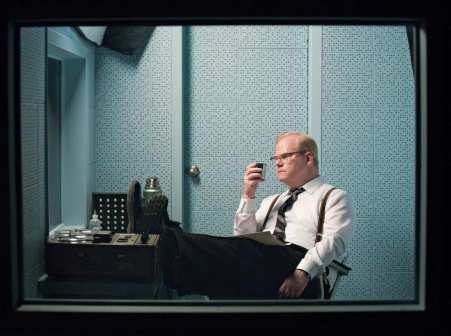
A fourth-wall demolishing, imagined memoir of the work of experimental psychologist Stanley Milgram (Peter Sarsgaard, in my favorite leading man performance of 2015), starting with and always coming back to his controversial 1961 experiment on subjects’ willingness to administer increasingly severe electric shocks to another person.  Jim Gaffigan, whose standup includes bits on being fat, plays James McDonough, a man Milgram hired to be the “victim” of the experiment’s situation, pretending to receive the administered shocks and begging for the experiment to stop.  When not acting as a man in distress, McDonough is an affable goof.  65% of the experiment subjects complied with all orders to shock McDonough, despite hearing him say that he had a heart condition and even after he became unresponsive.  Most of the depictions of subject experiments show these compliant people, but two depictions are of subjects who refused to comply, including a fat man who tells the researcher saying he has no choice: “In Russia, maybe, but this is America!”

02-experimenter.w750.h560.2x

Experimenter: No comedians were harmed in the making of this film.


Roundup: November 2015

A rundown of fat characters in films I saw over the past month, but didn’t post about.

Stranger by the Lake (2014, dir. Alain Guiraudie)

A French thriller set at a remote cruising spot, following Franck (Pierre Deladonchamps), who witnesses his favorite hookup Michel (Christophe Paou) committing murder.  Almost all of the characters in the film are men who have sex with men.  They are also mostly young and fit, with the exception of Henri ( Patrick D’Assumçao), a middle aged man with a beer belly who sits by himself and says that he is never propositioned for sex.  Only Franck approaches him for conversation, and their relationship remains platonic.  

stranger-by-the-lake02

Vanya on 42nd Street  (1994, dir. Louis Malle)

This incredible film documents a group of actors who gather in an abandoned Manhattan theater for informal rehearsals of Anton Chekhov’s play Uncle Vanya, under the direction of Andre Gregory.  Jerry Mayer plays Waffles, a sycophantic and persistently cheerful tenant of patriarch Serybryakov (George Gaynes).

Jurassic World (2015, dir. Colin Trevorrow)

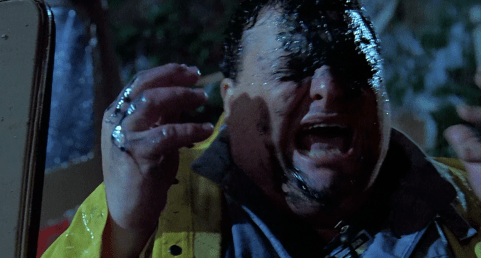
I noticed two fat characters before Blu Ray took pity on us and malfunctioned.  Hoskins (Vincent D’Onofrio), who Doesn’t Understand the Dinosaurs, serves as a foil to Owen (Chris Pratt), who Understands the Dinosaurs.  His goal is to weaponize the raptors for military use.  When the Indominus rex breaks free of its enclosure, one of its first victims is a fat security guard, who is monitoring the enclosure but fails to notice that there is a problem.  His death is somewhat reminiscent of Gennaro’s in the first film: paralyzed with fear and hiding behind a Jeep, he remains motionless while the dinosaur destroys his cover and devours him.

nedrygoo

Dennis Nedry (Wayne Knight), a fat character from Jurassic Park. Also, a representation of what watching Jurassic World feels like.

ThanksKilling (2008, dir. Jordan Downey)

A low-budget horror comedy about a group of college kids terrorized by a cursed turkey over Thanksgiving break.  Billy (Aaron Carlson) is the group’s fool, to borrow a term from The Cabin in the Woods.  He is a loose cannon redneck who makes more inappropriate comments than the other characters (with the exception of the Turkey).  He is introduced ripping his undershirt over his excitement for Thanksgiving break, to which Johnny the jock comments that he doesn’t want to see his “tits.”  Billy is the one who suggests that the group gets drunk in the woods after their car breaks down, and a research montage later in the film includes a shot of nerd Darren teaching Billy how to read.  Billy dies when Turkey tricks him into swallowing him, then bursting out of his guts.

A Pigeon Sat on a Branch Reflecting on Existence (2015, dir. Roy Andersson)

This film is a loosely connected series of static-shot vignettes that comment on mortality, morality, and human nature.  An opening sequence, “Three Brushes with Death,” feature two fat men who drop dead.  One dies in a ferry cafeteria; a second fat man takes his beer when the cashier points out that it’s been paid for and is up for grabs.  A fat dance instructor (Lotti Tornros) is inappropriately physical with a slender, younger male student (Oscar Salomonsson), running her hands over his body under the pretense of correcting his posture.  In a later scene, they are in the background having an intense conversation; he leaves her sitting at a restaurant table as she sobs inconsolably.  Another scene features a fat woman playing with a baby in a carriage.  Yet another is of a fat woman working in a laboratory, chatting on her cellphone while a confined monkey is tortured.  There is no narrative to speak of, but the most prominent characters are a pair of travelling novelty item salesman who are unsuccessful at their trade.  One of the salesman, Jonathan (Holger Andersson) is fat.  He is the more serious of the two and apparently the one in charge, describing his coworker as a “crybaby” and generally taking charge during their sales pitches.

“Anyone, no matter how odd or pale or chubby, can still have a good time:” The Addams Family and Addams Family Values (1991 and 1993, dir. Barry Sonnenfeld)

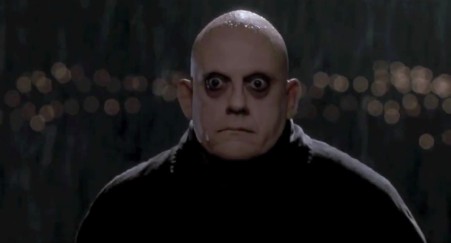
At first I was ambivalent about Uncle Fester, but it didn’t take much research to convince me that he is a fat character.  On his Wikipedia page, there is a quote from creator Charles Addams describing him as “fat with pudgy little hands and feet.”  Although his body is obscured under his black robe, he has usually been portrayed by larger-bodied actors, such as Jackie Coogan on the 1960s television series and Kevin Chamberlin in the original Broadway cast of the 2010 musical.  But as this is a film blog, the focus will be narrowed on the first two films and entertainment pillars of my childhood, the Addams Family and Addams Family Values, with Christopher Lloyd wearing a fat suit to play Uncle Fester.

I have yet to address fat suits on CPBS.  The only role I’ve looked at that utilized a fat suit is John Travolta’s in the Hairspray remake, which I didn’t talk about in the article.*  The reasons for putting an actor in a fat suit vary based on the film, but there are similarities between Travolta wearing one in Hairspray and Lloyd in the Addams Family movies, which is the spectacle of celebrity.  In either film, a fat actor could easily have been cast, but both Lloyd and Travolta are well-known names to mainstream audiences.  On top of this, putting both of these actors in a fat suit creates a spectacle based on their public personas that serves as a draw for the film.  Travolta’s abrupt left turn from his usual roles as a handsome leading man was one of the main sources of buzz around Hairspray, and Lloyd’s portrayal of Fester fits in with his reputation for playing characters whose offbeat looks indicate an offbeat personality.  I’m hard pressed to think of a fat actor for either movie who would have been suited to the role and at a comparable level of fame.  (My initial thought for a recast of Fester would be Pruitt Taylor Vince, master of creepy weirdos, but even today he is at the “hey it’s that guy” level of fame.)  Of course, this creates a vicious cycle in which a studio wants to hire someone at a certain level of fame, but there is a dearth of fat actors as well known as they want, so a thinner actor is put in a fat suit, preventing fat actors from reaching greater levels of notability.  Of course, fat actors are far from the only marginalized group to experience this vicious cycle, as disabled actors, actors of color, and queer/trans actors are often overlooked in favor of performers from more privileged groups who go on to give “brave” performances as marginalized characters– or whose characters are (re)written to have that privilege.

fester 1

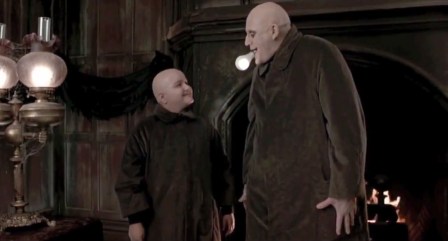
Fester as a character has changed through the years and various media incarnations of the Addams Family (although his ability to light a lightbulb by holding it in his mouth has been consistent).  In the films, Fester has brutish tendencies and is as gleefully morbid as the rest of his kin, but he is ultimately someone who is gullible, tender-hearted, and lonely.  In both The Addams Family and Addams Family Values, Fester’s story revolves around finding a connection with his family in spite of being duped by a manipulative woman.  When introduced in The Addams Family, he has been convinced that he is Gordon Craven, son of overbearing loan shark and con woman Abigail Craven (Elisabeth Wilson).  He and his mother “pretend” that he is long-lost Uncle Fester as a means of stealing the Addams fortune. Fester-as-Gordon-pretending-to-be-Fester is often perplexed, in way over his head in the Addams’ world and doing a poor job of convincing them that he is Gomez’s (Raul Julia) long-lost brother.  Despite believing he is only pretending to be Fester, the relationship he fosters with Wednesday (Christina Ricci) and Pugsley (Jimmy Workman) raises a sense of belonging with the Addamses.  As introverted, lurking Fester is a foil to debonair, zealous Gomez, chubby Pugsley is a foil to his svelter sister.  Wednesday is intense, dour and sadistic, where her brother is easygoing and (like his uncle) gullible, always playing the victim to Wednesday’s torturer in their games. Fester’s love for the family as a whole grows to the point where he is able to stand up to his villainous faux mother in their defense.  A flash of insight strikes (literally, in the form of a bolt of lightning and Fester’s head) and the prodigal uncle’s true identity is restored.  His redeemed status in the family is illustrated in the film’s final scene set on Halloween, with Pugsley having opted to dress up as his uncle.

fester and pugsley

In Addams Family Values, Fester begins the film with his identity intact.  He is gleefully ghoulish, not unlike his family members, but as he is no longer bumbling through a con, we see that he is genuinely awkward, shy, and oblivious.  In the first film, Gomez waxes nostalgic about what a ladies’ man Fester used to be (while they watch a home movie in which young Fester sticks his finger in his date’s ear), but in the second film, he can barely look at object of his affection Debbie (Joan Cusack, arguably doing her finest work), let alone talk to her. Like Abigail, Debbie is a criminal who survives on deceit and wants to use Fester to get her hands on the Addams fortune. She is a “black widow” who marries, then kills, rich bachelors.  No longer reacting to the Addams’ world out of ignorance, Fester is purely unintelligent, to the point of being childlike.  While seducing him, Debbie confesses that she is a virgin; he doesn’t know what that means.  This doesn’t logically match up with the rest of the family, making Fester look particularly idiotic. In an earlier scene, Wednesday tells a less-informed peer that she has a new baby brother because her parents had sex; this is played for laughs, but apparently Gomez and Morticia (Anjelica Huston) don’t shy away from candid biological discussions.  Plus, considering that Morticia and her mother both practice some dark form of magic, you’d think they would have vials of virgin blood or something like that lying around the mansion.  When Debbie tells him what a virgin is, he confesses that he is one as well, again highlighting his naivete.  Fester’s role as vulnerable outsider is used primarily for laughs (as in this scene) and conflict, where the rest of the family must save him from Debbie, who attempts to turn him into a “normal” person, more to her liking, before bumping him off.  Compare this to a thinner outsider with a goth aesthetic in a comedic modern-day fantasy released a few years earlier: the titular character of Edward Scissorhands.  Edward (Johnny Depp) is also socially awkward, vulnerable, and longing for love.  However, unlike Fester, his loneliness and vulnerability are romanticized.  Despite having dangerous blades for hands, Edward is an artist who doesn’t want to harm anyone.  Fester is sweet and caring, but also delights in mayhem and grotesquerie. Edward’s love for Kim is pure and chivalric,  as opposed to Fester’s love for Debbie, which is misguided and dangerous.  Edward is a source of creativity and wonder for the mundane community he tries to live in, while Fester is merely an oddity.  

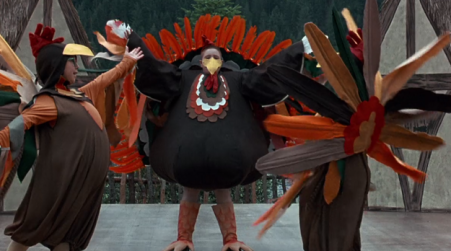
In a subplot, Fester’s young proteges find themselves in a similar dilemma.  Thanks to Debbie’s influence, Wednesday and Pugsley are also removed from their home and threatened with assimilation into normalcy at Camp Chippewa, a summer camp “for privileged young people.”  Camp Chippewa is a microcosm of the mundane world that the Addams are normally apart from, where people with non-normative bodies and identities are marginalized and attractive, athletic WASPs rule.  Wednesday and Pugsley befriend Joel (David Krumholtz), a nebbishy kid with multiple allergies.  The privileged-privileged campers, led by ultra-snob Amanda (Mercedes McNab) and enabled by chipper camp directors Becky (Christine Baranski) and Gary (Peter MacNicol), torture the outsiders with condescending mock-concern.   According to Becky, the WASPy campers “are going to set an example to show that anyone, no matter how odd or pale or chubby, can still have a good time!,”  while completely disregarding the needs and preferences of the marginalized campers. When the annual summer camp pageant is announced as a tribute to Thanksgiving, Wednesday is cast as Pocohontas, the leader of the Indians (played by the other outsider kids), and Pugsley as a fat-suit wearing turkey whose part includes a song begging the audience to kill and eat him.  And of course, as the Internet reminds us every Thanksgiving, Wednesday leads the other misfits in a spectacular rebellion

pugsley turkey

The Addams family is a subversion of American values, delighting in death and misery where most people would rather not think about such topics.  The family and their ilk include not only a Gothic aesthetic and diabolical values (Morticia laments that, as a busy wife and mother, she doesn’t have enough time to “seek out the dark forces and join their hellish crusade”), but an embracing of non-normative bodies.  In The Addams Family, Fester is re-introduced to Flora and Fauna, a ravishing pair of conjoined twins whom he courted as a young man.  Extras in scenes of the extended Addams family and friends include little people.  While this isn’t exactly liberatory, as little people are often present in films as little more than “weird” set dressing, it reinforces the idea that the Addams’ world embraces difference, along with death and destruction.  Although the inverting of social expectations fuels much of the humor in the film, perceptive audience members may wonder what the films are saying that these are also characters who passionately pursue their interests, are proud of their family history, care deeply about each other, and don’t exclude anyone based on ability or appearance.  


* …but I will talk about now.  John Travolta in a fat suit reflects my overall opinion of the Hairspray remake, namely that its admirable attempt to be more empathetic to the marginalized characters it portrays is undermined by its move towards wider mainstream acceptance as a movie.  One would expect to see a name as big as Travolta’s attached to the role of Edna, but John Travolta, a straight A-list celebrity who is an open and enthusiastic member of a religion that decries homosexuality, is a far cry from originator Divine a fat drag queen whose name was synonymous with trashiness.  In the remake, Edna is given more emotional depth in the form of being unwilling to leave the house until she loses weight (or, as actually happens, until she is empowered by Tracy to do so), but the casting choice was not to give this role– a potentially valuable career opportunity for a less famous actor– to someone who would have experienced the anxiety of being in a public space where they are reviled for what they look like.  Rather, the role went to someone whose reason to feel anxiety about appearing in public would likely be his immense popularity.

“You’re not such a dog as you think you are:” Marty (1955, dir. Delbert Mann)

I hadn’t heard of Marty until my partner recommended it for the blog, which was a little embarrassing when I found out how well-received it was in its day.  A low budget film version of a tv production, Marty won both the Palme d’Or and the Academy Award for Best Picture, and was a career highlight for star Ernest Borgnine, who until that point had been best known for his role as a villainous staff sergeant in From Here to Eternity. The trailer for The Catered Affair, Borgnine’s next film, perfectly illustrates the impact of Borgnine’s work in Marty.  Borgnine isn’t the star of The Catered Affair, nor is he the most glamorous star in the cast, but the studio used him as the spokesperson based on Marty’s warm reception by audiences.

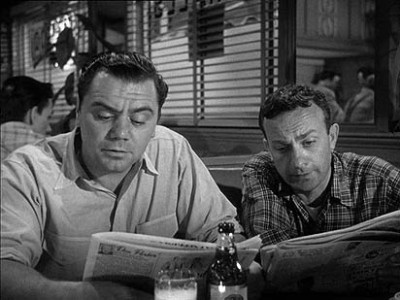
The premise of Marty is modest and relatable, set in the present-day Bronx and following 24 hours in the life of Marty Piletti  (Borgnine).  We are introduced to Marty behind the counter of the neighborhood butcher shop where he works.  He helps two customers in a row who inquire about his little brother’s wedding, and as “what’s wrong” with Marty that he is a bachelor at 34.  Everyone in Marty’s life feels entitled to comment on his lack of a wife, a status to which he feels resigned.  His bachelorhood is not pathetic in and of itself, rather the pathos comes from the relationship-shaped hole in his life.  He doesn’t have much else going on besides his job (though he does have ambitions of buying the shop from his boss).  A conversation with his best friend Angie is largely a repetition of “What do you feel like doing tonight?” “I don’t know, what do you feel like doing?.”  At Angie’s suggestion, he phones a woman he had met a month prior– “the big girl,” as Angie describes her– to ask for a date.  We only see Marty’s half of the conversation, the camera slowly pushing in on his face as he is rejected (“the big girl” presumably being someone who ought to struggle with finding a date for Saturday night as well), highlighting his loneliness and vulnerability.  Marty is shy and socially awkward, but he explicitly attributes his bachelorhood to his size and physical appearance.  “Whatever it is that women like, I ain’t got it,” he tells his mother (Esther Minciotti) when she tries to convince him to spend his Saturday night at the dancehall where Marty’s cousin met his wife.  When she persists, his facade of resignation slips to reveal a raw, frustrated pain.  “I’m just a fat little man, a fat ugly man… you know what I’m gonna get for my trouble? Heartache, a big night of heartache.”  

marty_3


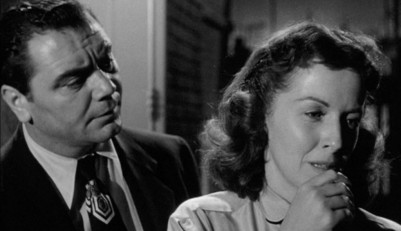
Marty and Angie go to the dance hall.  Angie quickly finds someone to dance with him, but after getting a quick once-over, the woman Marty asked for a dance turns him down.  As Marty is standing by himself, Clara (Betsy Blair) enters the film.  Paralleling Marty’s introduction, she is at the receiving end of someone’s disapproval:  her blind date is disappointed that he has to waste his Saturday night with someone as plain-looking as she.  He offers Marty $5 to take Clara off his hands; Marty refuses, and watches as Clara gets ditched regardless.  Marty becomes her knight in shining armor.  In a subsequent scene, the camera glides through the crowded dance floor to find Marty and Clara dancing together, commiserating over their unlucky social lives and finding refuge in each other.  “I’m really enjoying myself… you’re not such a dog as you think you are,” he tells her.  “Maybe I’m not such a dog as I think I am,” he adds after she tells him that she’s also having a good time.

As they get to know each other over the course of the night, we see that Clara and Marty are both kind, sensitive, optimistic people.  The romantic scenes in Marty are humble.  They lack the glamour of Burt Lancaster and Deborah Kerr making out on the beach in From Here to Eternity, the Best Picture winner two years prior.  Despite being average-looking people walking down a city street and getting coffee in a diner, the vulnerability that Clara and Marty share is more heartrending than the most exquisite locale or best-sculpted cheekbones could ever be.  They admit to each other that they both cry easily, with a relief that borders on excitement in having found someone that relates to their experience.  Later on, Marty tells Clara about how depressed and directionless he felt after returning home from World War II, and reveals that he thought about ending his own life.  “I know,” is her gentle response that tells us everything we need to know about her own relationship with suicidal thoughts.  What would be their first kiss in any other romantic movie is discontinued by Clara’s discomfort; where any other romantic lead would react with force or indifference, Marty crumbles into frustration and self-loathing.  Instead, Clara expresses her affection for him through her words: “I know when you take me home I’m just going to lie in my bed and think about you.”

marty and clara


The pain their loneliness causes is very real, but seems to be largely due to the opinions of others.  Clara is criticized for not being pretty, Marty is criticized for being bachelor.  The film does not portray marriage or a family life as intrinsically providing more happiness.  Marty’s mother and Aunt Katarina (Augusta Ciolli) lament the life of a widow; his cousin Tommy (Jerry Paris) and his wife Virginia (Karen Steele) squabble with each other over the wails of their newborn.  Marty’s friends focus on women who are “money in the bank” and fill their free time with drinking and trashy novels.  However, everyone focuses their pity on Marty, the fat “dog” who is 34 and unmarried, then ridicules him for spending the night with a woman who is too old and unattractive to be considered a worthy mate.  Clara’s introduction into Marty’s life reveals that his friends and family rely on him to stay in the state they they ostensibly pity.  Although these days it isn’t unusual for someone to be unmarried or even living with family in their 30s (I’m sure this is more true in New York City, considering the high cost of living), the implication for audiences of the time was that Marty is in a state of arrested development.  Borgnine plays him with an openness and vulnerability that borders on childlike.  I was impressed by the emotional maturity with which Mrs. Piletti was written, expecting her to be a two-dimensional Italian mama, but an early scene of her serving Marty his dinner, surrounding him with serving dishes, suggests that he is smothered by her, and that her smothering is the cause of his fatness.

The film ends on a hopeful, but uncertain note.  Initially, Marty gives in to the opinions of his friends and family, and avoids calling Clara.  We see the two lovers in their respective spheres, completely miserable.  Marty stands amidst a group of his friends outside their neighborhood bar, listening to the same “What do you feel like doing,” “I don’t know” conversation that has apparently reached Pinky and the Brain levels of repetitiveness.  The camera slowly zooms in on him, gradually edging his friends out of the scene as they suggest going to the movies or– if my interpretation of the euphemisms of the day is correct– soliciting sex workers.  Marty veritably explodes from frustration, breaking away from his friends and rushing to the payphone:

“You don’t like her, my mother don’t like her, she’s a dog and I’m a fat, ugly man! Well, all I know is I had a good time last night! I’m gonna have a good time tonight! If we have enough good times together, I’m gonna get down on my knees and I’m gonna beg that girl to marry me! If we make a party on New Year’s, I got a date for that party. You don’t like her? That’s too bad!”

Marty dials the phone.  As it rings, he sarcastically picks on Angie for being a bachelor, repeating the criticisms his customers threw at him in the opening scene.  Closing the phone booth door between himself and his loutish friend, we hear Marty saying, “Hello, Clara?” as the film fades to black.  Contrasting with other romantic films of the day like From Here to Eternity, which ends in dramatic heartbreak for Lancaster and Kerr’s characters, the ending of Marty is modest, but that’s what makes it so special.  We don’t know if Marty and Clara make a good couple in the long run, but the impact she has on him is enough for him to make two difficult choices in defiance of what he’s being told.  He stands up for her worthiness despite being told that she’s a “dog,” and he stands up for his choice to pursue love with her, despite implications that as a “fat, ugly man,” he isn’t capable of finding it.

Roundup: October 2015

October was a busy month for me, but I did manage to squeeze in some quality moviegoing experiences at the Chicago International Film Festival and the Music Box of Horrors.  Unsurprisingly, it was a month of fat villains and fat victims.

Behind the Mask: the Rise of Leslie Vernon (2006, dir. Scott Glosserman)

This charmingly deconstructionist mockumentary features a group of journalism students who are following an up-and-coming slasher Leslie (Nathan Baesel) who aspires to follow in the footsteps of Freddie, Jason, and Michael. Once the stock character teens start to get murdered, though, interviewer Taylor (Angela Goethals) and her crew lose their professional objectivity and turn against their subject. One of Taylor’s goofball cameramen, Todd (Britain Spellings), nobly sacrifices himself by distracting Leslie.  He lures the killer away form the main group and across a field, presenting himself as an easy kill and taunting him to chase after the “dough-boy.”

Maniac (1980, dir. William Lustig)

Speaking of slasher films, Maniac is 90 minutes of grimy, minimalist violence.  The titular character is Frank (Joe Spinell, who co-wrote the script with C.A. Rosenberg), a fat man who murders women, dresses mannequins in their clothing, and uses their scalps as wigs.  As the film progresses, it is revealed that the source of Frank’s madness is his problematic relationship with his mother (either she was a sex worker or there’s an Oedipal complex going on?  I couldn’t tell, to be honest).  Maniac felt to me like a spiritual sibling of Misery, as Frank’s violence is, like Annie’s, about maintaining the stasis of his little fantasy world. I should have taken notes on that theory right after seeing this, but it was a movie marathon and there was alcohol, so CPBS was on the back burner.  C’est la vie.  Maniac was remade in 2012 with Elijah Wood in Spinell’s role.

maniac

The Devil’s Candy (2015, dir. Sean Byrne)

A horror film that plunks likable characters into a story that practically throbs with foreboding.  The best way I can describe the tone of this film via text is to tell you that Sunn O))) provided the score.  A metalhead artist (Ethan Embry) and his family are stalked by the previous resident of their new house (Pruitt Taylor Vince), a large man who radiates sadness and vulnerability, but is also allegiant to Satan.

To Sleep with Anger (1990, dir. Charles Burnett)

Lovely, grounded character-driven drama about a black family in Los Angeles who carry on their rural Southern lifestyle.  A visitor from their past, Harry (Danny Glover) shows up unannounced and begins to cause trouble in the community.  His influence is as direct as inspiring other members of the community to drink and gamble, but also more mysterious, as the fat patriarch of the family, Gideon (Paul Butler) suddenly falls ill.

Suspiria (1977, dir. Dario Argento)

Can Suspiria be spoken about without using a phrase like “visually stunning”?  I think it’s a legal requirement.  Anyway, an American dance student Suzy (Jessica Harper) attends a German boarding school that is run by a coven of murderous witches.  Among the creepy and foreboding sights is a stout old woman, who seems eerily out of place among the young, slender dancers.

suspiria

“You look at me sometimes. I want to know if you like me.” Boogie Nights (1997, dir. Paul Thomas Anderson)

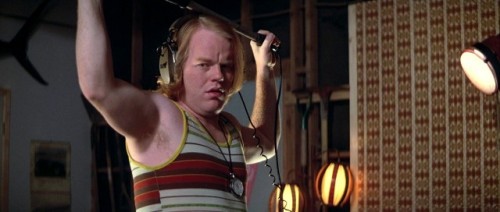
Paul Thomas Anderson’s breakout epic about the golden era of porn, Boogie Nights, flirts with the culturally subversive potential of the community on which it focuses.  When I recently rewatched the film (having first seen it over a decade ago), the inversion of the male gaze jumped out at me.  We do see female bodies in states of undress, meant to arouse, but Dirk Diggler (Mark Wahlberg)– or to be more specific, Dirk’s 13 inch penis– is the sun at the center of Boogie Nights’ universe.  Although the audience must wait until the very end of the 2 ½ hour film for the full frontal reveal, Dirk’s penis is very much a presence in the rest of the film.  When he whips it out, the camera focuses on the character who is doing the gazing.  The audience’s thrill and titillation is vicarious; we are invited to empathize with Rollergirl (Heather Graham), the Colonel (Robert Ridgely), and others as they marvel at Dirk’s cock, instead of to consume depersonalized images of Dirk’s body.  Similarly, during Dirk’s debut scene, the sight of him and Amber Waves (Julianne Moore) fucking is distanced from the audience as Jack’s camera is literally put between us and them.  The more clearly framed images are those of the cast as they watch Dirk’s performance; Scotty J’s (the dear departed Philip Seymour Hoffman) near-painful desire for Dirk, combined with the discomfort of holding up the boom mike, is of particular note. (More on him in a bit.)

phillip seymour hoffman, boogie nights, scotty j

Another aspect of the potential subversiveness of Boogie Nights is the characters’ sexual relationships.  The main characters form a family of sorts, headed by Jack Horner (Burt Reynolds) and Amber. Treating each other with support and affection, the members of this family both mimic and exist outside the boundaries of the heterosexual nuclear family. While we don’t see them engaging in kink or sex between characters of the same gender, making sex into an art and a profession is queering, to a degree.  Their lifestyles and sexual choices are used as reasons to marginalize them:  Buck (Don Cheadle) is denied a business loan, Amber loses custody of her child, and Dirk is queer-bashed while hustling.  (One of his attackers calls him “donkey dick,” turning the attribute that made him special in his community into an oddity.)  Whereas sex in movies is usually burdened with emotional weight, a cause of strife and jealousy, most of the characters in Boogie Nights are effervescently casual about it. However, we are given a few subplots where characters divert from the free-love culture promoted by Jack and his crew.  One is Little Bill’s (William H. Macy) blatant cuckolding by his wife (Nina Hartley), which culminates with him carrying out a murder-suicide; the other is Buck and Jessie (Melora Walters), who are pushed together as wallflowers at Jack’s Christmas party, marry, have a baby, and start a small business, executing so perfectly in line with the American dream that Buck’s commercial for his stereo store is dripping in red, white, and blue.  The trajectory of both couples in the film ultimately comes down to the husbands’ agency; both of whom take themselves and their wives out of the industry because they don’t fit in.  Little Bill and his wife apparently aren’t able to successfully navigate their relationship through her desire to have sex with other men– the film does not confirm whether or not she performs in Jack’s films, but casting real-life porn legend Nina Hartley in the role certainly implies she does.  The implication that Buck is out of place comes through his clothing; he dresses like a cowboy, which customers at his part-time salesman job find off-putting and his co-star Becky (Nicole Ari Parker) tells him is no longer fashionable.  When Jessie and Buck meet, he is dressed in a flamboyant new outfit with a braided wig, which he laughingly takes off as they warm up to each other, suggesting that he has been pretending to be someone else as part of Jack’s group, but has finally found someone he can be himself with.

The fat characters in Boogie Nights don’t make the choice to leave the community in the same way that Little Bill and Buck do, but neither do they have access to the inner circle, the ability to become true members of the family.  Kurt (Ricky Jay), the Colonel, and Scotty J reflect the subversive aspects of the porn community, but in a less romanticized way than the thin, conventionally beautiful characters.  Kurt, the director of photography, shows the same commitment to well-made porn that Jack does, but does not have the same emotional connection with his coworkers.  In an early scene, he badgers Little Bill about the lighting for the next day’s shoot, oblivious to how distraught Little Bill is over finding his wife having sex in Jack’s driveway amid a circle of spectators.  After Little Bill walks off, Kurt goes to join the spectators, placing his voyeuristic interests over the wellbeing of his colleague.  The Colonel, who funds Jack’s films, initially comes off as avuncular and powerful, similar to Jack.  However, this changes abruptly in 1980, as the new decade turns the harsh house lights on the party of the 1970s.  He is arrested for child pornography, representing a corruption of Jack’s idealized porn goals.  His pathetic rationalization, “I just want to watch,” is a creepy parallel of the self-conscious performance of Dirk and Amber’s sex scene in the first half of the film.  This revelation is too much for the otherwise warm and indulgent Jack, who turns his back on his old friend.  And then, there is the aforementioned Scotty J.

scotty j gif

Scotty J is the only character who is meant to be read as queer, as his arc in the film is his crush on Dirk.  Scotty enters the film through the side gate of Jack’s house during a pool party as two men carry an overdosing woman out the same way; the side portal into Jack’s world for the aspects of it that are not given much focus.  “You Sexy Thing” by Hot Chocolate starts playing as Scotty sighs.  Serving as his point of view, the camera pans across the the conventionally beautiful party-goers who might as well be a different species.  Scotty’s skin is pale, hair is messy, and his clothing ill-fitting; his belly sticks out from under his tank top.  His very posture is gauche; he tends to stand with his head tilted in a manner that suggests an awkward teenager.  Once he zeroes in on Dirk, lounging in a beach chair, he approaches and forces an introduction with awkward small talk (“Nice to meet you.” “Me too.”).  He fawns over Dirk, accompanying him from his dressing room to the set like an acolyte (as he chews on a pen in suggestion of where his mind is).  His hero worship of Dirk contrasts with Reed Rothchild (John C Reilly), who treats Dirk as a competitor but is positioned in the film as his right-hand man, where Scotty is merely flitting around in the background.  In a scene of the three men buying matching outfits, Scotty can’t quite button his pants, and looks awkward and out of place next to the other two.  This brief moment in Dirk’s upward career trajectory is a moment of relatable awkwardness and ostracization for many fat viewers who have been part of a social clothes shopping expedition with thinner friends.

The turning point of the film is the 1979 New Years Eve party, the last night of the idyllic 70s before the downturn into the 80s. Scotty transgresses the boundaries of his relationship with Dirk, first by revealing that he’s bought an identical Corvette, and then by trying to kiss him.  Dirk shoves him away, and Scotty automatically apologizes, explaining “You look at me sometimes. I want to know if you like me.”  Scotty wants to know if he can be accepted as the desired object of Dirk’s gaze.  Reflecting the emotional support and sexual open-mindedness shown by the family, Dirk is shocked but tries to be kind to Scotty as he but turns him down and returns to the rest of the party as quickly as he can.  Boogie Nights is full of characters regretting choices that have separated them from their loved ones, but no moment is so visceral, uncomfortable, or intimate than the lingering closeup of Scotty J sitting in his ‘Vette, sobbing his heart out and repeating “I’m a fucking idiot” over and over.

scotty j car

After that turning point in the film, Scotty is swept along with the course of the other characters’ stories, assigned to watching them.  He squirms uncomfortably in the background as Dirk starts his downward spiral of drugs and poor decision making.  When the characters find second chances at the end of the film, he films the birth of Buck and Jessie’s baby.  (During this montage, we also see the Colonel in prison, being abused by his cellmate.)  Scotty is not ejected from his group of friends the way the Colonel is, but after being rejected by Dirk, is not given his own chance at growth or redemption.  True to his personality, Scotty embodies an awkward position in Boogie Nights.  He is a stand-in for the audience.  Like Scotty, we able to gaze all we want at the porn actors who arouse our desire, but we are never able to touch them, to be with them. The feelings they invoke in us are ultimately fantasy.  However, this is where Scotty’s story ends.  The other characters grow and move on to other pursuits, just like we are able to move on to other experiences and aspects of our lives once we are through with our role as audience member, but Scotty remains mired in the role of unfulfilled gazer, an object of our pity (or derision).  This too, is a flirtation with subversion that is ultimately fantasy: Scotty J is a disempowered gazer relative to the object of his gaze (Dirk), but given that he is fat and queer, the film is attempting to change the power relationship using someone who is already marginalized.

“I can’t wait for people to see you, really see you:” Mad Men Season 5 (2012)

At the beginning of September, I saw Queen of Earth in theaters.  “Elisabeth Moss is such an incredible actress,” I thought to myself.  “I wish I could see her in more movies.

Or I suppose could finish watching Mad Men.”

I’m abominable at keeping up with series.  Mad Men is one of my all-time favorite television shows, but I had stopped watching at the end of season 5.  It’s been taunting me every time I get on Netflix, I want to watch it through the end myself instead of hearing spoilers for season 7, and, like I said, Elisabeth Moss.  Anyway, thereby hangs the tale of how I’ve been spending my viewing time this month.  I started with “Out of Town” (season 3, episode 1) to refresh my memory, and, as of writing this post, I’ve seen up through “Time Zones” (season 7, episode 1).  

It goes without saying, but one of the core themes of Mad Men is exploring the social change the US went through in the Sixties.  Its setting is a perfect lens for this conflict; not only is it largely set in the cultural vanguard of New York City, but it focuses on advertising, a profession helmed by the old guard who are tasked with staying current, producing media that is, at its self-professed best, orthodoxy in revolution’s clothing.  Consider Roger Sterling (John Slattery), an old-school mentality in a space-age office, a man who experiments with LSD and hallucinates being at the 1919 World Series.   

Most of the main characters are very privileged, but because of this ubiquitous dynamic, the lack of diversity often presents opportunities to comment on itself.  It can reveal how out of touch they are, such as Freddy Rumsen’s (Joel Murray) myopic opinions of women, or Pete’s (Vincent Kartheiser) petty complaints that today would come with #FirstWorldProblems attached.  We see the limits that the characters who are of marginalized identities face in ways that effectively circumvent devices such as on-the-nose dramatic speeches, such as Don’s (Jon Hamm) unwillingness to believe that Sal (Bryan Batt) as a gay man could be the target of unwanted sexual advances, or an accounts wunderkind whose career is declared over after a disabling accident that would not prevent him from carrying out his essential job functions.  Characters who face discrimination, even in smaller roles, are usually treated with empathy and given dimensions beyond the politics they symbolize.  We are privy to glimpses into Dawn (Teyonah Parris) and Ginsberg’s (Ben Feldman) personal lives, and we are spared no discomfort when characters we’ve known since the first episode mistreat them.  
mad men herb

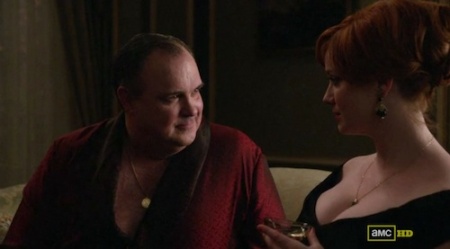
Given this tendency of Mad Men to open its characters and story up to historical meta-commentary, the way in which fat people are present on the show is somewhat disappointing.  Most of the fat characters on the show are small roles, but embody stereotypes about fat people.  Many of these roles are steeped in class, big-bodied folk tending to be Don’s plodding clients from less glamorous cities and industries, or blue collar bit roles.  The larger roles tend to be people who embody stereotypical fat character traits.  The most glaring example is Herb Rennet (Gary Basaraba), who shows up in season 5 when Sterling Cooper Draper Pryce is courting the Jaguar account.  New Jersey and nouveau-riche, Herb is a vulgar contrast to the posh, British Jaguar bigwigs.  He shamelessly uses his company’s account as leverage to get Joan (Christina Hendricks) to have sex with him.  Usually, sex scenes on Mad Men are preceded by wordless, implicit seduction, or pithy statements of desire.  The line Herb uses on Joan?  “Lemme see ’em.”  The pathos of the affront to Joan’s dignity and exploitation of her sexuality is heightened by the disgust implicated in her having sex with a fat man.  Frustrated with Herb’s bossiness and unable to move past the idea that Joan exchanged sex with him for business, Don impulsively drops Jaguar.  Breaking the news to the partners, he asks Joan if she doesn’t feel “300 pounds lighter.”  

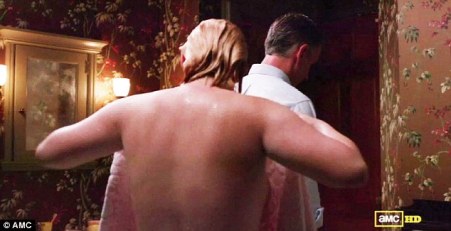
But you’ve seen the show.  You know that I’m writing this article to talk about the fifth season story arc of one Mrs. Elizabeth “Betty” Hofstadt Francis (January Jones), shorthanded on the Internet as “Fat Betty.”  Having divorced Don, married Henry, and moved her family into a mansion over the last two seasons, the next chapter in Betty’s adventure is noticeable weight gain, attributed to her boring life as a housewife.  (On a practical level, the writers were working around January Jones’ pregnancy.)  Having been a sophisticated, graceful presence for the past four seasons, we now have a Betty who sits on the couch with her hand in a box of Bugles like a common schlub.  “Tea Leaves,” the episode where we see her physical change for the first time, is treated as spectacle.  Betty is shown getting out of the tub as if to prove to the audience that yes, she really has gotten fat.
mad men bath

And really, the change isn’t that dramatic.  Her body doesn’t seem to be that much larger than Joan’s, who is not read as fat.  
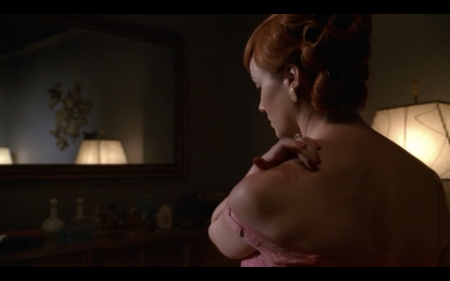
mad men joan

The drama merely comes from the fact that her formerly slim body has become larger than it is supposed to be.

Broadly speaking (ha), this was a time when the mainstream American beauty ideal was not as extremely focused on thinness as today, but it was also a time when the expectation of women to adhere to a set of aesthetic norms was not met with resistance.  The women of Mad Men are all significantly impacted by their looks.  A fourth season focus group for Pond’s cold cream where the secretaries discuss their beauty routines quickly turns into a somber discussion of their fears of being alone and ignored because they aren’t beautiful enough.  The sentiment resonates throughout the show, particularly with Betty. She has done well, based on what she’s expected to as a middle class woman, largely in thanks to her charm and beauty.  Her life, however, is also the most empty. She finds little joy in being a wife or a mother.  Betty in a nutshell is best illustrated in season 3 episode “The Fog.”  Under anesthesia during Baby Gene’s birth, she has a dream in which her recently departed father tells her, “You are a house cat.  You are very important and have very little to do.”  Nothing and nobody in her life inspires her to try and be anything outside of a beautiful wife and mother.  (Considering how often characters read popular books of the day, I’m a little surprised we don’t see her thumbing through The Feminine Mystique.)  When she gains weight, she is pressured to restore the image she maintained as Don’s wife.  Henry’s (Christopher Stanley) mother Pauline (Pamela Dunlap) tells Betty to ask her doctor for diet pills, since she is still of an age where her looks need to be pleasing to men.  Ironically, Henry doesn’t care about her weight gain:  “I don’t know how many ways to say it, but I don’t see it.”  “I know,” Betty snaps back, “Your mother’s obese.”  In her mind, it isn’t possible that Henry genuinely finds her beautiful; his view has been distorted by his fat, overbearing mother.

Betty’s story arc largely overlaps with her experience of dis-ease.  Her doctor, giving her an exam before prescribing diet pills, finds a lump on her thyroid.  She worries that she is dying, especially after a chance meeting with a friend in an advanced stage of cancer.  However, once she is told that the tumor is benign, the immediately describes herself as “just fat.”  Her fatness is attributed by the show to mental dis-ease.  In order to “reduce,” she goes to Weight Watchers meetings, which function as a support group with discussions about healthy ways to deal with troubling emotions and stressful situations (assuming that the participants are the weight they are due to over-use of food as a coping mechanism). 

As I’ve previously discussed, fat film characters aren’t determined by specific physical measurements, but rather by their bodies in relation to the bodies (and attached expectations) of the other characters.  Her own husband claims not to see a difference, or at least doesn’t care.  However, Betty is fat because of who she’s being compared to.  Not only is she fat compared to what her body looked like in the past (she was a model when she met Don) and what Mad Men’s audience expects to see, but she is fat compared to Don’s new wife, Megan (Jessica Paré).  Betty’s first appearance in season 5, “Tea Leaves,” is of her struggling to squeeze her larger body into a dress, then declining to go to the event she was preparing for because of her inability to close the zipper.  Her larger body is a shocking spectacle, as we have grown accustomed to a specific image of Betty.  This sequence is immediately followed by slender Megan in her underwear– no shapewear for her!– effortlessly slipping into her own dress on the way to a client dinner with Don.  In a later episode, “Dark Shadows,” Betty glimpses Megan’s body, thin like hers once was, in a state of undress.  Their following exchange immediately has an acidic edge to it; cut to Betty going to the fridge as soon as she gets home and spraying Reddi-Whip into her mouth before thinking better of it and spitting it into the sink, standing alone in her dark kitchen.  As with the dresses, this crass image of Betty stands in contrast to an idealized one of Megan:  in the previous episode “Lady Lazarus,” Megan performs as a chipper housewife for a Cool Whip commercial pitch that charms everyone except Peggy.

At first, Betty’s spite may come across as baseless.  Betty chose to end her and Don’s marriage after she had already fallen in love with Henry, with whom she is much happier.  Despite Don’s numerous infidelities during their marriage, he didn’t get involved with Megan until after they had divorced and Betty remarried.  It’s not like she’s still in love with her ex-husband, for and about whom she barely has a civil word.  But still Betty treats Megan with a petty acrimony that is similar to the relationship Don has with employees of rival firms.  The sense of competition Betty feels between herself and Megan has less to do with Don than it does with how she sees herself.  Her weight gain means that she’s failed as a woman and wife– as Pauline tells her, one of her essential functions is being attractive, which is impossible above a certain weight (Henry’s opinion notwithstanding).  Thus Betty’s reactions to Megan focus on subverting her legitimacy as a woman and wife.  After seeing Megan’s slim body, Betty finds a note from Don praising his current wife’s loveliness on the back of one of Bobby’s drawings.  (The drawing of a harpooned whale would be an accurate illustrations of how Betty feels about herself.)  Her jealousy leads her to reveal to Sally that Don had been married to someone else before he and Betty had met, and encourages her to ask Megan about the details.  The suggestion associating Megan with Don’s deceit leads the volatile teenager to call her stepmother a “phony.”  Unable to change her negative perception of herself, or the pathetic cultural trope of “sad, fat housewife” she’s found herself in, Betty lashes out at Megan, someone vulnerable to the same pain she is experiencing.
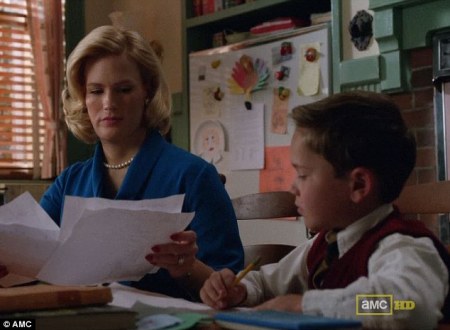
mad men betty note

Betty is also seen relative to Pauline, her mother-in-law.  Betty describes her as “obese,” assuming that Henry is unable to be disgusted by her weight gain because his mother has wrongly desensitized him.  As a younger, childless woman and new bride, Megan’s position in life is Betty’s past, unable to be regained.  Pauline, a grandmother with grown children, is her future.  But it seems a bleak one; not only is Pauline fat, but she gets her way by being bossy and unpleasant.  She takes care of the children when Betty and Henry are away, and somehow manages to be a worse influence on Sally than Betty, speaking with fondness of her emotionally abusive father and telling her young granddaughter the details of the Richard Speck murders in a manner that ghoulishly verges on fetishistic.  Betty is caught between Megan and Pauline, unable to retain her equivalence to the former and terrified of becoming the latter.

Ultimately, Betty is not a fat character.  Fatness is a phase for her, an expression of her internal struggle that fades as we move into season 6.  The cause of her weight loss, we are led to assume, is due to adherence to Weight Watchers, but also comes with a return to her roles as wife and mother.  In the second to last episode of season 5, “Commissions and Fees,” Sally is visiting Megan and Don in the city, but gets her first period.  Scared, she takes a taxi back to Rye to be with Betty, who feels validated by being relied on for comfort and wisdom.  As Betty smugly tells Megan on the phone, “she just needed her mother.”  In season 6, Henry tells Betty that he has decided to run for office, and that he can’t wait for people to “really see [her]”.  Whether due to the pressure of being highly visible or finding fulfillment in a role she enjoyed enacting when married to Don, by “The Better Half,” the eighth episode of the season, Betty is once more the slender blonde we’ve come to know and have ambivalent feelings towards.  The episode hammers home that her attractiveness has been restored.  We initially see her in a gown at a political fundraiser, being propositioned by a strange man.  Confessing this to Henry on the drive home leads to the couple making out.  Later in the episode, Don ogles a beautiful woman at a gas station.  The camera pans up a pair of bare legs to reveal they belong to Betty.  Appropriate to its protagonist, Mad Men has a brief liaison with exploring how complex, relatable characters are affected by fat stigma, but ultimately can’t commit.


Roundup: August 2015

(CN sexual assault) A summary of films I saw over the past month with fat characters that I didn’t write about.

Super (2010, dir. James Gunn)

Mr. Range (Don Mac) is a powerful drug dealer who does business with Jacques (Kevin Bacon).  Jacques has procured several women to entertain Mr. Range during their transaction, but Range insists on being alone with Sarah (Liv Tyler), who is high.  Jacques allows Range to take Sarah into a bedroom.  After she tells him she doesn’t want to have sex, he attempts to rape her.  Frank (Rainn Wilson) kills Mr. Range.  During Frank and Jacques’ climactic showdown, Jacques refers to Range as “that fat n—–.”

The Grapes of Wrath (1940, dir. John Ford)

Ma Joad is portrayed by Jane Darwell, who was also in The Ox-Bow Incident. The neo-Biblical feel of Steinbeck’s story features characters who are drawn very simplistically.  Ma is a pretty typical matriarch of a rural family in a lot of ways, but she is portrayed with dignity, as the Joad family’s strength and emotional center.

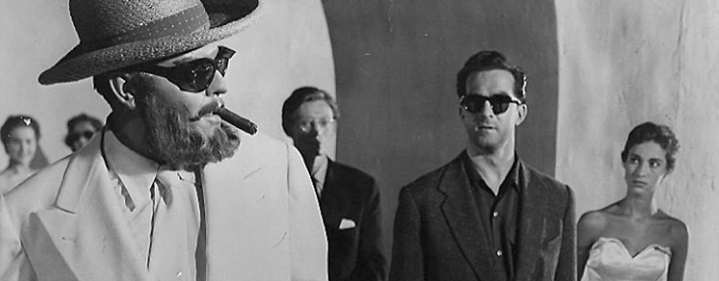
Confidential Report/Mr. Arkadin (1955, dir. Orson Welles)

The great man himself as the titular Mr. Arkadin, a powerful, wealthy criminal who can’t remember his own past.  Fat bit players include an indignant chef and a cigar-smoking retired general.

mr. arkadin, orson welles

Mommy (2015, dir. Xavier Dolan)

The great thing about Mommy is how it centers and humanizes characters who are often written as obnoxious cartoons, namely Steven, a teenage boy with behavioral issues (Antoine Olivier-Pilon), and Diane, his foul mouthed, fading beauty mom (Anne Dorval).  However, most of the other characters in the 2+ hour film are roughly drawn, more aides or impediments to the main characters than characters in themselves.  One of these characters is a fat woman who has assumed her husband’s position as editor of a magazine where Diane works.  The woman takes sadistic pleasure in firing Diane, telling her that she has no talent as a columnist and was only hired because her husband found her attractive.

F for Fake (1973, dir. Orson Welles)

The last film Orson Welles ever directed was a frenetic documentary about forgery and deception, featuring Welles himself as the narrator and master of ceremonies.  Until this point I haven’t written about fat documentary subjects I’ve come across because their weight has been purely incidental, but Welles’ role in his film was intentional (even if it was in part due to his ego).  He appears as an erudite and mischievous dynamo in a fabulous black cloak and hat: performing magic tricks, spinning glorious tales for the audience (both watching the film and situated around him at a fine restaurant and on a picnic) while at the same time reminding us that we can’t always trust what we see and hear.

PeeWee’s Big Adventure (1985, dir. Tim Burton)

There are a handful of fat characters in this film, all of whom pose a threat or impediment to PeeWee (Paul Rubens) to some degree: Francis Buxton (Mark Holton), a snotty rich kid who pays to have PeeWee’s bike stolen; Large Marge (Alice Nunn), the ghostly trucker who gives PeeWee a ride and a scare; Andy (Jon Harris), a trucker who wants to hurt PeeWee because he’s jealous of his relationship with his girlfriend Simone (Diane Salinger); and some members of the biker gang who want to torture and kill PeeWee, until he wins them over with his dancing:

Hangover Square (1945, dir. John Brahm) and the Tragedy of Laird Cregar

(CN dieting, death)

Art that foreshadows the death of its creator– especially the death of a younger artist– contains an emotional gravity that’s hard to put into words.  This is certainly true for artists who intentionally create art to communicate their pain and self-destructive tendencies, like Elliott Smith or Amy Winehouse, but for a film actor, a particularly significant last work can retrospectively take on an element of particularly poignant, even eerie, tragedy.  I have never seen this phenomenon unfold quite like Laird Cregar’s performance in Hangover Square, which I saw last night at the Noir City Film Festival.

Laid Cregar, in a publicity still for Rings on Her Fingers (1942)

Laird Cregar, in a 1942 publicity still.

Hangover Square is a haunting Victorian tale of George Bone (Cregar), a composer who suffers from stress-induced, murderous fugue states.  Despite his formidable, brooding physical presence, George is gentle and sensitive, vulnerable to the opinion of others by the very nature of his vocation.  His friendship with his pretty blonde neighbor Barbara (Faye Marlowe) would be romantic in any other film, but is chaste in this one.  George lives a life of solitude, obsessed with his art.  Although his life’s work is classical music and he is hard at work on a concerto commissioned by Barbara’s father Sir Henry (Alan Napier), he is distracted by femme fatale Netta (Linda Darnell), who manipulates him into composing popular songs for her to perform.  Netta leads him on for the sake of her own rising star, but has her eye on svelte theater producer Eddie (Glenn Langan) as a mate.

Hangover Square was Laird Cregar’s only starring role.  He had a successful career as a character actor, his 6’3″, 300 lb body contributing to effective portrayals of villains, his characters often significantly older than the twentysomething actor.  He performed with and has been compared to Vincent Price.  However, Cregar grew tired of being typecast.  He wanted to be a leading man, but saw his weight as a barrier, describing his character type as “a grotesque.”  Starting in 1942, he crash dieted and used amphetamines to lose over 100 lbs.  In 1944, he starred in The Lodger, a horror film about a man who may be Jack the Ripper, followed by his leading role in Hangover Square.  Not satisfied with the results of his diet, Cregar opted for weight loss surgery in late 1944.  The stress that the operation caused his body led to a fatal coronary a month later, two months before the release of Hangover Square.  He was 31.

laird-cregar-02

Laird Cregar in Hangover Square

As one might expect from a film whose protagonist kills people, Hangover Square doesn’t end well for George.  Trying to arrest him for Netta’s murder, Scotland Yard follows him to the debut of his concerto.  He starts a fire in an attempt to evade them, which rages out of control.  Everyone must evacuate the building before the performance is complete, despite his attempts to force the musicians to continue.  In desperation, he sits at the piano and continues from where the fleeing orchestra has left off.  The last image of the film is of George playing his masterwork as he is consumed by smoke and flames.

Cregar’s performance of George Bone serves as a grimly appropriate memorial, struggling with his mind that both created and destroyed, just as Cregar himself struggled with a career that allowed him to pursue his art but confined him in stock character roles due to his appearance.  The role he was slated for after Hangover Square went to Vincent Price.  We’ll never know if Cregar’s career could likely have been as fruitful and celebrated as his colleague’s.

See Also:

Virtual Virago: Heavy: the Life and Films of Laird Cregar

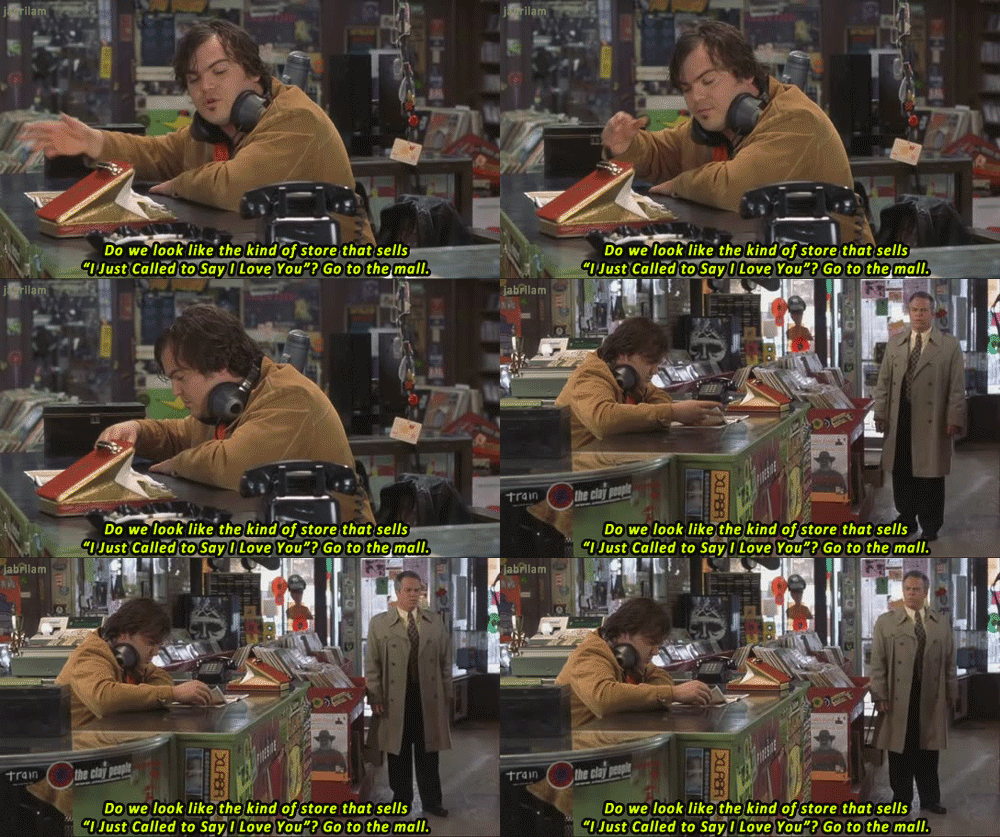
Link: This is the exact moment that Jack Black became a movie star

In ongoing AV Club feature Scenic Routes, Mike D’Angelo analyzes the importance of specific film scenes.  His most recent article, he makes an argument for High Fidelity as Jack Black’s star-making vehicle, specifically his character Barry’s introduction to the film.

High Fidelity was my favorite film in late high school/early college.  These days, the shittier aspects of Rob’s (John Cusack) personality are more glaring and the endless ending is harder to tolerate, but I still have a great affection for it.  (Especially now that I live in Chicago!  I’ve been to the intersection of Milwaukee and Honore!  [It’s super gentrified!]  I read the Reader!)  Jack Black’s performance remains one of the film’s strongest aspects, and my affection for him as an actor has the same staying power that the film does, even though my film snobbery prevents me from seeing a fair chunk of his oeuvre.  I can’t get enough of his boundless energy and masterful ability to put some stank on a scene.  His work in Bernie is probably my favorite because those impulses are reined in enough to convincingly portray someone as gentle as Bernie Tiede, but emerge organically through his character’s love of music and theater.  (This scene is an excellent example, both because he’s being so dang adorable and because the bit player he’s singing to can’t keep a straight face.)  However, High Fidelity is probably the filmic apex of that Black magic.  Not only is Barry well-written, but given that he’s a pretty one-dimensional character, Black has the freedom to take him to the sublime heights of ridiculousness without losing the audience.

High-Fidelity-Mixtape-2

For all the side-eye I give fat character tropes on this blog, I do love when fat characters are vivacious agents of chaos.  It’s both a subversion of fat = slow/lazy and an outright denial of respectability politics, a grab at hyper-visibility and confrontation that provides a vicarious thrill for a fat introvert like yours truly.  Even if the institution doesn’t actually change once including someone like Jack Black or Rebel Wilson on the A-list, it feels good to see them win widespread recognition for playing a character who challenges everyone around them.